Full article about Navió e Vitorino dos Piães
Oak-smoke drifts over terraced vines in Portugal’s tiniest Lima parish
Hide article Read full article
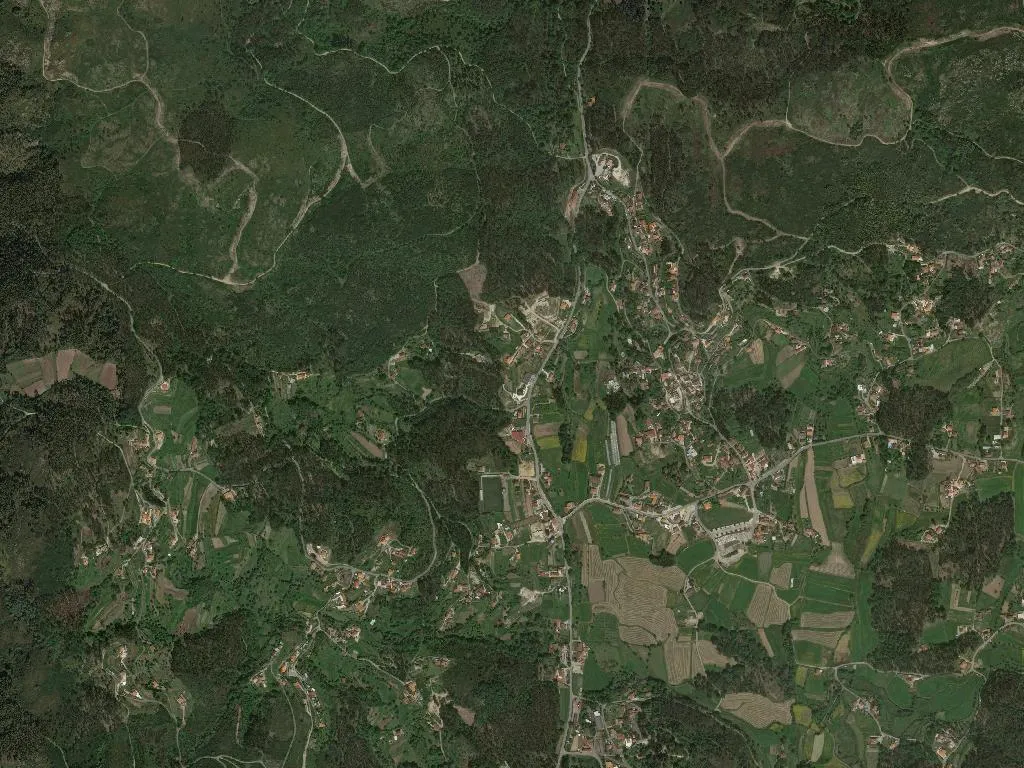
The first thing you hear is the crackle of oak logs inside granite smoke-houses, a sound like thin ice breaking. Then the water: narrow stone channels funnelling mountain run-off down to the River Lima, their murmur louder than any traffic. Finally the bell of Navió’s church slices through the morning haze – one metallic note that makes the green valley hold its breath. At barely ninety hectares – red soil so fertile it looks like devil’s-food cake – this is the smallest civil parish in Ponte de Lima, and the tractor has to perform a three-point turn between terrace walls no wider than a London parking space. Maize grows tall enough to spy on the neighbour’s vines; low pergiums of loureiro grapes hug the ground; the air smells first of damp earth, then, as noon approaches, of sausages exhaling slowly in dark larders – a scent that should be bottled as appetite stimulant.
Two hamlets, one shared memory
Navió and Vitorino dos Piães were forcibly married by a royal decree of 1836, yet they still keep separate wardrobes. Navió appears in an 1120 charter as “Neviola de Masse Ardega” – a name that sounds like a spell from Harry Potter – while Vitorino’s Latin root, Vulturinus, tips its hat to the griffon vultures that once owned the thermals above these ridges. Walk the lane that stitches them together and you thumb a history book dampened with green wine: Iron-Age hillforts on Cresto and Alto das Valadas older than any biblical mother-in-law; Navió’s granite cross, upright since the era when your ancestor’s ancestor wore knee-breeches.
Half-hidden in a bend sits the chapel of São Pedro, but the real eyrie is the Monte de São Simão. From here the Lima unwinds like an apple-green ribbon between vegetable plots; pine resin rides the wind, and on feast days the echo of processions drifts up – distant as next-door’s radio, but you can still hum the tune.
Calendar ruled by saints, not smartphones
Forget Google Calendar; the year is organised by romarias. Our Lady of the Good Death, the Lord of Health and the Lord of Help – three separate invitations to the divine because one patron saint clearly cannot cope with local levels of hypochondria. Each village adds its own footnotes: Santa Marinha (18 July) and the Transfiguration (6 August) in Navió; São Pedro (29 June), Our Lady of Lourdes and São Simão (10 August) in Vitorino. Processions set off along beaten-earth paths arched with hydrangeas woven by teenagers the night before while their fathers salt sardines. In makeshift cellars off the village square, vinho verde flows faster than a Lisbon commuter train and the folk group “Danças e Cantares de Vitorino dos Piães” launches into songs once crooned on grandmothers’ laps, now rehearsed on WhatsApp voice notes.
Smoke, corn and Barrosã beef
Kitchen clocks are decorative; lunch happens when the pot says so. Sarrabulho – a tar-black pork stew thickened with blood and smoked paprika – bubbles like volcanic mud, staining teeth traffic-cone orange (nobody cares). Cornbread arrives as plate, spoon and occasional dessert. In the fumeiros, sausages cure until their skins resemble vintage luggage: alheira bursting with yesterday’s bread, chouriça that snaps like bubble-wrap, farinheira so robust it frightens off most vegetarians. On high days the table groans under cozido à portuguesa: DOP Barrosã beef that collapses at the sight of a fork, greens cut at dawn, turnip tops with just enough sting. Between mouthfuls, a light vinho verde rinses the palate – then immediately begs for a refill.
Boardwalks, lagoons and blistered boots
The parish slots into the Protected Landscape of Bertiandos and São Pedro de Arcos like a hand in a well-worn glove – albeit a glove twitching with wildlife. Wooden boardwalks cross boggy woods where mosquitoes hold raves; herons and mallards argue over sunset real estate on the mirror-bright lagoons. Two less-noticed pilgrim routes also pass through here: the Portuguese Central and the Nascente caminos to Santiago, funnelling walkers with boots like burnt toast and rucksacks apparently containing entire kitchens. They stop at granite fountains, puzzled by coffee served in knotted plastic bags and convinced that cornmeal loaf must be cake.
Despite appearances, Vitorino has more evening pulse than most rural parishes: a health centre where Dr Ana can read your family history in a single wrinkle, a crèche that counts in Mirandese as well as Portuguese, a day-centre where octogenarians play bisca as though FIFA rankings were at stake, and twenty active associations resisting the demographic maths: 321 over-65s to 160 under-25s. Tiny Navió, meanwhile, compensates with soil so prolific a single allotment out-earns the minimum wage.
Come late afternoon the light turns the colour of aged Madeira and smoke columns rise dead-vertical, sketching white against the dark-green terraces. The scent – oak, sausage, humid earth – clings to clothes, hair, memory. Long after you’ve left, when you’re back in a city tasting diesel instead of dawn, you’ll recall it like the smell of your grandmother’s hallway – and feel the tug northwards.