Full article about Serdedelo: granite village above Lima’s hush
Hear chapel bells echo down 405-metre schist slopes where three saints ignite stone lanes
Hide article Read full article
The Chapel Bell at 3 pm
The chapel bell strikes at three and the note rolls downhill like someone going for bread—no argument, no discussion. At 405 m above the Lima valley, the air has the clean scrape of altitude; even in August it makes a Londoner’s lungs remember they exist. Breeze lifts off the river, freighted with eucalyptus and damp schist, the scent metropolitan visitors inhale as if it were a new drug.
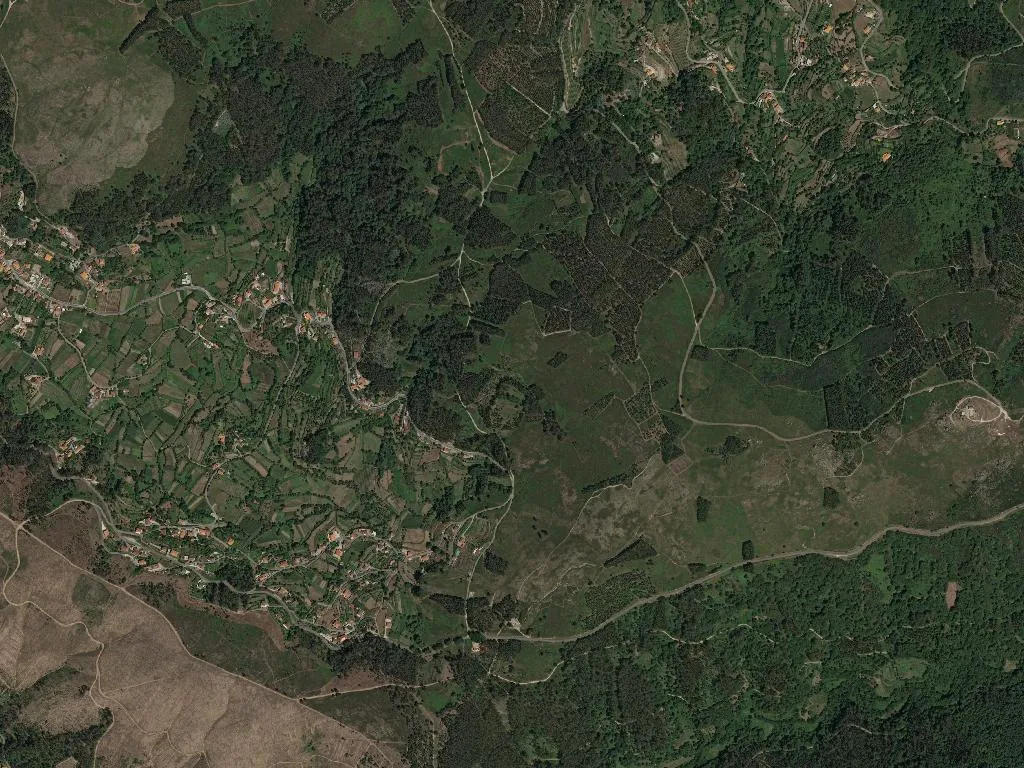
429 souls occupy just under six square kilometres of granite ridge. The arithmetic is simple: room enough for every sin. What defines Serdedelo, though, is not elbow-room but verticality. Houses climb like climbers, each terrace claiming its own ledge, each vegetable plot its own gradient. Granite erupts everywhere—dark grey when it rains, almost lunar at dusk—giving the impression that the mountain is baring its teeth.
Three saints, three parties
The liturgical calendar still rules here with a punctuality that would feel oppressive elsewhere. Our Lady of the Good Death, the Lord of Health, the Lord of Help—three weekends when the scatter of houses suddenly behaves like a city. Emigrants reverse the A3 in freshly valeted BMWs, capels built for sixty hold a hundred and sixty, and the village square throws up a feast without benefit of risk assessments or resident-committee WhatsApp groups. These are micro-pilgrimages: everyone addressed by first name, the accordionist paid in wine, fireworks launched from a wheelbarrow.
On the pilgrims’ stripe
Two variants of the Camino—Central and Nascente—cut across the parish. After 20 km of shin-splitting cobbles the ridge is cruel, but the compensation is a horizon that starts at the Lima and ends somewhere in Spain. Accommodation runs to two family houses retrofitted with bunks: no urban-hostel neon, just a kitchen table where you will be served caldo verde while someone’s uncle explains why the corn-meal must be stirred clockwise. The Minho is learnt in these kitchens, not in guidebooks.
Amphibian country
Three kilometres east, the Bertiandos and São Pedro de Arcos lagoons form one of Portugal’s smallest classified wetlands. Serdedelo sits on the lip of that sponge, sharing its mists, its water-table, its morning dew that clings to oak leaves like candy-floss. The parish is amphibian even when the surface looks dry: levadas thread the woods, wells blink in every courtyard, and the air itself feels potable.
Barrosã beef—DOP-protected, reared on the high commons—arrives on tables via wood-fired ovens, its crust blackened by four-hour roasts that start before first light. Vinho Verde from the Lima escarpment follows, sharp enough to make your molars hum, gentle enough to let the evening stretch. The opposite, in other words, of anything poured in Soho.
At civil dusk the west-facing granite catches fire. Serredelo’s geometry reveals itself: not a village but a constellation sharing a postcode. Every house owns its cistern, its smokehouse, its dog whose bark operates with nightclub-bouncer efficiency. Between one warning and the next you hear only wind in the chestnuts and the sub-audible gossip of water running under stone—a secret everybody knows and nobody tells.