Full article about Friestas: granite bells, silver coins & mountain mills
Spring water, 18th-century tiles and shepherd dogs guard this Valença hamlet above the Minho.
Hide article Read full article
The hammer strikes before seven. Mr Joaquim is already re-pointing the cistern wall where frost has prised the granite apart. The spring inside holds a year-round 12 °C – welcome in August, brutal in January. Locals still queue at the spout to fill five-litre carafes; the water is free, untreated and tastes of nothing but itself. In 1932 a plough turned up 54 silver coins in the Visconde’s field; no one pocketed a single one – they sit today in Valença’s municipal museum, labelled “Friestas hoard”.
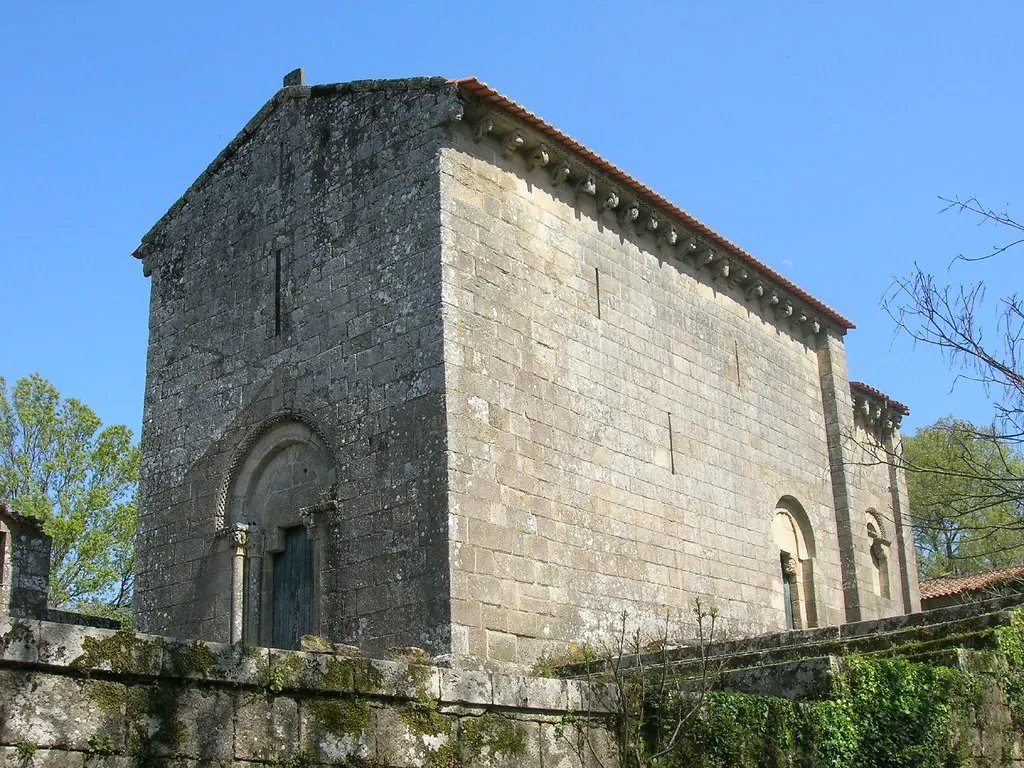
São Vicente Church
Doors unlock at nine, shut again for lunch. Slip through the side gate, climb the narrow spiral to the choir: from here the entire gilded altarpiece is framed like a theatre set and the 18th-century tiled tableau of the saint’s life reads like a strip cartoon. The bell still answers to a rope: pull, count to thirty, listen to the bronze groan over the rooftops. Two kilometres uphill, the chapel of Nossa Senhora do Faro is kept by Dona Amélia (first blue door on the left). On clear afternoons you can pick out the sierras of Galicia from her front step.
Mill Trail
Eight signed kilometres, 250 m of ascent. Start at the boarded-up primary school where a faded topo map is pinned to the plaster. Five water-mills lie in ruin; the third still carries its wooden gear-teeth, perfect for shadow-play photography. At Outeiro do Castro a stone marker records 360 m above sea level – high enough to lose phone signal, so fill your bottle in the village; there are no fountains on the ridge. Shepherd dogs patrol the high pastures; give them a wide berth and you’ll be back in the square within two and a half hours.
Where to eat
Taberna do Cruzeiro, Largo do Cruzeiro 9, fires its stove only Friday–Sunday, midday–three. The €9 prato do dia might be rojões (cider-braised pork), feijoada or salt-cod, jug wine included. Six tables, no card machine; book ahead on +351 251 821 003. Mid-week, drive six kilometres to São Pedro da Torre and ask for sarrabulho – a peppery pork-and-blood stew – at O Pescador.
Wine
Communal lagares open the third week of September. Turn up at four in the afternoon at Mr Armando’s stone press (Rua da Fonte 42) and you’ll be handed a glass of half-fermented must straight from the trough. The finished red is drawn off the following April and sold from the door for €3 a litre; bring your own bottle or buy one on the spot.
The Way of St James
Three yellow-arrowed routes converge on the N202 just before the bridge over Friestas stream. The former primary school has been turned into a five-euro albergue: eight bunks, hot shower, no Wi-Fi. Collect the key from Valença town hall or from the parish president’s blue house next door. There is no shop in Friestas; stock up in Valença before you climb.
Getting here
Transdev Norte runs three weekday buses from Valença (15 min, €1.85); on Sundays a single departure at seven in the evening. A taxi from Valença costs around €10. Cyclists face a steady five-kilometre gradient of eight per cent.
No café lifts its shutters before nine. Early arrivals either wait or knock on the bakery cellar door – bread is ready at eight-thirty. Between October and April the Minho fog slides in at dusk; by five the village is muffled. Pack a jacket, even in July.