Full article about Loivo: Where Grapes, Gunpowder & Granite Echoes Meet
São Roque bell, Loureiro scent, Camino boots—Loivo’s August nights fuse faith, wine and memory
Hide article Read full article
Bell wax and vine scent
At six o’clock on an August evening the single bell of Loivo’s church thrums across the terraces, announcing the procession of São Roque. Women step into doorways, strike matches and set tealights flickering in granite niches; molten wax drips onto warm earth that still smells of ripening Loureiro grapes. The village—834 people scattered over 500 hectares of northern Minho hillside—keeps time by these liturgical cues, not by any clock in the town hall seventeen kilometres away.
Written in stone
The place-name first appears in 13th-century foral charters as Lavio, probably from the Latin latus, “broad”, a nod to the wide saddle it occupies 177 m above the Minho valley. In 1643, during Portugal’s war of independence from Spain, local militia led by Gaspar Mendes ambushed Castilian troops on the Pedroso track; a modest stone cross, the Alminhas do Pedroso, still records the skirmish. Three centuries later the Cerveira-born poet Rosa Varela, exiled in Loivo by ill-health, fixed the episode in verse—an entire battle compressed into four granite stanzas beside the footpath.
Between vines and wayfarers
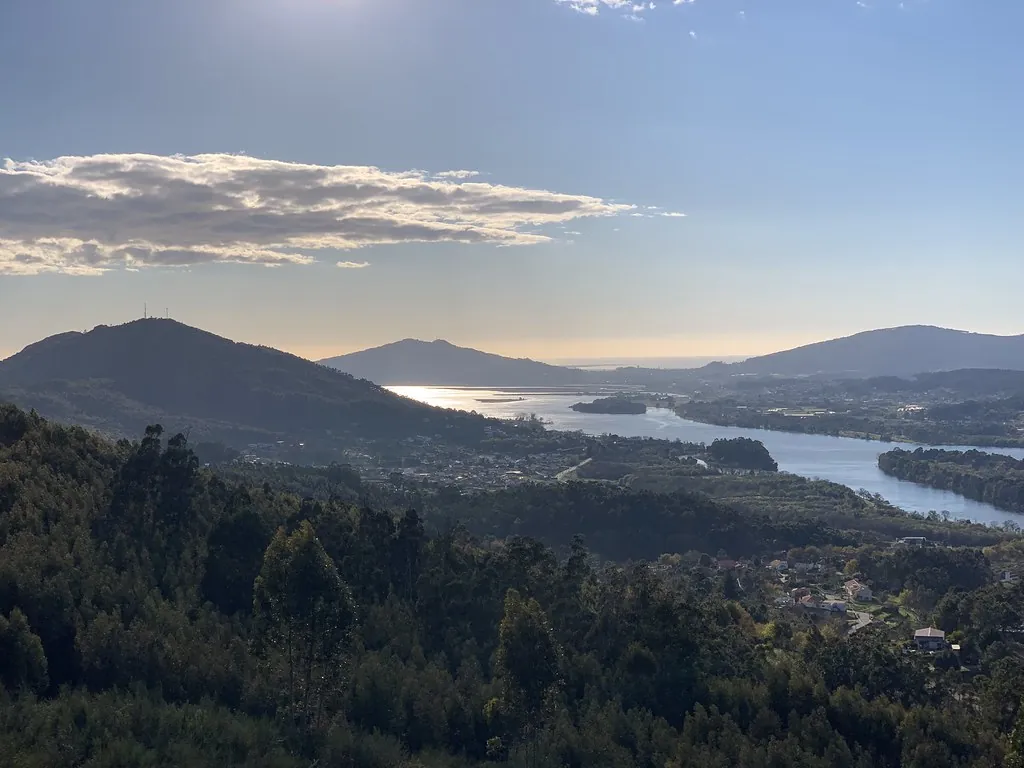
Loivo sits inside the Vinho Verde demarcation, yet you will find no tasting rooms or selfie-ready quintas. Instead, parreira vines braid the pergolas of back gardens and family plots are worked with hoes whose handles have shortened a finger-width each generation. The village is a waystation on the coastal Camino to Santiago; pilgrims emerge from corn fields, rucksacks salted white, boots clacking on the worn calçada as they ask for the fountain marked simply “água potável”. Three kilometres north the Minho slips past, the international boundary with Spain close enough to feel, too far to see.
Festas that redraw the map
On the last weekend of August the population doubles. Emigrants fly in from Paris, Geneva, Newark; campervans clog the single lane. São Roque is followed by São João in June and the municipal festa of São Sebastião in January—processions, brass bands, rockets that ricochet between schist walls. Census data list 106 children and 195 residents over sixty-five; for two nights the age pyramid becomes a column of neighbours dancing in the street while sardines blacken over makeshift grills.
Daily life without footnotes
There is no river beach, no way-marked trail, no museum shop. Sunday morning the parish church unlocks at eight; swallows dive through the open door and the interior smells of beeswax and damp stone. The only listed building is the church itself; everything else is ordinary, and therefore intact. Eighteen rooms are scattered among farmhouses—no reception desks, just a key under a tile and a note telling you where to leave it. Down the hill, Vila Nova de Cerveira offers biennials, castle walls, an aquamuseu. Up here, dusk grazes the granite cross and a distant dog rehearses the same three-bark aria it delivered yesterday, and will repeat tomorrow, when the bell calls the village back into itself.