Full article about Carlão-Amieiro: Stone Terraces Above the Tedo
Walk schist-walled vineyards where Port grapes cling to 499 m slopes in Alijó’s quietest corner.
Hide article Read full article
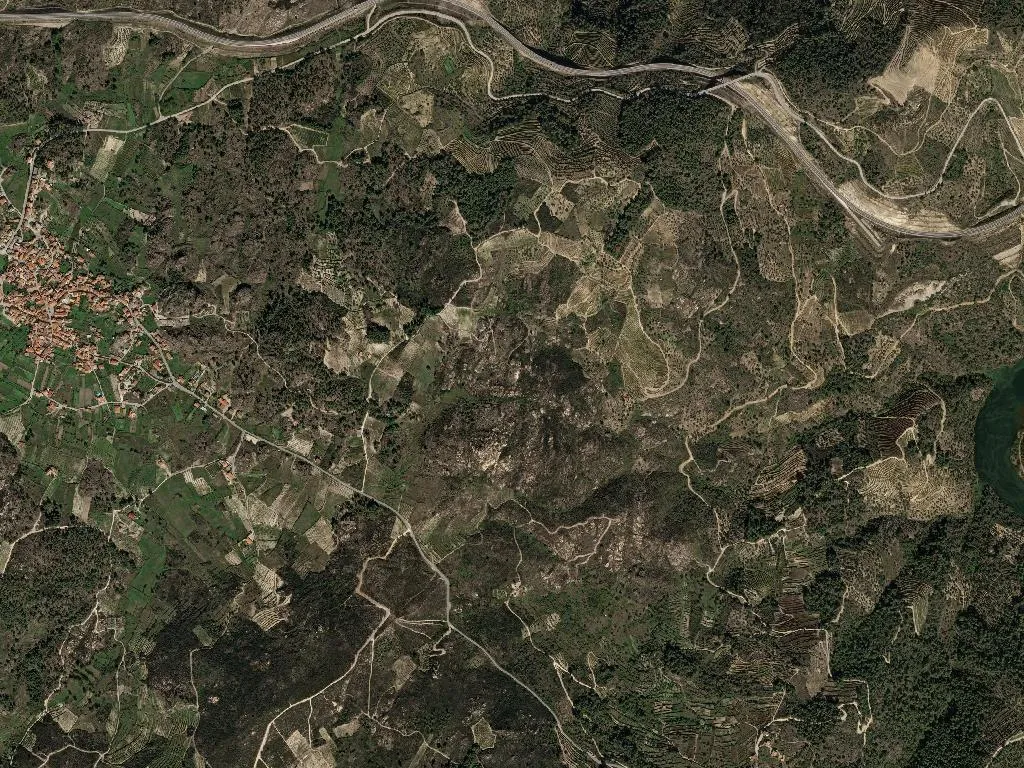
Schist flakes beneath your boots like brittle slate as you climb the walled terraces. At 499 m the air is already warm; the only sounds are the soft drag of a hoe and the updraft from the Tedo Valley carrying the scent of rosemary and hot stone. Carlão and Amieiro were lumped into one civil parish in 2013, yet the landscape made them a single place centuries earlier — 33 km² of dry-stone geometry inhabited by 627 people, a population density lower than the Outer Hebrides. Your nearest neighbour may be half an hour’s walk away.
Vineyards that step down to the river
These terraces are the uppermost gallery of the Alto Douro Vinhateiro, UNESCO-listed since 2001. Walls of schist, stacked without mortar, create irregular staircases that drop to the Tedo’s tributaries. Touriga Nacional and Tinta Roriz root themselves in fissures a metre and a half deep, hunting for water that summer bakes out of the rock. Family quintas — Casa Ferreirinha’s original vineyard among them — hide in the folds at Vilar de Maçada, Carlão and Amieiro; each still has its granite lagar and a cellar where Port sleeps in 550-litre pipas. There are no DOP seals here, no coach parties: production stays artisanal, invisible to the cruise boats that idle past Pinhão fifteen kilometres south.
Granite, lime-wash and procession days
The parish churches at Vilar de Maçada and Amieiro anchor the settlements like blockhouses: 60 cm walls, yearly coats of white lime, sparrows nesting under terracotta. Between May and September the liturgical calendar gives the villages a pulse — the Festa do Senhor Jesus da Capelinha, Nossa Senhora dos Aflitos, Nossa Senhora da Piedade. Processions climb gradients of 18%, the litter of the Virgin swaying to litanies sung in Trás-os-Montes dialect, incense mixing with charcoal from sardine grills. On those weekends the squares refill: grandchildren flown in from Lyon or Newark, wine poured from unlabelled bottles, the band striking up a waltz at 3 a.m.
What the land tastes like
The cooking is mountain-plain: kid roasted over vine-prunings, butter-bean feijoada thick with chouriça and salpicão, cozido served in cracked blue-and-white faience. Cornbread still emerges from two communal wood ovens every Friday, crust blackened, crumb tight enough to sop up gravy. Feast-day sweets — pão-de-ló soaked in spiced syrup, walnut cakes that use the October harvest — appear on lace tablecloths and disappear faster than the espresso cups. The house red stains the glass violet; tannins rasp the tongue like schist itself. No toasts are proposed; the glass is simply refilled.
Almond blossom and boar tracks
Rural lanes switchback through a topography of oblique lines: narrow socalcos, knife-edge ridges, valleys that drop 300 m in a kilometre. In February almond trees ignite the slopes with white and rose petals; by July the vines form a chlorophyll wall against the biscuit-coloured earth. Oak and holm-oak shelter streams where water smells of moss and wet slate. Wild-boar hoofprints crisscross the paths; at dusk a Bonelli’s eagle circles overhead, wings motionless. From the Vilar de Maçada lookout the Tedo Valley becomes a stone amphitheatre of walled vineyards, the horizon finally stopped by the blue bar of the Serra do Marão.
307 residents are over 65; 30 are under 20. Empty houses outnumber occupied ones, their wooden shutters warped, gardens swallowed by bramble. Yet when the church bell strikes noon the note rolls down the valley for miles, and whoever hears it — pruning, spraying, firing up the bread oven — knows someone else is still here, keeping the terraces vertical and the wine in cask.