Full article about Vila Chã: Dawn ignites schist terraces above the Corgo
Sunlight strikes flinty vineyards and granite doorsteps in Alijó’s highest hamlet
Hide article Read full article
First light on schist
Morning arrives sideways in Vila Chã. At 650 m the sun has to climb over the Serra do Marão before it touches the village, and when it does the terraces light up like struck flint. The air is thin enough to carry the smell of cold stone and the faint sweetness of wild apple. A single dog barks; someone latches a shutter. That is the entire soundtrack.
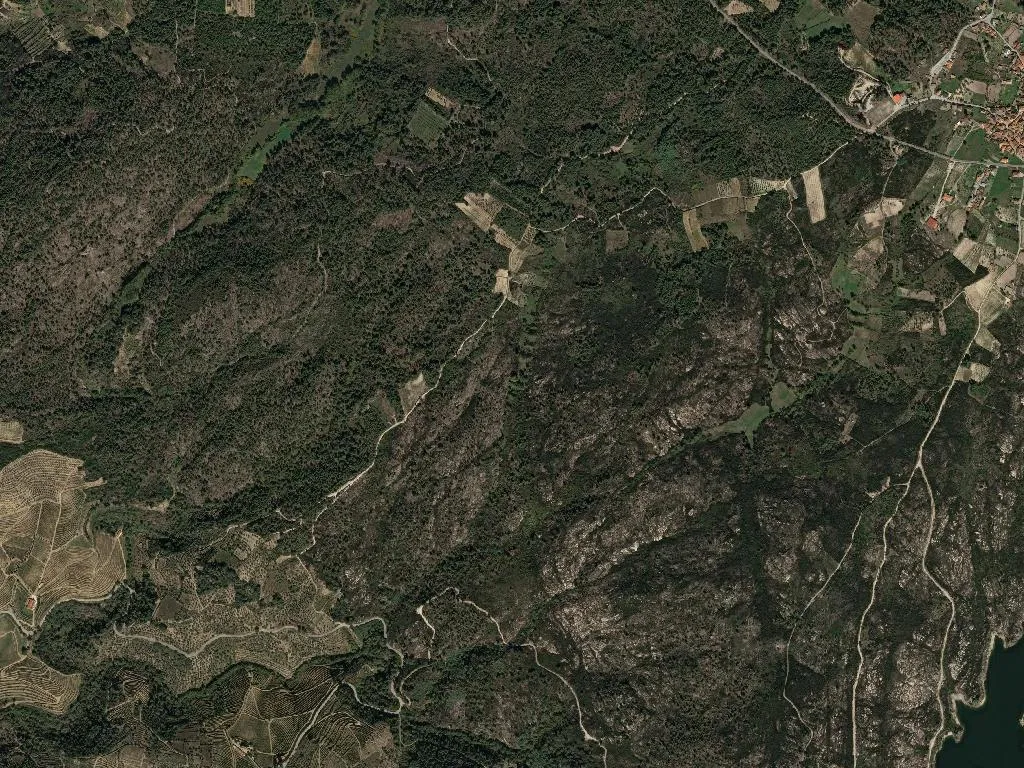
Below, the Corgo river glints between folds of vineyard so steep that every row is a shoulder-wide staircase hacked into schist. The 445 inhabitants – 169 of them over 65, only 47 under 14 – live scattered across 20 km² of gradient. Granite doorsteps are polished by centuries of boots; in September the smell of crushed grapes drifts from tiny stone lagares where treading is still done by foot.
Three dates the exiles circle
The village calendar shrinks to three summer weekends when emigrants flood back from France, Switzerland, the outskirts of Lisbon. First comes Vilar de Maçada’s feast for Senhor Jesus da Capelinha, then Nossa Senhora dos Aflitos, finally Nossa Senhora da Piedade. Each procession shoulders a gilt and velvet statue up gradients that would shame a StairMaster. Men in pressed shirts take the turns at the front; women balance candles and gossip. Long tables appear under pergolas, the church bell – the only national monument for miles – clangs across the valley like a tin dinner gong. For forty-eight hours the demographic graph is turned on its head.
Altitude in the glass
Vila Chã is the Douro’s upper balcony, a place where vineyards climb rather than cascade. The river is too far away to moderate temperature, so the grapes – mostly touriga franca and tinta roriz – ripen slowly, thicken their skins against the north wind and deliver wines that taste of bitter chocolate and graphite. Quinta do Junco, the largest estate, keeps its 1920s stone treading tank in working order; the others are smallholdings of two or three terraces whose labels you will find only in Alijó’s Saturday market or, inexplicably, a Copenhagen natural-wine bar.
There are four places to stay, all converted village houses with citrus trees in the courtyard and no perceptible light pollution. No pool, no gift shop, no tasting room with a view. What you get instead is the sound of your own footsteps on loose schist, the sudden hush when a red kite circles overhead, and the realisation that emptiness can be a form of hospitality.