Full article about Vilar de Maçada: granite, vines and vanished keys
Dawn honey-light warms stone terraces where cork ghosts ride the Corgo breeze
Hide article Read full article
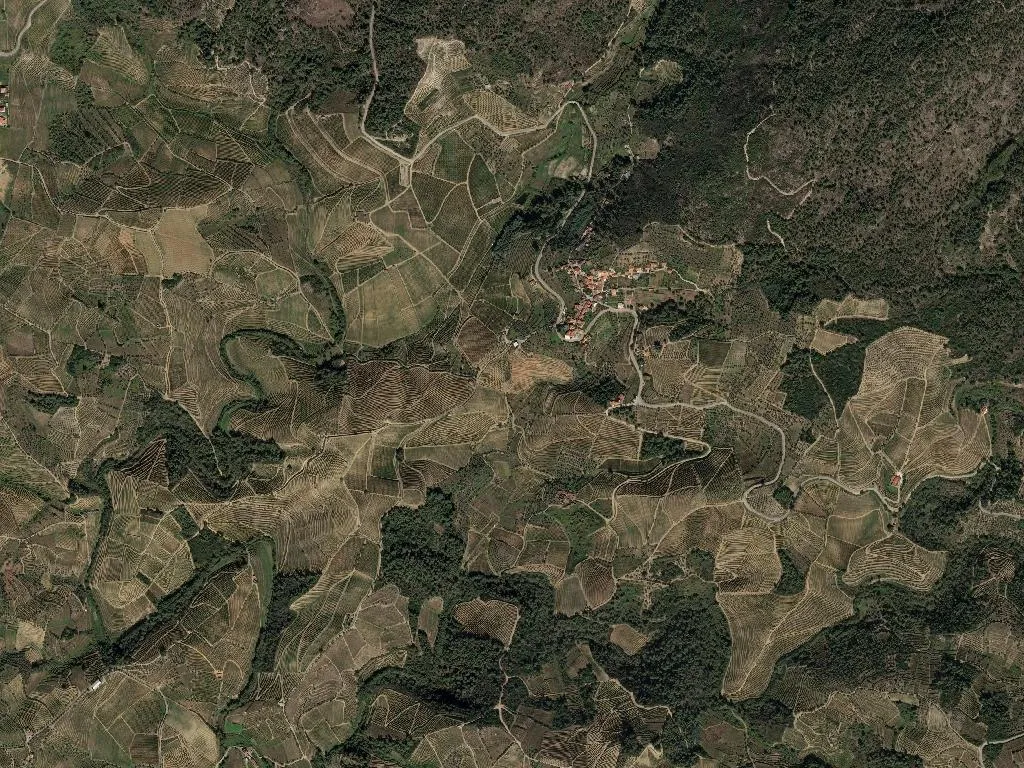
The morning sun slips across the terraced slopes with a light that is more than orange – it has the colour of heather honey, a tone you only see in Vilar de Maçada when the Atlantic wind has scoured the sky clean. At 440 m the granite houses do not merely “store heat”; they hoard it all day, then surrender it through the night like a cat that refuses to leave your lap. Up from the Corgo valley rides a breeze carrying more than the scent of schist earth: there is a ghost of burnt cork where farmers still torch the terrace walls to kill off weeds, and, higher up, the resinous nip of freshly clipped holm-oak.
Stone that remembers
The tenth-century “Villa de Maçada” survives as a fistful of blocks lost inside a eucalyptus grove; even the oldest residents no longer bother to visit. The village houses were never “robust” – they are simply what could be built with what was to hand. Windows are not “narrow slits” but exactly the width required for a woman to spot the postman and know, before he reaches the door, whether he brings a letter from a son in France or merely another utility bill.
The official heritage list contains one church whose door has stayed unlocked since the key vanished three decades ago, and a stone cross where children sit to eat bread and quince jam when their mothers aren’t looking. There are no interpretation panels, nor any need: the slab in front of the spring is dished like a spoon by the feet of generations who fetched water before indoor pipes arrived.
Vines that trained the hands
Vilar de Maçada did not “grow with the vineyard”; the vineyard climbed wherever a man could swing a mattock. Among the 816 inhabitants are 87-year-old Zé, who still prunes with the olive-wood-handled knife his father gave him, and Alice, down from Porto five years ago, learning to tell Tinta Roriz from Touriga Franca by the shape of a leaf.
Hands that worked the terraces fifty years ago can no longer close around a hoe; most weekly labour is now done by the grandsons who appear on Friday evening, ask questions the grandfathers answer through clenched teeth, and film the knot used to tie willow whips to the wires for TikTok.
The “dense silence of August afternoons” is punctured by Joaquim’s radio – RFM at full volume while he waters the vegetable patch – and by Bruno’s tractor, lurching uphill with a 1,000-litre tank because the year has turned savagely dry.
Calendar of small anxieties
The annual Festa is the moment Adelino keeps the village shop open until one in the morning and still runs out of ice. Our Lady of the Afflicted is patron of those who fear drought, fear fire, fear grown-up children who cannot find work. The procession has no pyrotechnic spectacle – just three modest rockets that Evaristo buys in Vila Real, letting them off alternately with his brother, who has had a weak arm since a stroke.
On those days the “houses closed all year” stay shut because their owners are dead; the rest light lamps visible from the road, and someone always brings an orange cake made with fruit from their own yard. The returning “emigrants” are simply Paulo, whose French is now better than his Portuguese; Manuela, back from Switzerland with chocolates melted into foil shapes; and Zézinho from Luxembourg, pretending not to recognise anyone.
Where schist keeps the day’s fire
At dusk, when light lies almost flat, the schist does not “radiate dry mineral warmth”: it burns. It burns the hands of anyone who forgot gloves and must gather the last prunings, burns the bare feet of children who kick off plastic sandals to race on packed earth. That moment – when the valley is already in shadow but the ridge tops still glow – does not “encapsulate” Vilar de Maçada. It is the scent of wood-smoke beginning to drift from chimneys, the neighbour’s television drifting through open windows, and the dog barking at a figure it has decided, after dark, it no longer knows.