Full article about Covas do Barroso: granite, smoke & lion-borne knights
Covas do Barroso, Boticas: oak-smoked Barroso DOP meats, 15th-century knight’s tomb with stone lions, Maronesa cattle trails
Hide article Read full article
Smoke on the granite
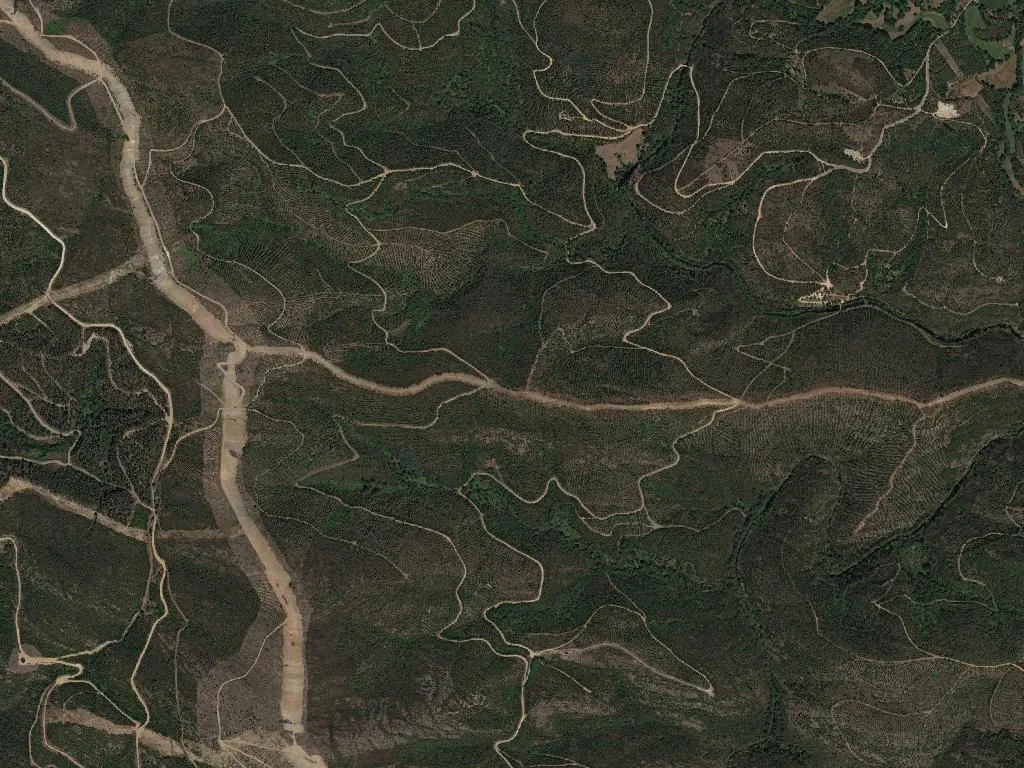
The communal-oven chimney releases a single, unwavering plume that scores the valley air like a charcoal line. By mid-morning the granite cottages are still breathing out the night’s moisture; their joints bloom with moss the colour of oxidised copper. Below, the Covas stream mutters under a single-arch bridge – not medieval, but rebuilt after the 1909 flood that swept away the old span and, with it, the miller António da Ribeira. From the Alto do Castro lookout the village’s name makes sense: a natural bowl cupped between the Serra da Sombra and Serra do Pinheiro at 621 m, population 191.
A knight among lions
Inside the parish church of Santa Maria the silence has body, as though the air itself has weight. The stone vault of the high altar drinks every echo. Centre-stage lies the 1409 tomb of Afonso Anes Barroso, squire to the House of Braganza, carved from a single slab of granite and borne aloft by two stone lions – a statement of power almost unheard-of this far north. Gilt baroque retables flare against the grey 16th-century walls; outside, a Manueline cross, its knots softened by four centuries of weather, still points a crooked finger skyward. Both monuments are listed buildings (Decree 43 980, 8 Jan 1960). When a Roman altar was unearthed at Poio in 1973 it merely confirmed what the tomb already argued: people have knelt to their gods on this shelf of rock since the first century AD.
Smokehouse and heather honey
Zé Manel’s grocery smells of oak ash and pork fat. From the ceiling hang salpicão, chouriça de carne, blood sausage and pumpkin-smoked chouriço – all Barroso DOP – their casings bronzed by weeks over smouldering oak. In the surrounding meadows Maronesa cattle, introduced in 1902 by royal veterinarian Augusto Lima, thread prehistoric tracks between dry-stone walls. Lunch is lechal – milk-fed lamb – roasted in a wood-fired oven until the skin shatters like caramelised sugar. Dona Emília, born here in 1924, uses only salt, garlic and bay; nothing else has changed since her grandmother’s day. A glass of local red – Bastardo and Mourisco in equal parts – cuts the fat, and the meal ends with Barroso heather honey, its resinous sweetness pooling in warm rye bread baked an hour earlier by Dona Rosa.
Water, stone, silence
The Mills’ Trail drops to the stream where two water-wheels lie drowned in bramble and fern. The Penedo mill, raised in 1892 by the Augusto brothers, ground until 1963 when the miller snapped the axle on his way to the threshing floor. Along the levadas – irrigation channels hacked out in 1784 at the behest of Abbot Francisco de São Torcato – the sky fractures into shifting mosaics of reflected light. The path climbs to Romeínho, where the chapel of São José keeps its annual feast on 19 March and houses cling to the slope like barnacles. On the Penedo crest, 812 m above sea level, a short-toed eagle has nested since hunting rifles were finally silenced in 1978. The territory entered the Barroso Biosphere Reserve in 2021, yet certification feels redundant: the landscape is already measured in the 47 tiny terraces that Adérito still tills exactly as his father and grandfather did.
When darkness falls – no streetlights, no headlights – the stars ignite one by one above the granite bowl. The church bell, cast in 1924 from the bronze of two First World War field guns, sends its slow note across the valley; the hillside catches it, holds it, then gives it back changed, as though the stone itself were remembering for us.