Full article about Santa Leocádia’s bell tolls over empty terraces
254 souls, 45 gilded coffers and a hump-backed bridge above the Tedo
Hide article Read full article
The bell that measures the day
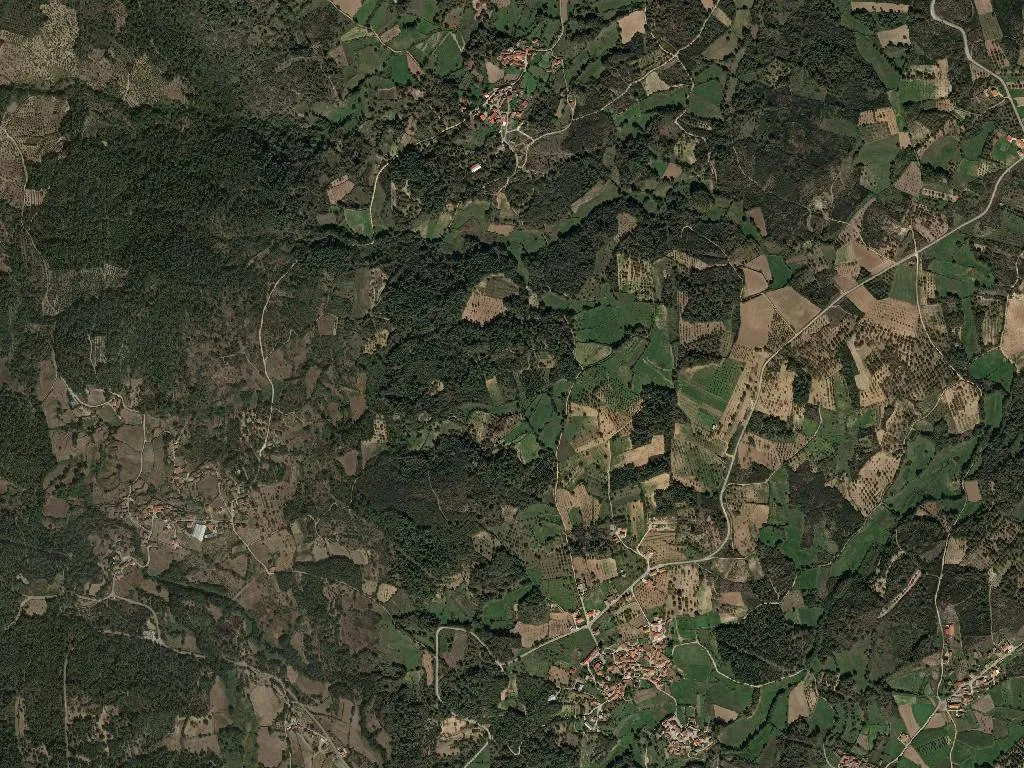
São Bartolomeu’s bell counts time over a valley where silence carries more weight than sound. At 804 m, Santa Leocádia drapes itself across the northern flank of the Serra do Brunheiro like a woollen blanket someone forgot to shake out. Even in August the air is sharp, scented with sun-baked schist, broom and, when the wind shifts, oak-smoke curling from scattered hamlets—Adães, Carregal, Fornelos, Matosinhos, Santa Ovaia, Vale do Galo—names that matter only to the 254 people still here, two-thirds fewer than in 1989.
Forty-five painted coffers
The parish church rises in the village centre with a baroque façade whose bat-wing pediment claws at the Trás-os-Montes sky. Inside, the nave breathes old gold and darker wood: 45 painted ceiling coffers, candle-light caught in gilded retables, and a side altar to St Peter paid for in 1727 by parish priest Domingos de Araújo—an unusually private clerical commission carved into the very stone. Boards creak underfoot; the air tastes of beeswax and centuries of winter damp.
The bridge that joins two banks
Below, the Tedo river runs narrow and deep, flanked by chestnut terraces and olive groves stitched to the slope. The Ponte Antiga—medieval ashlar, hump-backed deck—once carried mule traffic between Tabuaço and Armamar. Listed in 1977, the bridge still bears its own weight and the chill of dawn fog when stone sweats and moss gleams bottle-green. Silence is absolute except for water murmuring under the arch and the low pass of nesting crag martins.
Vineyards, chestnuts and high-altitude charcuterie
Santa Leocádia eats what the slope gives. High-altitude vineyards climb as high as gradients allow, yielding Trás-os-Montes reds stiffened by mountain nights. Padrela and Terra Fria DOP chestnuts drop heavy in October, gathered by hand for market or for roasting on home hearths. In smoke-houses hang Barroso pumpkin and pork chouriço, salpicão hams and alheira sausages ageing slowly over oak. At table, IGP Trás-os-Montes potatoes support Barroso kid or lamb, finished with local olive oil and honey DOP, or—on feast days—a custard-larded pastel de Chaves still hot from the bakery.
Paths that take you further
Two Santiago routes—the Interior and the Nascente—cut across the parish, shepherding backpackers up old grazing tracks between schist walls and wayside shrines. Natural belvederes hover over the Tedo valley; the view unravels into the distant Marão and Gerês ridges, scented with thyme and gorse. Walkers learn quickly that haste is pointless in this geography.
Dusk fires the church’s gilded coffers and draws long shadows across the terraces. Cold drifts down from the Brunheiro, smoke rises again, and São Bartolomeu’s bell strikes the hour—slowly, like everything else.