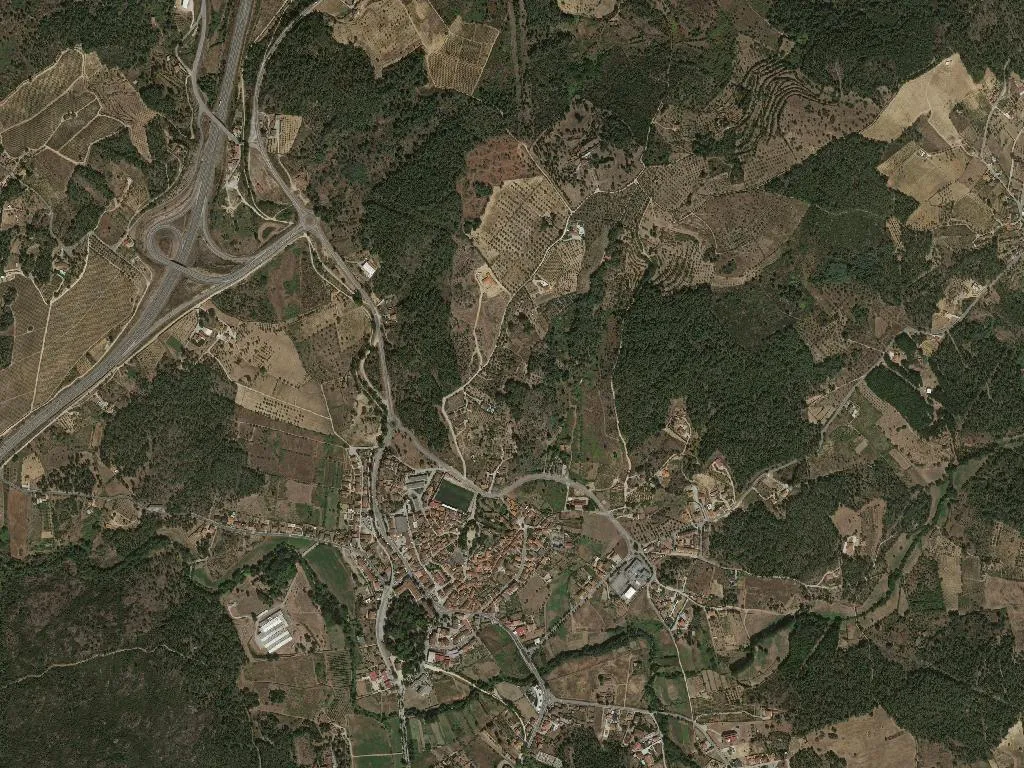
Full article about Vidago: where Belle-Époque fizz still haunts the valley
Palace lawns, chestnut chapels and carbonated springs in Trás-os-Montes
Hide article Read full article
The valley that still fizzes
Ribbons of vapour curl from the spring at dawn, sketching copper-coloured halos on the granite coping. Mineral salts bleed into the stone, mapping centuries of carbonated seepage that first drew the Portuguese court to this wind-hollowed valley on the edge of Trás-os-Montes. By sunrise the Ribeira de Oura is already gossiping under the poplars, indifferent to the Belle-Époque fantasies its waters once inspired.
A palace that anchored the mountain
Vidago Palace, completed in 1910, sits in the valley floor like an ocean liner marooned among chestnut groves: pale-cream façade, 30-metre belvedere towers, wrought-iron balconies that once framed monocled generals and tubercular duchesses. The 40-hectare park still obeys a strict Versailles geometry—hornbeam tunnels, lime-lined allées, fountains timed to coincide with the changing of the spa’s thermal baths. Inside, the Salão Nobre glitters with its original bronze-and-crystal chandeliers and a 200 m² hand-woven Aubusson carpet depicting the four seasons of the Minho.
Across the lawn, the defunct Hotel Salus (1918) now houses municipal archives; its azulejo panels advertise “Águas Gasosas” to passengers who no longer arrive. The railway terminus—platform canopy painted ox-blood red, wooden benches polished by tweed-clad backsides—last saw a scheduled service in 1990, yet the station clock still insists it is 1934.
Chapels, crosses and chestnut canopies
Leave the spa quarter and the parish dissolves into hamlets stitched together by granite chapels. The 17th-century Capela do Côto, dedicated to Our Lady of Good Health, keeps a wooden ex-voto of lungs that apparently cleared after three weeks of Vidago’s bicarbonate-rich waters; inside Capela do Olmo, frescoes of St Simon stylite are flaking like overcooked pastry. An arched-roof stone cross marks the spot where, in 1925, Vidago won independence from neighbouring Arcossó—an event still toasted on 25 October with sparkling water instead of wine.
Centenary Park is where the 1,728 locals conduct their evening passeggiata beneath plane trees planted in 1912. From here the PR4-CHV footpath climbs 300 m through sweet-chestnut coppice to a ridge that lets you peer west into the Douro valley and east towards Spain’s Sierra de Sanabria—no passport required, only stamina for the return descent.
Smokehouses, chestnuts and Roman ghosts
In the curtained kitchens, Presunto de Barroso DOP hangs above slow fires of holly oak; slices arrive translucent, the fat already melting at room temperature. Alheira sausages coil like watch springs, while Maronesa beef—reared at 1,000 m on the same breed that pulled Roman carts—arrives charcoal-seared, sided by wood-oven potatoes whose skins split open to reveal saffron-yellow flesh. October’s Feira da Castanha turns the main street into a montage of roasting drums and icing-sugar snowstorms as the Padrela chestnut is folded into vermicelli puddings that pre-date French mont-blanc.
Local pride also rests on a 5 cm bronze Venus dredged up in 1908, now displayed in Chaves’ Museu da Região Flaviensis: she suggests legionaries knew the springs two millennia before anyone thought to carbonate the water and sell it by the bottle. Two modern variants of the Camino de Santiago—the Interior and the Nascente—still bisect the parish; hikers top up aluminium bottles at the public fountain and march westward toward Santiago, 250 km away.
As dusk settles, Vidago Palace lights snap on section by section, throwing amber pools across the lawn. Mist lifts from the rivulet, merging with cigar smoke drifting from the terrace bar. The spa’s new wing—white marble designed by Álvaro Siza Vieira—offers midnight soaks under constellations that, according to the 1910 guestbook, “cure sleeplessness and broken engagements alike”. Whether the water heals or not, the valley keeps fizzing, indifferent to whichever century believes in it.