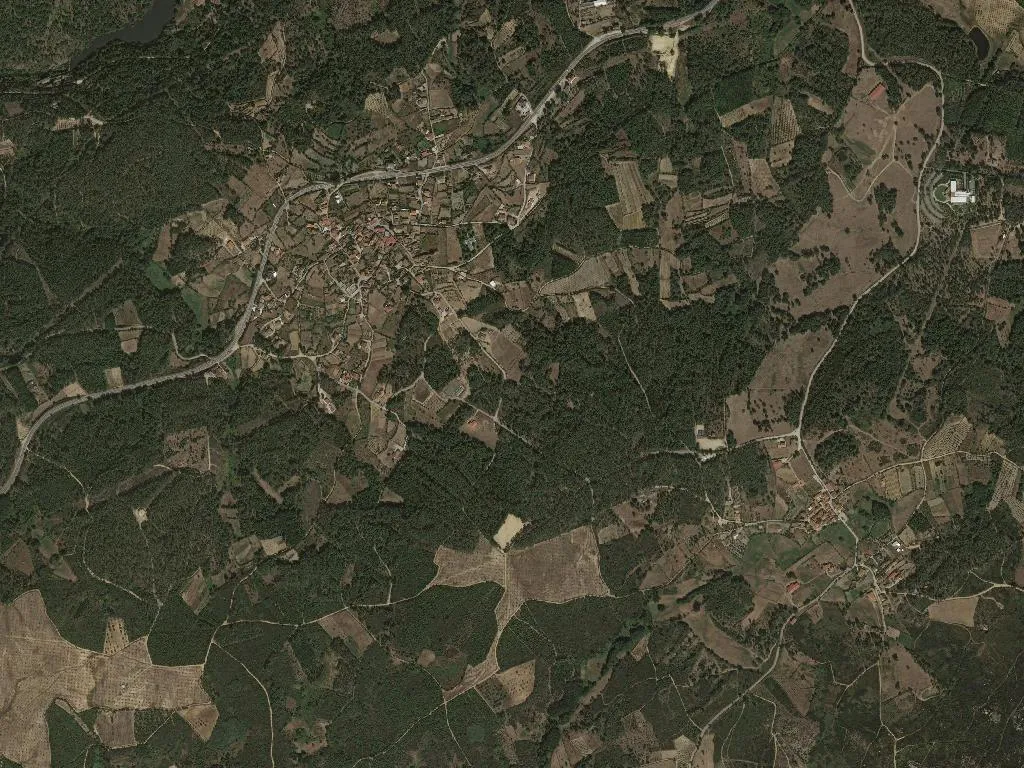
Full article about Vilela do Tâmega: Where the River Writes the Dawn
Chestnut terraces, 1909 flood-proof bridge and partridge alheiras echo in Chaves’ mountain parish
Hide article Read full article
The Sound Before the Image
The river speaks first. Before the valley walls come into view, before the chestnut leaves flicker in peripheral vision, the Tâmega announces itself—water dragging over granite, a low, ceaseless syllable that 353 neighbours have heard every dawn since Afonso Henriques lured the first settlers here in the twelfth century. At 541 m above sea-level the parish wakes to that same bass note: a hydraulic heartbeat that once drove fulling mills, irrigation channels and, according to the 1285 royal charter, “the monthly market of Vilela on the riverbank”.
Stone That Survived the Flood
The bridge downstream is younger than its footings. After the Christmas flood of 1908 tore away every span between here and Amarante, engineers rebuilt in 1909, re-using the medieval piers that already featured in the 1515 town ordinances. Darkened by silt and time, the granite now carries scallop-shell waymarks of the Portuguese Interior Way—an alternative Santiago route that forked off the Roman Bracara-Asturica road and climbed towards the fortress town of Monterrei. Oil merchants from Galician Verín once rattled across these planks; shepherds still do on the first Saturday of each month when the cattle fair authorised by King Dinis convenes beneath the plane trees.
In the churchyard above, a 1773 crucifix marks the spot where parishioners once left rye, maize and grapes for the tithe collector. Inside São Salvador the gilded work of José de Santo António Ferreira (1743) survives, as do 1698 blue-and-white tiles that escaped the Victorian overhaul of 1872. Stand at the altar and you face the same triptych described by the royal visitor of 1758: a landscape of vines, rye terraces and chestnut coppice that still defines the view today.
Sausages That Outwitted the Inquisition
Taste, not text, explains Vilela’s most stubborn tradition. Local alheiras—smoked, horseshoe-shaped sausages—trace back to 1615, when converso families swapped pork for partridge and hare to fool inquisitors. The communal oven on Rua do Calvário (1853) fires up at new moon when women insist the air is dry enough to take the smoke; strings of sausages hang above smouldering chestnut logs while Barroso IGP hams cure for two years in the same rafters. Order a plate at Dona Albertina’s tavern and you receive the full triad: alheira grilled over arbutus embers, kid from the same Barroso breed, and a clay casserole of chanfana—goat slow-cooked in red wine and mountain herbs. The wine itself is field-blend Tâmega, co-fermented from old parcels at Quinta do Conde and Herdade do Monte; it arrives rough, slatey and honest, the liquid equivalent of the local dialect.
Between Chestnut and River
Hunters way-marked a 12-km riverside circuit in 2004 that threads oak and cork forest where wild-boar prints dry in the mud. Dawn is the moment: light skims the canopy, mist clings to the water and a royal kite lifts from granite crags upstream of the bridge. In October the chestnut harvest still follows a manual rhythm—no mechanical shakers—so families spread blankets under the 200-year-old trees that earned the area EU priority-habitat status in 1998. The fruit travels no farther than Chaves market; peeled, it perfumes the autumn air with the same tannic sweetness that once filled the holds of riverboats bound for Porto.
Milk Offerings and Verse Duels
August belongs to São Salvador. A procession leaves the mother church, follows the medieval street grid and halts at the stone cross while the regional choir sings the Latin mass. Neighbouring parishes—Tronco, Santa Cruz-Tronco—still dispatch ox-carts of fresh cheese and ricotta for the romaria do leite, a dairy offering that predates refrigeration. After the liturgy, men in tweed caps seal cattle deals with a crossed-finger handshake known locally as o torno, a gesture recorded by the parish priest in 1758 when 120 oxen, 300 sheep and 80 goats changed hands. Come nightfall, singers square off in the church square, trading improvised quatrains that Zeca Afonso collected here in 1968; the verses still mock slow tractors, tight-fisted mothers-in-law and, lately, Brussels subsidies.
Dusk settles. Woodsmoke rises straight in the still air; the Tâmega keeps its ancient murmur. Flood-level stains on cottage walls record centuries in sedimentary rings—growth rings nobody fells, calendars nobody tears off. The river has always been the only clock this parish trusts, and tonight, as ever, it refuses to hurry.