Full article about Vilela Seca: Where Silence Weighs 5.8 Hectares Per Soul
Vilela Seca, Chaves: wind-whistled schist village, 238 souls, 1,401 hectares of echoing oak, granite church open to swallows.
Hide article Read full article
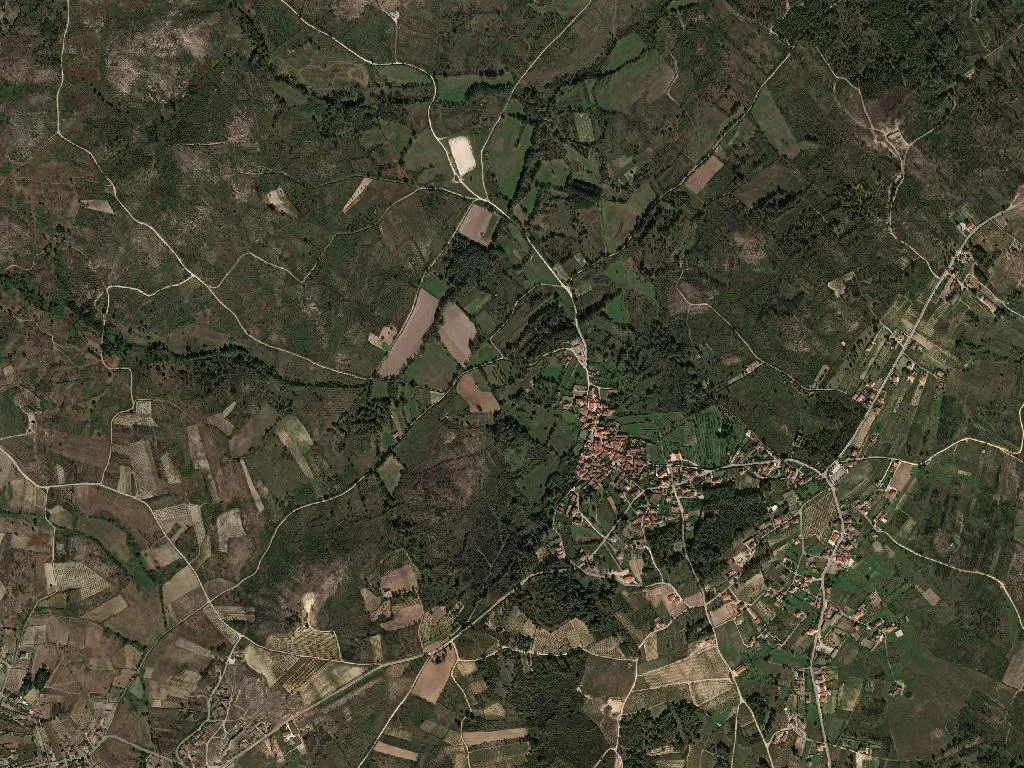
The wind arrives before the village does: a low sibilance in the oak canopy, then the faint clatter of water in the Rego do Milho valley below. Only after these two notes does Vilela Seca reveal itself—408 m above sea level, granite houses scattered up a tilted meadow as though someone had tossed a handful of dice at the hill. The name is a sleight of hand: “Seca” (“dry”) recalls centuries when springs failed, yet the bottom of the slope is now a lucid green, fed by a small mirror-like dam installed in the 1970s. Two hundred and thirty-eight people share 1,401 hectares here; do the division and every soul commands 5.8 hectares of schist, oak and heather. Silence, too, is measured in hectares—thick, almost chewable, like the air that meets you when you unlatch a house left shut since winter.
Granite memory
The parish first surfaces in a 1320 charter as Santa Maria da “Terra da Frieira”—literally “land of the cold”. Until 1853 it belonged to the extinct municipality of Ervededo; redistricting shipped it to Chaves, though no one remembers receiving the memo. The main church keeps the paperwork, but it is the ruined Igreja Velha that carries the heavier freight of time: stone on stone, lime mortar flaking like old skin, a nave open to the sky where swallows stitch the acoustics. Wayside crucifixes stand in miniature plazas; granite fountains, no longer used for laundry, function as sundials that tell the time only by day. Farmhouses follow the Transmontano grammar: walls a metre thick so January feels shorter, oak doors warped into permanent complaint, wrought-iron balconies where afternoon sun stores enough heat for a wrist-check—handy when mobile reception vanishes and you need to know if it is supper yet.
Valley folds and mountain ribs
From the last house the view tilts over the dam, an unlikely slate-green lozenge held back by a curved concrete lip. The parish crests at 475 m on the Alto do Brunheiro; from there you can pick out the Serra do Brunheiro and, farther south, the keep of Monforte castle etched like a paper cut-out against the sky. The topography is a tweed neither jacket nor coat: high-meadow rye gives way abruptly to chestnut and oak, the path’s altitude yo-yoing between 410 m and 470 m until the phone loses the will to roam. Walkers on the local loop smell moss and wet loam; they also smell wood smoke, because someone is always boiling coffee on a butane ring in a field shelter.
What the table still insists on
Pig is the local currency. Hams hang three winters in the fumeiro—never two, never four—until the fat yellows like old ivory. Chorizo is stained a deep paprika red; the smell alone makes eyes water in self-defence. Easter folar, a saffron-laced brioche threaded with cured ham, is still baked in the communal oven whose key hangs on a nail outside the parish council door. Wine comes from the Chaves sub-region—high-acid, high-altitude reds that make your cheeks suck in like a vacuum pump. On 15 August the feast of Nossa Senhora da Assunção blocks the single through-road with trestle tables; bottles of Barroso DOP ham, Maronesa beef and kid goat from the same protected designation are passed until the village breathes in a different, briefly syncopated rhythm.
Crossroads in rubber and dust
Two branches of the Camino—Interior and Nascente—cross in the main square, though “square” glorifies a triangle of granite setts round a fountain. Pilgrims top up bottles, glance at the escarpment ahead and consult phones that insist they are nowhere. Vilela Seca has never been a destination; it is a comma in other people’s sentences. Even the Romans used it as a night halt on the road between Aquae Flaviae (modern Chaves) and the gold seams along the Tâmega. The café, open only on Fridays, functions like a station waiting room where everyone leaves 50 cents on the counter for the next traveller.
Late afternoon, the wind shifts downhill, carrying the scent of a fumeiro that was already ancient when the euro arrived. Below, the reservoir reflects a sky the colour of wet concrete. Vilela Seca offers no spectacle—only the exact geometry of a life that refuses to stop: granite slab by granite slab, day after day, between the greening valley and the mountain that keeps watch. Call it a book no one reads but no one dares remove from the shelf.