Full article about Mesão Frio: Slate Terraces & River Echoes
Roman-ledged vineyards, granite wine-press, UNESCO Douro silence
Hide article Read full article
A Landscape of Layers
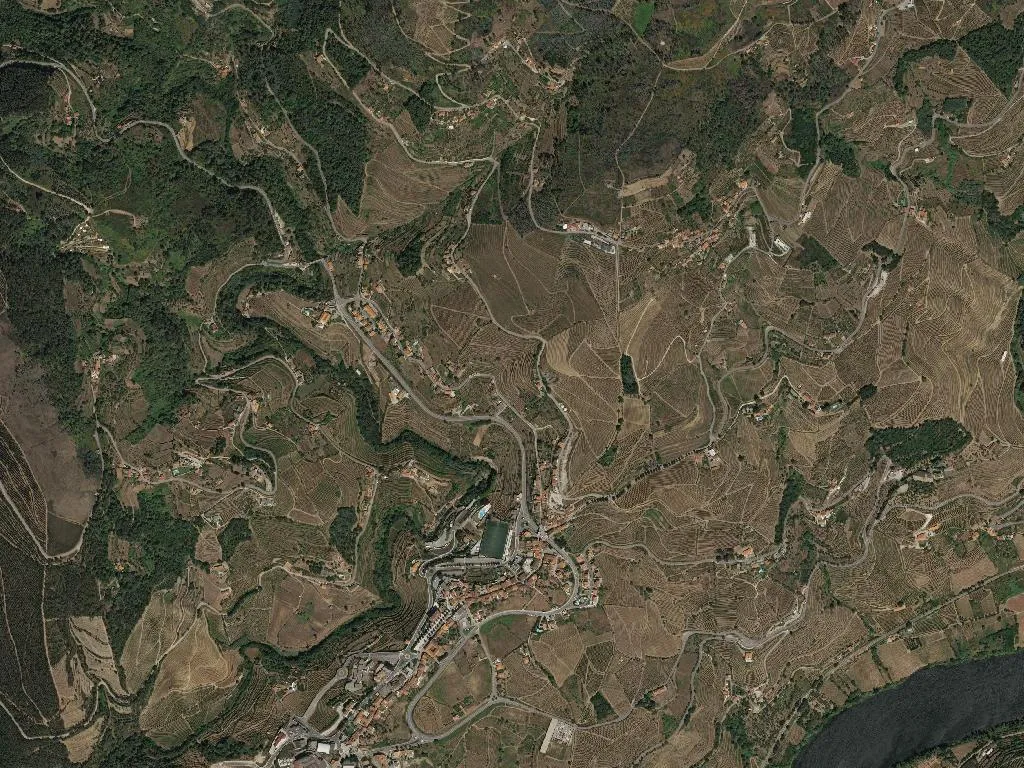
The dark slate of the terraces descends in steps to the Douro, where the water reflects the dense green of the vineyards. In Mesão Frio (Santo André), the landscape is composed of vertical layers — sky, slope, river — and the eye quickly learns to measure distance by the incline of the land. The dominant sound is not wind or bells but the thick silence of summer afternoons, when heat rises from the valley and the air seems to pause between the vine leaves.
This parish of 1,615 souls spreads across 7.38 km² on the right bank of the Douro, a territory classed as World Heritage by UNESCO in 2001. At 349 m above sea level, the vineyards enjoy the solar exposure and diurnal temperature swing that define the Douro Demarcated Region, first regulated by the Marquês de Pombal in 1756. Here, granite and schist are more than geology; they are everyday vocabulary, the fabric of walls, houses and identity.
The Mark of Time on Stone
Three monuments classified as Properties of Public Interest punctuate the terrain: the thirteenth-century Capela de Santo André, its Romanesque portal eroded by weather; the eighteenth-century Quinta da Vedoria, still sheltering a stone wine-press where grapes were once trodden by foot; and the Conjunto de Fornos de Cal, kilns that fed the lime trade until the 1960s. Population density — 219 people per km² — reveals a parish that, despite an ageing demographic (429 residents over 65, only 164 under 15), keeps a pulse. The 31 registered tourist lodgings listed by the town hall in 2023 — apartments, guesthouses, villas — show the valley now earns its living from hospitality as well as vines.
Granite door jambs turn honey-coloured with age. Dry-stone terrace walls, rebuilt each generation, lock together without mortar, a technique learned from the Romans who planted olive trees here two millennia ago. Walking these paths is a calf-burning lesson in perspective: every metre gained in altitude redraws the valley below.
Wine and Smoke
The kitchen follows the slope. In the dining room of O Tachinho on Rua da Praia, a 2019 Vale de Mendiz — produced three kilometres away — is poured alongside plates of Presunto de Vinhais IGP, delivered each Monday by the 07:30 bus from Vila Real. The ham is sliced with rye bread from the wood-fired oven in Santa Marta de Penaguião and olives cured in brine by Dona Amélia, 78, who lives on Rua do Calvário. Smoked pork, chouriço, alheira and morcela hang in dark smokehouses where oak fires burn for three days; the scent of woodsmoke clings to winter coats.
Vines command the view but do not exhaust it. Between the terraces, fig trees burst in May, almond blossoms appear in February and are ruined by March frosts — the last, on 15 March 2023, wiped out 30% of the local crop. Centuries-old olive trees, twisted by wind, survive because they were negotiated with the terrain, metre by metre, as Joaquim, 82, will tell you while pruning his 2.3 ha at Quinta do Espadanal, still refusing to use a long-handled shear.
Light that Shapes the Day
Douro light is a clock. At dawn, fog rises from the river and wraps the vineyards in milky whiteness — a phenomenon recorded on 120 days a year at the Peso da Régua weather station. By noon the sun is perpendicular and the schist burns under bare feet. At dusk, slanting light ignites the slopes and turns every vine leaf into a shard of green gold. It is the hour when the whole valley seems to exhale, when the river flashes copper and silence becomes almost audible — broken only by the 17:30 departure of the Douro Azul river-cruiser bound for Pinhão.
Mesão Frio (Santo André) does not shout. It offers itself slowly, like unfolding an antique map where every contour line tells a story of labour, patience and stubbornness. When the sun slips behind the ridge and shadows climb the terraces, the smell of warm earth lingers, and the distant thud of the wooden door at O Forno tavern closes at 21:30 — gestures repeated for centuries without hurry or fuss.