Full article about Poiares: sunlit schist, oak-smoke & silence
Walk terraced vineyards, taste Vinhais ham, follow pilgrim stones above Douro’s silver thread
Hide article Read full article
Late light on schist terraces
The sun slants across the afternoon, laying a gilded ruler over every row of vines that climbs the 527-metre ridge. Nothing stirs except the updraft from the Douro valley, carrying the scent of warm slate and, somewhere in the folds of the hill, the resinous drift of oak-smoke escaping a stone smokehouse. Poiares never declares itself; it unbuttons slowly, like a pocket of air trapped between geological seams.
In the folded heart of the Alto Douro
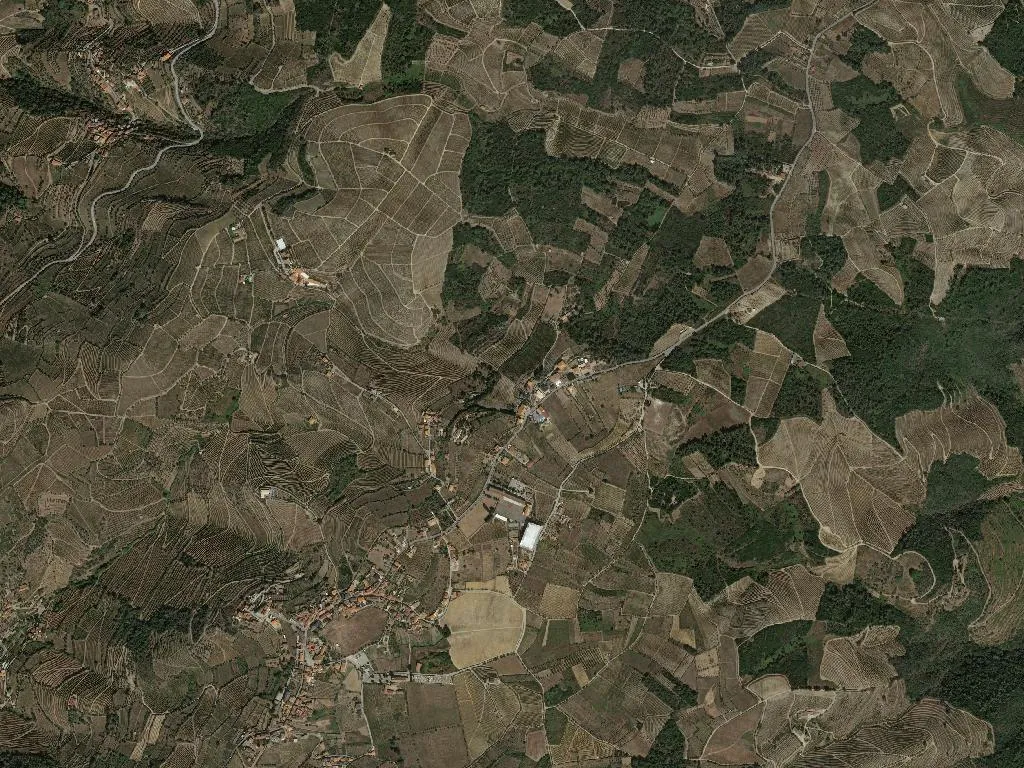
Barely twelve square kilometres of UNESCO-stamped mountainside have been cleaved into terraces so exact they look set with a mason’s square. Schist bursts through retaining walls, cottage footings and the footpaths that stitch the hamlet to its neighbouring quintas. Five-hundred-and-ninety-six souls still work this brittle soil, one of the most sparsely peopled corners of Peso da Régua municipality. Population density is measured in horizons: south-east, the Távora scribbles its silver thread through the gorge; opposite, the same vine geometry repeats until the retina gives up.
Way-marked by pilgrims
The Via Lusitana – the interior arm of the Camino de Santiago – passes through as an unpicked thread, re-sewing past to present. Boot leather taps the same granite slabs used by 14th-century mercenaries heading to Compostela. From the ridge the track delivers a cinematographer’s pan: river light flashing on schist, almond blossom fizzing against a cobalt January sky, the gradient so severe that even fit walkers pause to steady quadriceps and let the landscape settle in the eye. Germans, Brazilians, Koreans – their languages braid briefly at the lone drinking fountain before dispersing again into footstep monologue.
Smokehouses and slate
The pantry here is Transmontana, not postcard-Douro. Order presunto de Vinhais IGP and the plate arrives the colour of antique mahogany, each translucent sheet still carrying the memory of six mountain winters in an attic smokehouse. The native Bísaro pig roams wood-pasture before its haunches are chimney-cured over holm-oak logs; the flavour is a slow crescendo of pepper, resin and cold granite. Pour a glass of field-blend red from Quinta do Panascal, five kilometres east in Valença do Douro, and the tannin tastes of the same schist that grazes your fingertips when you lean on the terrace wall.
Festa, firecrackers and homecomings
Every second weekend in August the village census swells to twice its size. Firecrackers ricochet off the church tower at dawn, announcing the Festa de Nossa Senhora do Socorro; processional banners are unfurled, alleys hosed down, and the single road closed to traffic so trestle tables can be laid with grilled sardines, peppery olive oil and plastic jugs of youthful red. By midnight the accordion has migrated to the churchyard, grandparents dance with toddlers on their shoes, and someone is always explaining to a first-time visitor that the patron saint is invoked less for salvation than for the simple fact that she brings the scattered grandchildren home.
Dawn after the festa, the ridge reclaims its silence. The vines catch first light like struck matches; wood-smoke lifts from one remaining chimney; a pilgrim shoulders his pack, surprised by how reluctant the feet are to leave. Poiares has no souvenir shops, no viewpoints with stainless-steel railings. What it offers is breathable: a measured exhalation of stone, sap and smoke that lingers in the lungs long after the road has twisted you back down towards the river.