Full article about Covas do Douro
Terracotta roofs, granite corners and altitude-sharpened reds in Sabrosa’s sky-high parish
Hide article Read full article
Stone fingers and schist light
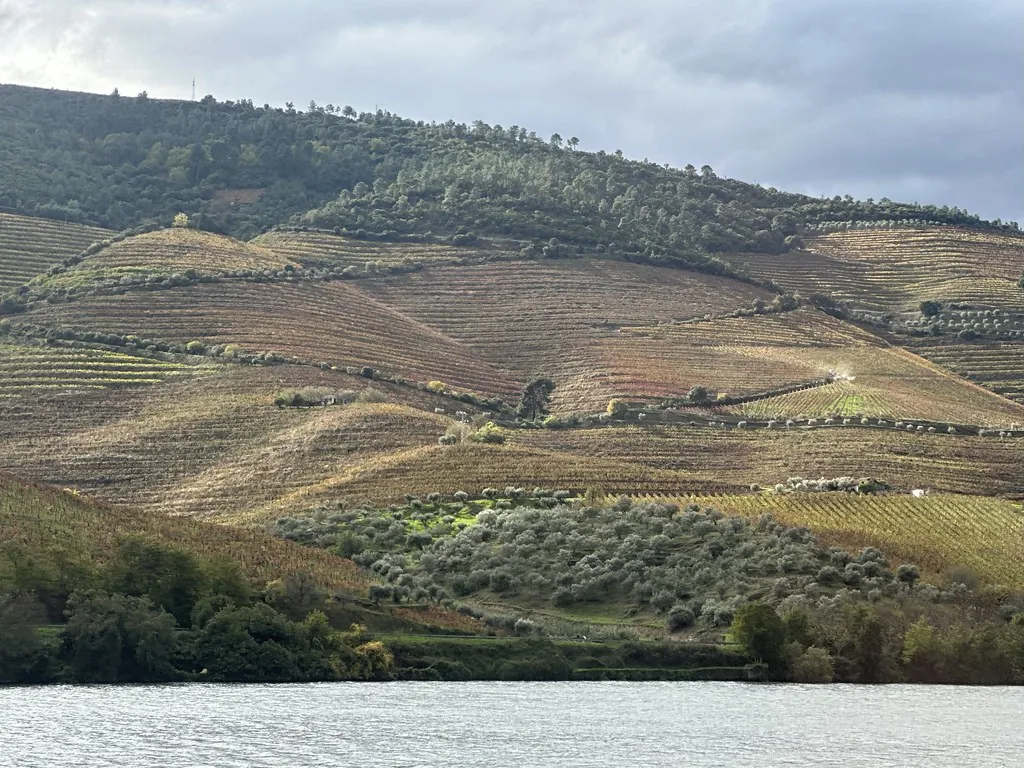
The hillside falls 469 metres to the Douro in a single muscular gesture, its vineyards braced by dry-stone walls that grip the earth like interlaced fingers. Covas do Douro clings to this incline, a scatter of terracotta roofs and granite corners that rearrange themselves with every shift of light—honey at noon, bruised violet by seven. Silence has density here; only the river wind prises open wooden shutters or sets the poplars hissing.
Three hundred and sixty-three souls occupy nearly two thousand hectares, a ratio that translates into breathing room. Walk from one dwelling to the next and you cross vineyards, gorse thickets, boulder-strewn pasture; the parish council counts 123 residents over sixty-five and just twenty-one children, yet the place refuses to become a demographic footnote. September still smells of crushed grapes and diesel from the lagar tractor; smokehouses exhale the slow, sweet incense of Vinhais IGP ham curing on chestnut poles.
Faith you can set your watch by
Monumental heritage stops at the 16th-century Igreja de Santa Marinha, classified in 1977, but the calendar is punctuated by three pilgrimages that double as population audits. On the first Sunday of May, Nossa Senhora da Azinheira draws the diaspora back from Porto and Paris; the last Sunday of August belongs to Nossa Senhora da Saúde; Holy Week stages the procession of Senhor Jesus de Santa Marinha. No tickets, no PA systems—just candles, shared wine and grandparents whose knees protest on the uphill cobbles yet still arrive early to secure a place outside the chapel portico.
Altitude in the glass
Covas has answered to the Douro Demarcated Region since 1756 and to UNESCO since 2001. At this elevation, ripeness is a negotiation: Touriga Nacional and Tinta Roriz cling to schist that stores midday heat and releases it after dusk, producing reds with the graphite edge of altitude. Mechanisation is impossible on gradients that exceed 40 per cent; pickers climb with secateurs and 15-kilo baskets, ferrying the fruit to granite lagares or the stainless-steel tanks favoured by grandchildren who studied oenology in Vila Real.
The logistics of staying
There are no viewpoint signs, no boutique hotels—just four village houses registered for short lets. Stock up before you leave Vila Real because the grocery opens when the owner finishes milking, and the café only closes when the last domino falls. The N322 coils up from the river like a thrown ribbon; every hairpin reveals another tier of walled terraces and, if you arrive after dark, the solitary street lamp outside the church. Wake early and you’ll hear the same oak-fuelled fire that scented the room overnight, proof that someone rose before you to start another day of vintage.