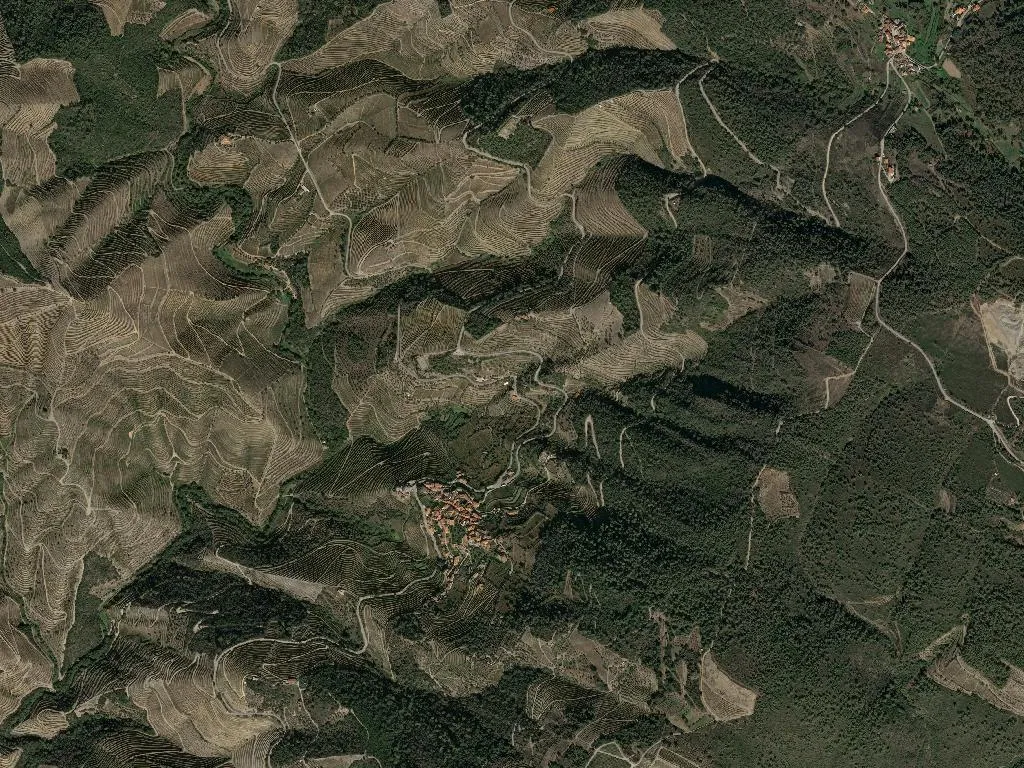
Full article about Gouvinhas: Stone Granaries, Bitter Acorns & Tinta Echoes
Granite coffers, oak-capped chapel and Touriga vines cling to the Tedo’s schist shoulders.
Hide article Read full article
The granite of the Gouvinhas granaries keeps a low, slow heat—nothing to do with the afternoon sun, simply the afterglow of every bare foot that has crossed the threshing floor. Fifty-odd stone canasters stand in staggered rows, each casting its own slim shadow, each family name still chiselled into the block like a deed. My grandfather swore maize slept better in that moving air than in any marital bed. When the wind climbs the Tedo valley it brings the smell of crushed vine leaf, shredded schist, and—if you catch it right—chestnuts scorching on a hillside brazier across the ravine. The Gouveio grape has vanished; only the syllable survives, clinging to the lips of anyone over seventy.
Church, chapel, oak
St Martin’s is barely a chapel, yet its gilded retable ignites at four o’clock each afternoon, a theatrical flare that dies the moment the sun drops an inch. Above the village the Capela da Azinheira is reached by a gradient that tightens the lungs like a screw. Legend claims the Virgin was found wedged inside a holm oak that still drops acorns edged with bitterness—bite one and the tannin confirms the story.
River, rock, red
The Tedo is narrow, opaque, and unexpectedly deep. Mid-span on the single-lane bridge one slab has been polished glass-smooth by centuries of boot leather; lie on it and the clouds slide past like slow frames of cine-film. The irrigation channels that once fed rye and terraced vines now carry only wild sorrel and Iberian water frogs. No one has diverted a current since the 1970s, yet the right-hand leat stays alive: village children learn to swim there, fingers hooked around bulrush stems.
Vinha da Raposa was old long before “old-vine” became a marketing handle. The trunks flex like beggars’ arms, yielding barely a crate per row. Taste the berries and you bite schist and winter rain; the resulting wine is poured in thimble-sized glasses, gritty enough to rasp enamel. Textbooks call it Touriga Nacional; here it answers to tinta de morto—reds that drop a man before they touch his soul.
Up the hill with the village
The Romaria da Azinheira happens on the Sunday after 8 September. It begins with a cigarette struck outside the café, ends with an accordion whose tuning succumbs to altitude. Pilgrims on crutches refuse lifts; they finish the climb or know the reason why. In May the procession carries bread and watered wine; in August cauldrons of pig’s blood and onion bubble beside firewater that burns hotter than the pyre. St Martin’s Day (11 November) is the moment chestnuts detonate inside oil-drum lids and the new wine still foams—if it doesn’t, the year is suspect.
Inside the pop-up tabernas you part a bead curtain of smoke. Kid goat turns on a spit, fat hissing onto ember, laughter ricocheting off the ceiling beams. Chanfana demands three days: one to slaughter the goat, one to drown it in red, one to forget the deed. Alheira sausages are nailed to hoe-handles hardening like wood-fired masks. Cornbread arrives in slabs heavy as guilt; split open, it steams longer than the log pile.
The espigueiro trail starts where asphalt gives up. Five kilometres of loose granite will blister anything lighter than a hiking boot. From the ridge the Tedo performs a goose-neck bend, terracotta roofs layer like fish scales, the church tower points toward a heaven no scheduled flight crosses. Griffons occasionally appear; more often it is the blunt silhouette of a vulture quartering the aftermath of the autumn slaughter. When the sun slips behind the Marão the granite still radiates, holding the day a little longer, reluctant to let night reclaim Gouvinhas.