Full article about Sabrosa: Where Granite Cellars Breathe Fermenting Wine
At 528 m, Sabrosa’s medieval lanes still echo with 1756 harvest rites and Marquês de Pombal’s bounda
Hide article Read full article
At 570 m, the air itself is wine
Before sunrise, the scent of fermenting must drifts up through the granite cellars of Sabrosa’s medieval core. By mid-September the slope-sided baskets appear, wicker bruised purple, and the third Saturday brings bare feet onto the stone lagares in a cadence unchanged since 1756, when the Marquês de Pombal’s boundary stones first ring-fenced what would become the world’s oldest demarcated wine region. The village – population 1,130, altitude 528 m – does not merely produce wine; it inhales it.
The charter that made a village into a broker of barrels
Afonso Henriques’ 1182 royal charter elevated Sabrosa from hamlet to market town, granting it the right to levy tolls on every pipa that left the quays for Porto and, beyond that, the England of Henry II. Inside the parish church – rebuilt 1721-37 – gilded baroque retables frame the 1742 contract that paid 120 tuns of red for the blue-and-white tiles behind the altar. Walk Rua Direita and the granite coat-of-arms above No 32 still shows three golden vines on an azure field: António Morais Pimentel’s 1687 export licence for London-bound claret. The pillory, re-erected in 1932 on its 1514 base, marks the spot where São Martinho’s autumn fair once traded 500 barrels in a single afternoon.
Caterpillar presses and 4 a.m. deliveries
Quinta do Crasto’s 1615 lagar still turns: a wooden caterpillar gear that crushes four tonnes of fruit an hour. When the granite steps begin to glisten, juice runs into 1,200-litre stone troughs and the night shift at the Mendiz co-op weighs in – 200 tonnes before dawn, Touriga Nacional and Tinta Roriz hauled off 350 ha of schist terraces that tilt between 200 m and 600 m above the river.
Three feast days, one village
On the Sunday after 8 September, 3,000 people climb to the 1575 chapel of Nossa Senhora da Azinheira, built around an ancient oak. Temporary wooden awnings dispense 800 litres of lamb broth and 1,200 sugar-dusted farturas before midday. Mid-May brings the three-kilometre procession of Nossa Senhora da Saúde, farmers slipping heirloom corn seed into priest-blessed satchels as they walk. New Year’s Eve belongs to the janeiras: pairs of singers (never an odd number, never fewer than six) leave Casa do Pesso de Sá at 21:00, finishing 47 doorsteps later at 04:00, their verses reciting the previous year’s yields: “In twenty-three, three pipes to the hectare…”
Dinner with a 900 g view
O Lagar’s wood-fired oven roasts 45-day-old kid from 14 surrounding farms – six kilos, give or take, served with April-planted seed potatoes. The feijoada transmontana is measured per diner: 400 g of Babaçal red beans, a 30-percent-wheat alheira from Mirandela, and 60-day-cured pork chouriço. Across the square, Sabrosa Tinto’s posta mirandesa arrives as a 900 g slice of mature beef, grilled fourteen minutes over oak embers and dressed with olive oil pressed in Alijó. End with the local sponge: a twelve-yolk pão-de-ló, recipe lifted from Vila Real’s 1732 Franciscan convent, baked 50 minutes in a wood oven.
Terraces that outrun the eye
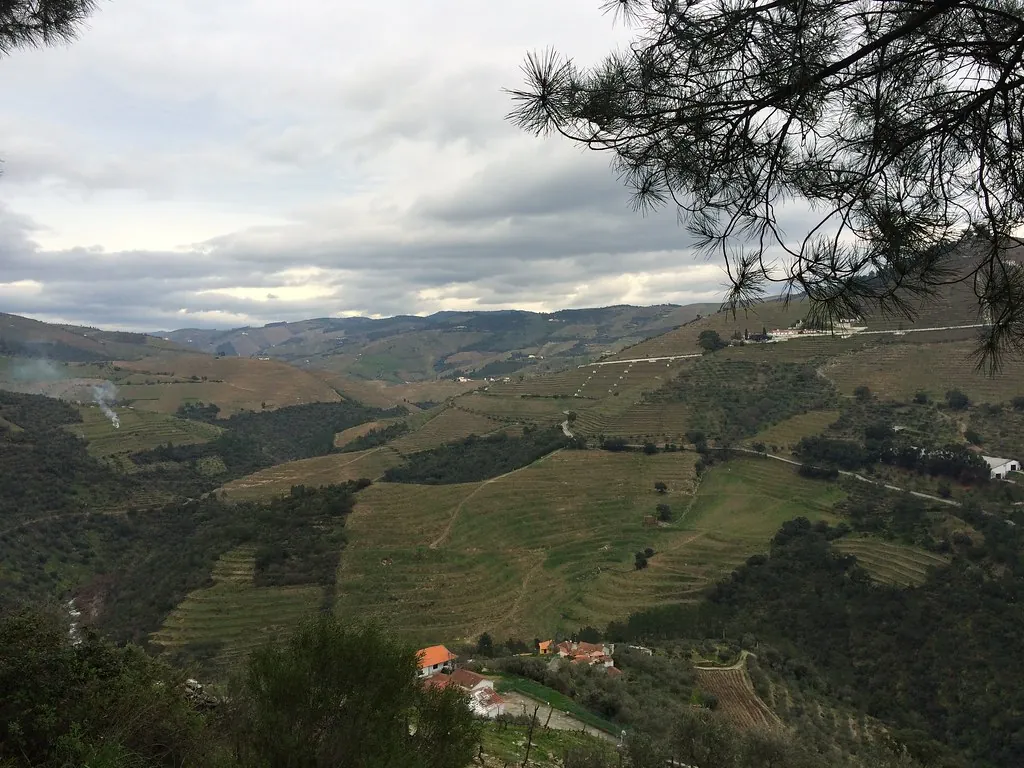
From São Domingos viewpoint at 640 m, 1,200 ha of walled terraces spill downhill to the Pinhão confluence. Dry-stone retaining walls – 86 km of them, begun in 1761 – stripe the slopes like grey contour lines. The PR1 footpath (8.3 km) threads past Quinta da Veiga, in the same family since 1615 and now bottling 180,000 bottles of reserva a year. At 18:00 on an October evening, when the sun slips behind the Marão ridge, the shadows realign into the identical geometry etched on Pombal’s 1758 cadastral maps.
Night settles; 47 quinta windows glitter where boundary lanterns once marked the 1761 land registry. Wood smoke drifts through the lanes, mixing with the cool, yeasty breath of 23 cellars held at a constant 12 °C – granite, grape and oak, the scent of Sabrosa ever since the Romans planted vitis vinifera here two millennia ago.