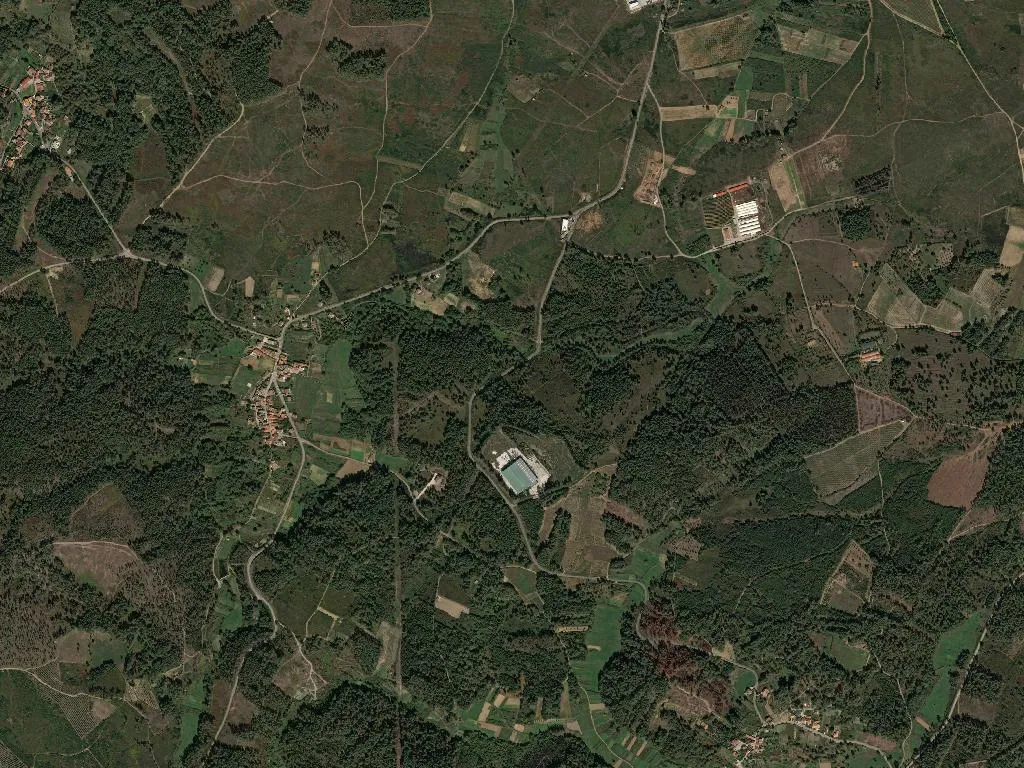
Full article about União das freguesias de São Martinho de Antas e Paradela de Guiães
Presunto bísaro curing in mountain air above 5,000-year-old dolmens
Hide article Read full article
The slow smoke of morning
A thread of smoke climbs from the chimney, sketching pale spirals into the cold morning. Indoors, scarlet blades of presunto bísaro dangle from chestnut beams, their surface crystallised by months of mountain wind. At 615 m, the unified parish of São Martinho de Antas e Paradela de Guiães inhales and exhales with the terraces of the Alto Douro: schist shelves that rise and fall like frozen waves, each wall a hand-stacked reply to gravity.
Two villages, one memory
The civil parish merger of 2013 only rubber-stamped what geography had long decided. São Martinho de Antas takes its name from the neolithic dolmens still found among the vineyards – granite tombs erected four millennia ago when death demanded architecture. Paradela de Guiães means literally “the stopping place on the River Guiães”, the Tâmega’s brisk tributary that once powered watermills and now irrigates small vegetable plots. Both settlements have answered to the Douro’s wine bureaucracy since the 1756 demarcation; their economies were recalibrated by the 18th-century British taste for port and the subsequent gold-rush for brandy.
Five minutes above the village, the rural hotel Anta occupies a 19th-century manor whose garden ends where a grassed-over burial mound begins. Breakfast is taken within sight of a 5,000-year-old tomb – a reminder that the region’s habit of ageing things slowly predates oak barrels.
Calendar of processions and pork fat
Time here is kept by romarias. On the last Sunday of May, the faithful walk three kilometres from the parish church to the hilltop chapel of Nossa Senhora da Azinheira, following a brass band and a statue wreathed in yellow broom. In mid-August it is the turn of Nossa Senhora da Saúde, when the procession detours through the vineyards so the priest can splash holy water on the vines. Temporary tables appear beneath the plane trees: linen printed with faded lilacs, glass jugs of red wine that stains lips a violent violet, and thin sheets of smoked ham carved so translucently you could read the Douro sun through them.
The ham is Presunto de Vinhais IGP, made from black Bísaro pigs that spend autumn foraging for acorns in the oak and chestnut forests above the village. Salted by hand, cold-smoked over oak or chestnut for days, then hung for at least eighteen months, the final flavour is a balance of resinous smoke, dried porcini and something metallic – the taste of a wet hillside at dawn. Locals serve it simply, with warm broa de milho (corn bread) and a glass of brisk white from the high-elevation Rabigato grape. Luxury is irrelevant; the pairing is an act of geographical logic.
Between vines and a forgotten mine
Footpaths weave eastwards into the tributary valley of the Rio Torto, a Douro支流 whose name – “crooked river” – describes its habit of doubling back on itself. The terraces narrow to shoulder-width, interleaved with olives and gnarled orange trees that survive winter frosts by hugging stone walls. Halfway to Paradela the track passes a padlocked adit: the Mina da Senhora da Azinheira, registered in 1937 for wolfram and tin. Production never justified a railway siding, but elderly villagers remember the clatter of hand-held drills and the smell of carbide lamps that once drifted over the vines at dusk.
Walk the old mule route between the two settlements at siesta time and the only sounds are a trickle of unseen water and the metallic click of a distant pruning shear. Schist crunches like brittle toast underfoot; every second terrace wall contains a fossilised sea shell, proof that the Douro was once an inland ocean.
Stone and vine, staying
When the sun slips behind the Marão ridge, shadows pour down the terraces like dark wine. The air cools quickly; wood smoke settles in the hollows. In a parish where pensioners outnumber primary-school pupils three to one, the landscape speaks more often than its inhabitants. What it says is uncomplicated: that ham, vine and wall are three dialects of the same language – ways of remaining when everything else departs.