Full article about Louredo & Fornelos: Where Time Flows Like the Aguilhão
Roman kilns, vineyard terraces and a 1998 river-beach cooled by mountain water
Hide article Read full article
The Aguilhão keeps its own clock
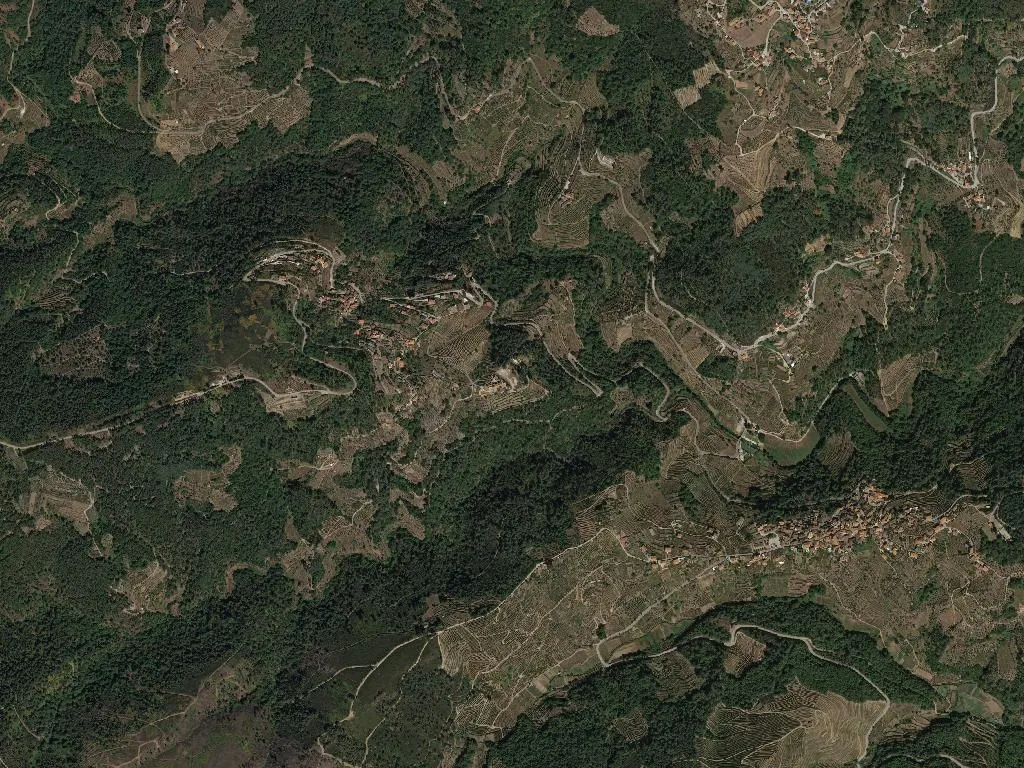
The stream moves as if it has already been everywhere and found no reason to hurry. Between slate ribs and granite knuckles it slides, willows leaning over to deal a hand of Sueca in the shade. São Cristóvão’s bell counts the hours like a neighbour who taps his watch only to confirm it isn’t four o’clock yet. Below, the valley folds itself into a natural amphitheatre where vineyards climb in disciplined rows, each terrace shouldering the next like villagers queueing for bread.
Two millennia baked into brick
Beside the river-beach a Roman kiln lies half-cradled in grass. No QR code, no ribboned stanchion—just a circle of bricks that have outlived empires and still smell faintly of the last fire that fed them. Those bricks coined the name Fornelos—“little ovens”—and already appeared in the 1220 royal inquiries, listed between tithes and olive groves without fuss. Above the water, São Cristóvão’s church was built for posterity, not fashion: eighteenth-century gold leaf so thick it looks wet, a painted ceiling where saints mutter, “Slow down, Marco, what’s the rush?” Its twin in Fornelos repeats the refrain—carved, gilded, unapologetic.
Vines, schist and a beach that remembers 1998
At 425 m the vineyards have front-row seats to the Douro without the price tag. Dry-stone walls press the terraces into the slope; moss colonises faster than gossip spreads. Morning sun heats the schist, dusk draws the warmth back out, releasing a waft of rosemary no one planted. The river-beach—created in 1998, lengthened in 2012—remains stubbornly domestic: towels flap like back-garden sheets, children engineer stone dams that survive until someone’s mother calls out. The Aguilhão’s water is cold enough to reboot the mind; the bar pours chilled white into tumblers that could survive a meteor strike. Network coverage vanishes with the first toe in the river.
Smoke-cured Sundays
In the tascas, Vinhais ham arrives sliced to translucency; hold a plate up and you can read the day’s menu through it. Cornbread, still warm from Dona Alice’s oven, and olives that taste unmistakably of Sunday set the rhythm. Feijoada transmontana comes in a clay pot that shifts if you stare too hard. Douro red doesn’t ask permission—it pulls up a chair and stays until the conversation turns to tomorrow.
The Festa de São Pedro is a straightforward equation: procession, Mass with an accordion that flatters no key, fair lights recycled from December. Sardine smoke drifts across the square, wood-smoke climbs the hill, and a concertina keeps strict time until the last pair of feet can manage the three-step turn.
When dusk finally settles, the Aguilhão stores the vineyard reflections like a family secret. You leave with ham on the tongue, smoke in the fibres of your shirt, and the certain knowledge that coming back is simply a matter of when, not if.