Full article about Algeriz: Walking the Granite Breath of Trás-os-Montes
Stone hamlet at 514 m where wind-cured ham and silence outnumber people
Hide article Read full article
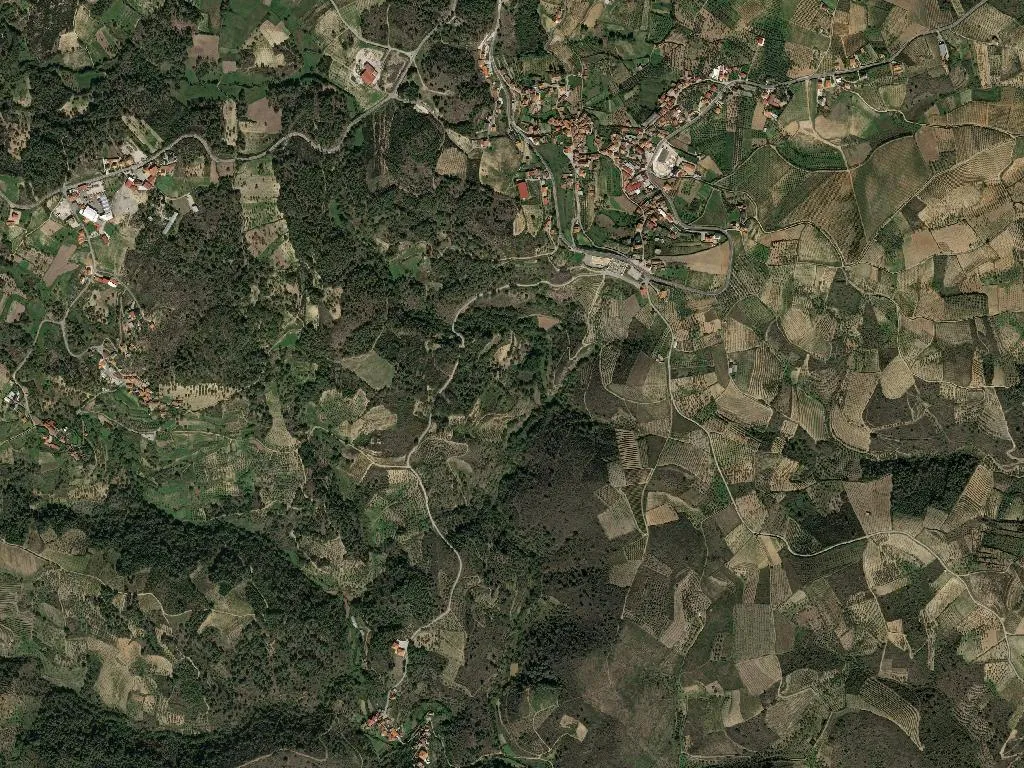
The cobbles rasp beneath your shoes. In Algeriz, silence has body: 502 people breathing across twenty square kilometres of Trás-os-Montes plateau at 514 m, where the wind arrives from Spain tasting of wood-smoke and cold iron. Two bell towers rise above the slate roofs like exclamation marks on a sentence that otherwise runs in long, low horizontal lines over the fold of the hills.
Stone that out-waits us
Both of the parish’s listed buildings are built from the same grammar: granite laid dry or bound with lime, corners trimmed by weather rather than by ornament. Walls are 80 cm thick—summer cool, winter furnaces—doorways just tall enough for a 19th-century ploughman in clogs. You walk slowly here not because distances are great—nothing is more than ten minutes away—but because the ground itself discourages haste. The gradient, the altitude, the way sound carries: they conspire to reset your internal metronome to “processional”.
The arithmetic of absence
239 residents over 65; 29 under 15. Those are the only statistics that matter. Yet the same numbers can be read backwards: Algeriz is an open-air archive of muscle-memory—how long to salt a haunch, how many turns of the cloth squeeze the whey from Terrincho curd, when the chestnut bursts its shell without scorching. Knowledge that lives in the ulnar nerve rather than in print.
What the plateau puts on the table
Nothing here begins with a chef’s whim; everything starts with geography. Folar de Valpaços IGP, the Easter loaf scented with cinnamon and pig fat, goes into the wood oven while the sky is still Martian-blue dawn. Presunto de Vinhais, haunches salted the day of the November matança, loses 40 % of its weight to the plateau’s freeze-dry wind, emerging ruby, almost translucent. Terrincho DOP, made from the milk of Churra da Terra Quente sheep, tastes faintly of thistle rennet and pepper; a warm corn-bread muffin lifts the flavour into something almost shocking. Chestnuts from the officially demarcated Terra Fria zone are buried in ash until they crack like champagne corks, revealing cream the colour of parchment.
Carne Maronesa DOP—burgundy-coloured beef from animals that graze the common at 800 m—simmers in cast-iron with nothing more than garlic and bay until a spoon will suffice as a steak knife. Cabrito Transmontano DOP is roasted in a bread oven fired with ilex, the skin blistering into bronze shards that shatter at first bite. Even the potatoes carry altitude in their DNA: Trás-os-Montes tubers grow so slowly they develop a waxy density that holds together under hour-long braises. Dessert is honey from the hot country to the south, dark as bitter ale, its aftertaste of rosemary and heather still buzzing when you go to bed.
Sleeping inside the hush
Three granite houses take guests. No playlists, no yoga decks, no “experiences”. Instead: absolute dark, a dog barking two valleys away, the sudden whip-crack of an owl. Summer nights are cool enough to leave windows open; morning arrives with rooks and the smell of dew on schist rather than with an iPhone chorus. You wake when you wake—usually to the distant bell that simply notes the hour, never hurries it. By late afternoon the west-facing stone glows the colour of set honey; a hen investigates your shoelaces. Somewhere bread is proving for tomorrow. And you realise the place hasn’t slowed you down; it has merely allowed your own cadence to re-emerge, like a stream freed from a dam.