Full article about Canaveses: granite hamlet clinging to the sky
Canaveses (Valpaços, Vila Real) is a 17-house granite village above the Rabaçal valley, where smoke-cellar hams, abandoned gardens and 90-year-old Dona Aur
Hide article Read full article
The road tilts, then delivers
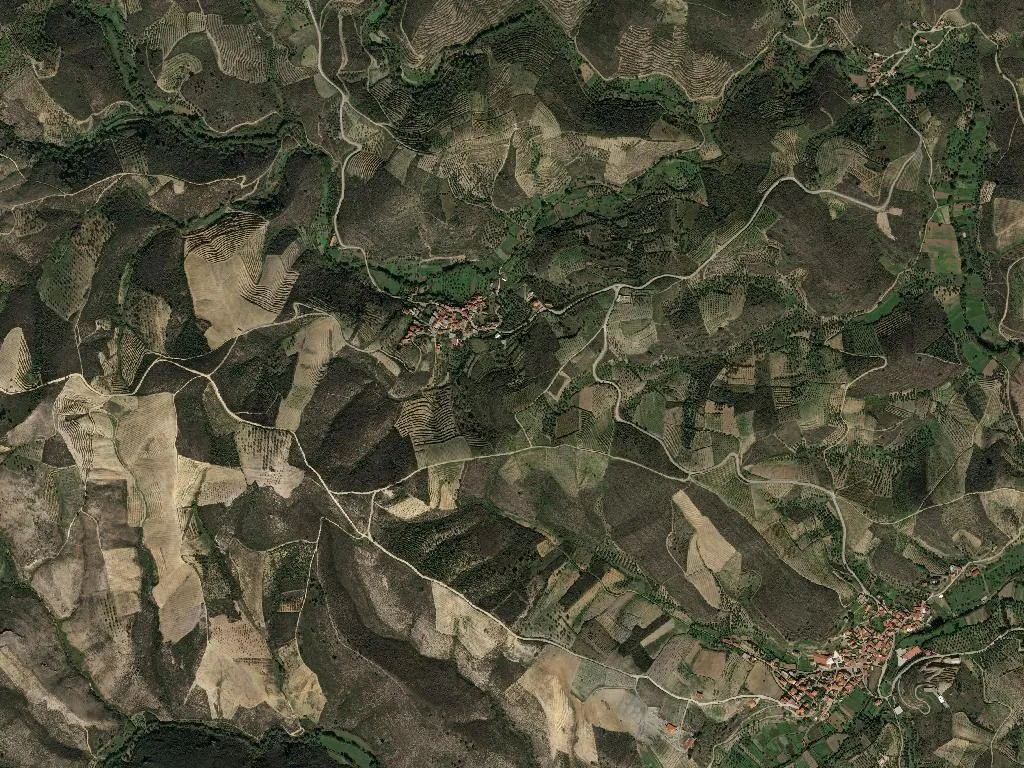
The tarmac climbs through pine and eucalyptus until you doubt it has anywhere left to go, then suddenly releases you into Canaveses: seventeen granite houses soldered to a 444-metre slope above the Rabaçal valley. One chimney is still breathing; another doorway is ajar and inside a man barks “Sim, senhor!” into a 1990s cordless. The parish head-count is 170, but on the ground that translates to four under-tens, ninety-odd pensioners and a floating population who time their visits to the Tuesday/Friday Intermarché run in Valpaços, 17 km away.
Land of few, remembered by many
There is no café, no bench, no newspaper rack. What exists is a chapel (Santo António, 1693), a spring where 5-litre bottles are filled on Sunday afternoons, and the parish granary whose upper room occasionally hosts Dona Aurora’s 90th-birthday dinner. She still peels tangerines faster than most people text. Empty dwellings outnumber occupied ones, so João-Baptista—blue motorbike, always parked facing downhill—has copied keys for seven ruins and listed them on OLX: “weekender potential or decent tool shed”. Behind the walls, gardens survive without their owners: goat-footed vines, medlar trees that taste like every childhood you never lived.
A smokehouse for a library
Do not ask for a menu. Mondays mean leftover cozido; Tuesday re-heats it; Wednesday is feijoada only if the pig was killed the previous Saturday. The smoke-cellar belongs to Maria Alice. She unlatches the door and the aroma hits like a bouncer—enter, but don’t loiter. The hams are bísaro, Celtic pigs that grazed the opposite oak ridge; the honey comes from a high-slope beekeeper in neighbouring Celeiró. Ask him the secret and he shrugs: “Never let the bees know you’re about to rob them.” There is no restaurant, yet if you arrive as the bread is torn there is always space for one more plate. Bring appetite; don’t mention gluten.
Landscape that refuses adjectives
Leave the tarmac at the Pipa fountain, follow the stone track until you reach the wall where Xico left his hoe to rust. From the crest you see rye flexing like swell waiting for a surfer, an oak grove that still feeds the village spring, and Canaveses below—an abandoned pumpkin-button on a blue enamel plate. No fingerposts, no selfie-sticks, no sunset yoga. Just wind that finishes your sentences for you, and winter air that doubles the life of a cigarette.
The weight of the almost-empty
When the sun drops behind Santo António the stone glows the colour of heather honey and even the Loura’s dog falls silent, as if watching free television. That is the hour you understand: Canaveses is not a place for holidays; it is a place for people who no longer need to be anywhere else. A hinge creaks, a cat slips through the shadows, Dona Aurora switches on the kitchen bulb and her silhouette becomes a silent film projected on whitewash for the two-hundredth night running. And everything is fine: the world keeps racing down in the valley, while up here the granite, the smoke, the memory remain—along with João-Baptista, who still hasn’t found a buyer for the third house but has had another set of keys cut, just in case.