Full article about Lebução, Fiães & Nozelos: wind-carved villages of Valpaços
Bronze-age hoards, dry-stone bridges and granite hamlets breathing oak-smoke above the Tinhela
Hide article Read full article
The wind that smells of wet earth
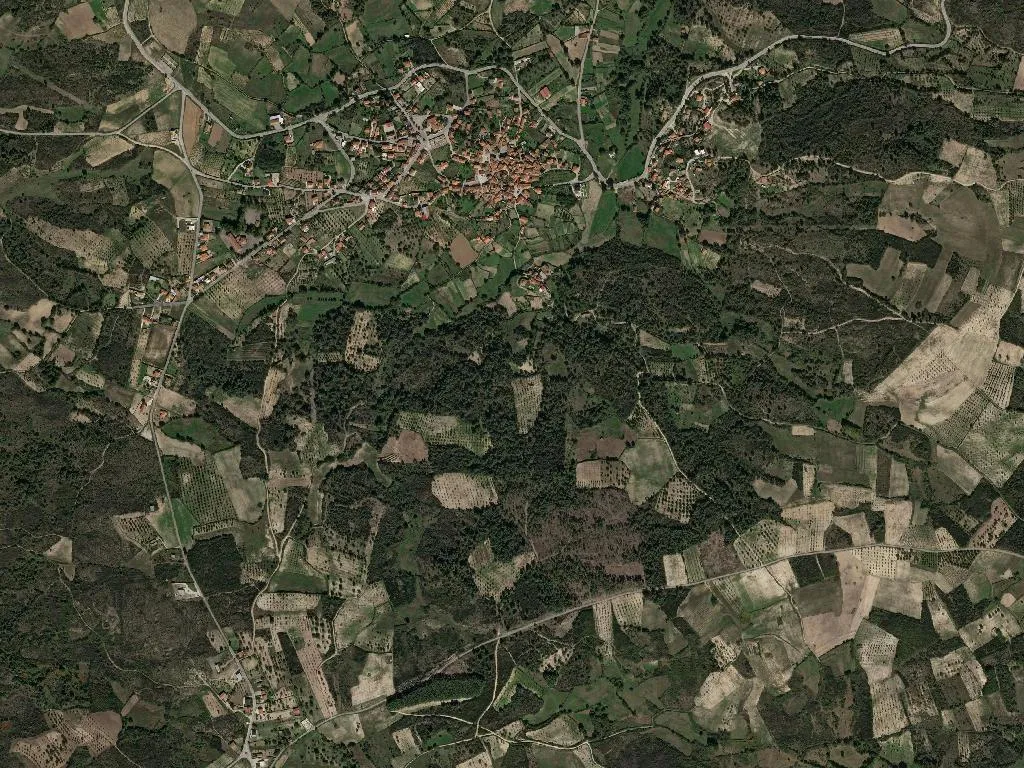
The wind climbs out of the Tinhela valley carrying the smell of wet earth, oak and wood-smoke. At 685 m the granite breaks through the terracing and the houses settle into three hamlets — Lebução, Fiães, Nozelos — yoked together in 2013 by a municipal pen-stroke, yet linked for centuries by the same roll of land and the memory of a castle that no longer exists. Population 548, density 18 souls per km²: a territory measured by silence, by the delayed echo of a bell, by the slow scrape of boots on uneven cobbles.
Bronze-age bling
Late in the nineteenth century the Cabeço da Mina spoil-heap yielded a set of iron jewellery speaking fluent Celtic ornament — the so-called “Lebução Hoard”, now in Lisbon’s National Archaeology Museum. No sign points to the spot, yet its presence pins the parish to the Late Bronze and Iron Ages. Above, the wrecked keep of Monforte castle — an advance post against Castile listed in the 1258 Inquiries — stares down the valley. The first tenants were excused the sales tax in return for manning the walls; when gunpowder made the place redundant the settlement slid downhill to Lebução, which briefly served as the county seat between 1836 and 1853.
Three villages, one river, dry-stone bridges
The River Calvo divides Lebução from Fiães, spanned by bridges that have survived since the royal road from Chaves to Bragança thundered with pack-mules. At Pedome one arch remains perfect, its joints hairline, the masons’ chisel-marks still visible where they locked the stones without mortar. Lebução’s parish church, rebuilt in the nineteenth century round a baroque retable salvaged from its predecessor, stands at the village core; in Nozelos the chapel of St Anastácio and a stone cross on Rua do Pêro still pace the devotional calendar. Fiães keeps its medieval tag “Sancti Michaelis de Feanes”, inked on twelfth-century parchment. There are no blockbuster monuments, only continuity: granite shrines, schist walls, lime-wash that weathers the Transmontano winter.
Smokehouse, oven, Easter loaf
Here gastronomy is not theatre but subsistence refined into flavour. At Easter the communal ovens release Folar de Valpaços IGP — a brioche-style loaf layered with cured sausage and pork — while tables groan under thick rashers of Vinhais smoked ham IGP and maronesa beef DOP. In the smokehouses chouriças and salpicões swing from the rafters; in the cellars Trás-os-Montes red matures in clay talhas. Cabrito Transmontano DOP kid, roasted over vine-prunings, and pungent semi-soft Terrincho DOP sheep’s cheese fill a larder still ruled by the seasons and the hand. Cold-land chestnuts DOP, gathered from the surrounding groves, appear in soups, stuffings and desserts.
The arithmetic of leaving
Of the 548 residents counted in 2021, 267 are over sixty-five; only thirty-five are under fifteen. Lebução school closed in 2016, joining Fiães (2009) and Nozelos (2012). Vegetable plots are still hoed, cattle graze the water-meadows, summer festivals haul emigrants back from Paris and Neuchâtel. Nearly 3 000 ha of broom, maritime pine and oak slowly swallow the abandoned dwellings, yet dirt tracks still lead to springs, frozen water-mills and improbable look-outs over the Tinhela.
When the afternoon drops and the raking light ignites the schist, hearth-smoke rises — vertical, dense, smelling of resin and memory. It is that smoke, more than any brown sign or heritage trail, that returns Lebução, Fiães and Nozelos to the map of places where the essential is still measured in gestures, not words.