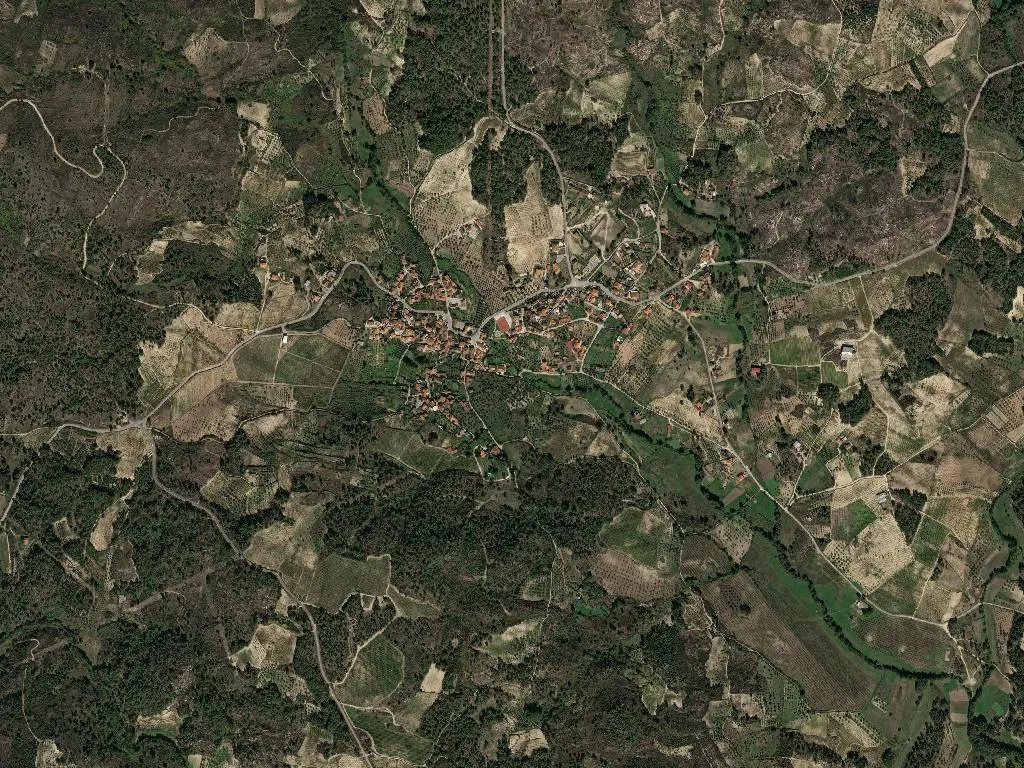
Full article about Santa Valha’s granite lagares still hold Roman grape juice
Walk the rock-cut wine tanks, hillfort and 1657 church where coins of Antoninus Pio surface
Hide article Read full article
Sun-warmed granite and stone-pressed wine
At midday the granite gleams almost black, burnished by two millennia of bare feet, donkey hooves and boot leather. In the lagares rupestres – rock-cut treading tanks – of Santa Valha, the stone still carries the shallow dip where grapes were crushed underfoot and the groove that funnelled the must into the adjoining basin. Twenty-nine survive, the largest concentration in Portugal’s Terra Quente Transmontana, scattered among gorse and low vines, each a tacit witness to someone between the first and fourth centuries balancing on the lip to fill amphorae under this same sky.
Stone that remembers
Above the village, a pre-Roman hillfort keeps a fragmentary wall among heather and scree. The parish church rose here in 1657, Abbot Nuno Álvares re-using earlier footings: anthropomorphic tombs chiselled into the bedrock, shards of red pottery, a coin of Antoninus Pio dropped eighteen centuries ago. The churchyard exudes history without flourish – baroque carving inside the side chapel, the Solar dos Ciprestes bearing the 1653 coat of arms of Gonçalo de Morais, lime-washed walls throwing back the high light of Trás-os-Montes.
Lower down, the Pedregal do Canamão defies geology: 2,500 m² of dark granite blocks heaped without accepted explanation. The silence is thick, slit only by lizards skittering through the fissures.
Smokehouse, cheese and folar
Santa Valha’s kitchen needs no garnish. Terrincho lamb roasts in an oak-fired bread oven, fat spitting onto the tray; kid grills slowly, scented only with coarse salt and crushed garlic. On the table, doorstop slices of Valpaços folar – sweetish loaf layered with smoked meats, dense and damp – sit alongside cured Terrincho DOP cheese and Vinhais IGP ham, hand-cut and translucent. Autumn chestnuts from the neighbouring Terra Fria thicken soup; Transmontano potatoes bulk the cozido that bubbles for hours in a black iron pot. The local high-altitude red pours rough and frank.
Trails between tanks and streams
The signed “Lagares de Santa Valha” footpath loops five kilometres through vineyards and olive terraces, linking the rock tanks to the hillfort and the old transhumance routes. Streams spill from the Serra do Alvão, their crystalline water once turning stone millwheels that now spin loose in ruined mills. In the valley, the chapel and cemetery of the vanished hamlet of Calvo stand among brambles – all that remains of a settlement that once boasted a communal bread oven and a tungsten mine, emptied when its men left for France in the 1960s.
The village folklore group still rehearses the cantigas ao desafio – improvised duet singing – and Transmontano circle dances, but you must book ahead. Monthly livestock and craft fairs ended in the 1980s when the town hall demanded paperwork no one knew how to complete. Today the 317 inhabitants – 150 of them over sixty-five – keep the memory of lagares, hillforts and coats of arms to themselves.
At dusk the granite cools quickly, yet the fissures still hold the day’s heat. Lay a palm on the slick stone and you feel the precise weight of two thousand years.