Full article about Santiago da Ribeira de Alhariz: where chimney smoke stitches
Santiago da Ribeira de Alhariz hides in Trás-os-Montes mist, its unmapped sheep tracks, stone mill and iron-rich beef waiting beyond billboards.
Hide article Read full article
The chimney that draws its own horizon
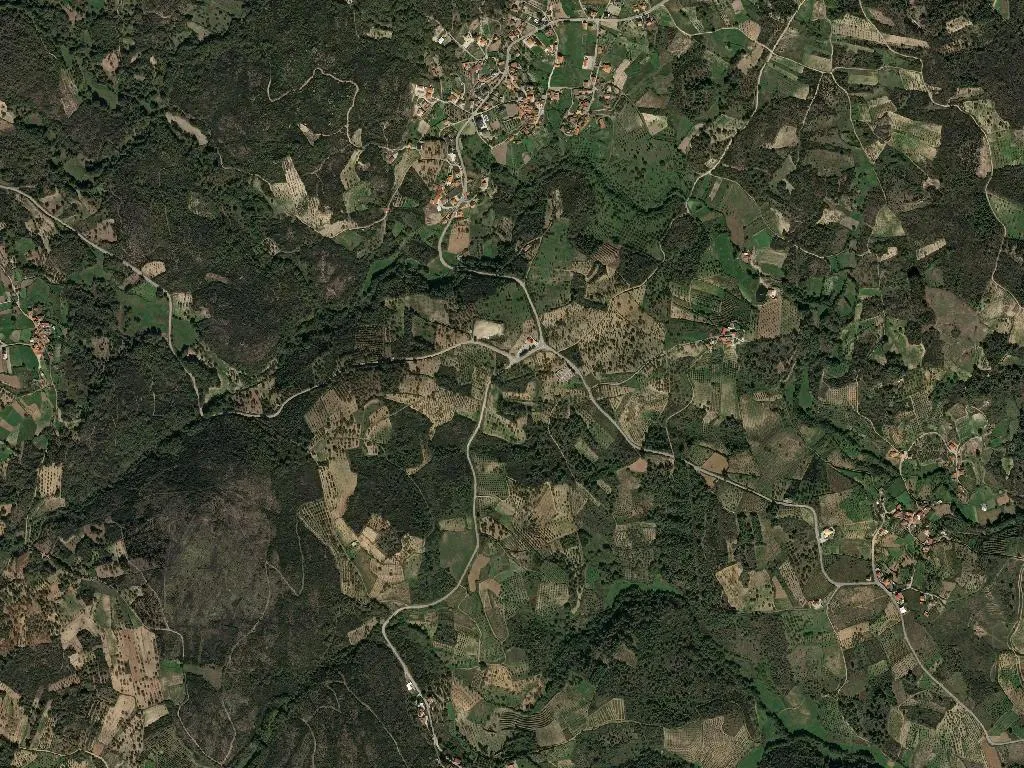
Wood-smack rises dead-straight from the chimney, inking a charcoal line against the pewter sky of a Trás-os-Montes morning. Below, the land falls in pleated terraces to the Alhariz stream – rye stubble the colour of wet tobacco, dark olive knots bent by the Atlantic wind that barrels across the 663-metre plateau. Santiago da Ribeira de Alhariz arrives without billboards or brown signs: you read it first in schist walls and the smell of damp soil, then in the sound of water turning a small stone mill.
The stream that named the place
Alhariz means “cold water” in the older tongue, and the stream keeps its promise even in July. It fed Iron Age farmers, Roman wayfarers bound for Braga, medieval mule trains hauling salt and saffron between the Douro and Galicia. The parish charter was granted in 1283, when Portugal was still a frontier kingdom whose bishops rode armed. Today the water turns only one working mill, yet 503 souls still divide their labour between potato rows, chestnut groves and the Maronesa cattle whose forelegs carry the white birthmark of Iberian aurochs.
What lunch tastes like when the land is high and thin
The kitchen here distils, rather than invents. Carne Maronesa – dark, almost purple beef from animals that wintered above 1,000 m – is simmered with Trás-os-Montes potatoes whose yellow flesh smells faintly of chestnut. On feast days the air outside the chapel is lacquered with the fat of Borrego Terrincho, its pink meat sweetened by heather and broom. After the bells, slices of Folar de Valpaços – bread freckled with chouriço – are pocketed for the fields, while wedges of Queijo Terrincho, aged in rye straw, scrape the palate clean. Dessert is a spoon of honey from the Terra Quente, where orange blossom begins a week earlier than on this frost-prone ridge.
Walking where no one has printed a map
There are no way-marked loops, no QR codes on gateposts. Instead, sheep tracks stitch the valley to its neighbours – Vales, Selhariz, Água Revessa – through corridors of oak and winter heliotrope. Follow the Alhariz upstream until the gorge narrows and you will find an Iron Age castro watching the same bend where 19th-century smugglers once swapped coffee for linen. The only soundtrack is the squeak of damp leather and, every half-hour, the single bell of Santiago’s church tolling for the elderly who still count the day in canonical hours rather than smartphone time. Population density: 23 per km², measured in echo.
What remains when the car turns the bend
No gift shop will sell you a fridge magnet. Instead you leave with the granite grit that lodged in your palm while you levered open a kissing gate, the resinous after-breath of a mill-fire fuelled by old vine roots, the metallic taste of stream water cupped in your hand. More than half of the 503 residents are over 65; they have memorised every stone wall like a line of poetry they refuse to forget. Come back in a decade and the wall will still be there, possibly with another stone added, possibly with the same woman in black balanced on it, scanning the valley for her neighbour’s goat. Santiago da Ribeira de Alhariz does not do change; it does persistence.