Full article about Alfarela de Jales: Where Mine Dust Still Clings to Chestnut
Gold seams, granite wind and goat stew—trace a vanished quarry village above the Olo valley.
Hide article Read full article
The Silence Has Body
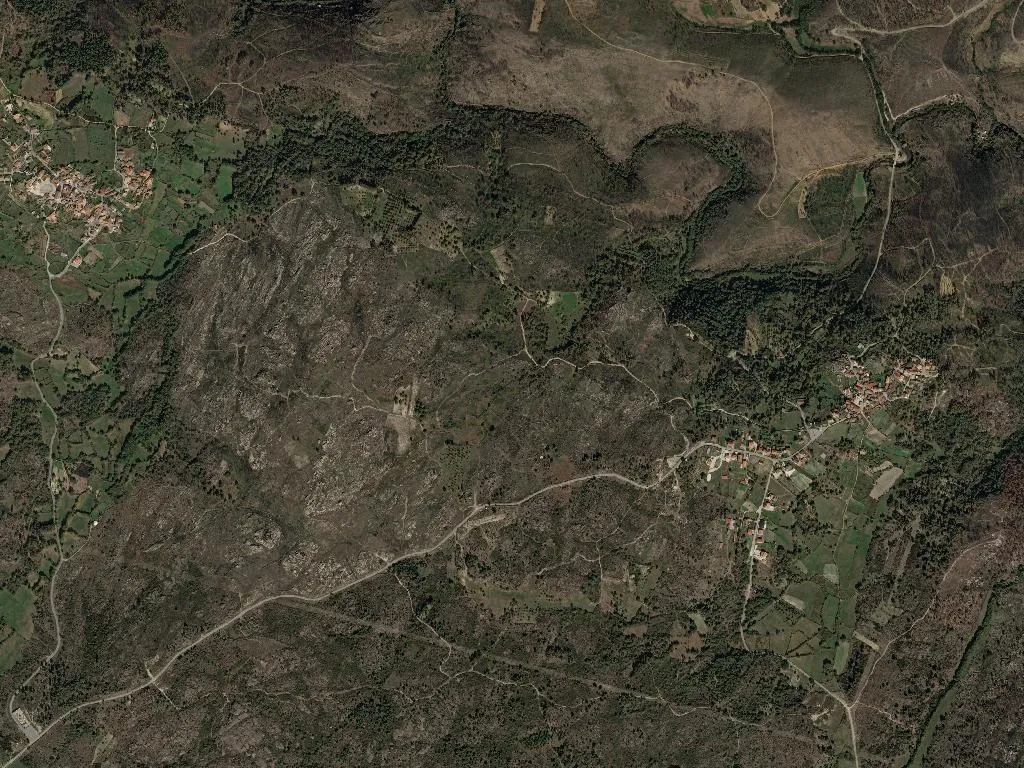
At 773 m the air settles on skin like damp linen. Step outside just after the rain and you can hear granite loosening under your tread while wind combs the chestnut groves, each leaf still carrying the fingerprint of every autumn since your grandfather’s war. When the sun drops behind the Serra do Alvão the light thickens to something you could slice with a pocket-knife; indigo floods the Olo valley as if a careless hand had tipped ink across the paper of the land.
When the Mine Still Swallowed Men
Between 1933 and 1992 a gold seam ran like a vein beneath these slopes and the village coughed up its sons before dawn. They descended before coffee, stomachs hollow, mouths tasting of gunpowder dust, and surfaced at dusk with eyes the colour of rusted iron. Shaft Three took my uncle’s two middle fingers; they never surfaced. Today the Interpretation Centre keeps a replica gallery that smells of sour shale—exactly the mildew that used to walk into our kitchen clinging to my father’s overalls, leaving damp prints on the schist floor.
Time here is sedimentary. Cross the chestnut belt and the Castro de Jales rears up—a rib-cage of granite. Romans camped here, yes, but older voices speak of the “mud people” who lived on the hillside long before bronze reached these hills. Further up, the Fraga do Quelho boulder carries medieval crosses, spiral whirls no archaeologist has decoded, and the initials my cousins and I gouged with a hay-cutting knife one bored August afternoon. The pillory stone now props sacks of harvest chestnuts beside the road to Vila Pouca, yet its capital still bears the faded crown that reminds you Jales once mattered enough to punish.
A Table That Tasted of the Earth
Grandmother’s table was dark chestnut, permanently fragrant with garlic and the ghost of last night’s red. Kid goat arrived not on porcelain but in a black-iron pot, skin welded to the base; we ate with our hands, cracking bones for marrow. The milk-fed lamb came from Zé da Tareja’s field beside the sealed mine-shaft—he swore the grass grew sweeter there, fattened on men’s blood. Friday meant transmontana hotpot: clay vessel sunk in the wood-oven since my parents’ wedding night, the belly-pouch stuffed with fresh blood, corn bread and garden mint—cumin is treason. Dessert was almond tarts thin as communion wafers, honey sliding as slowly as if the hive were still humming.
August, When Silence Takes a Holiday
During the festas the churchyard fills with grandchildren who have acquired Lisbon or Paris vowels; elders recognise them only by the eyes—everything else has been renovated. The reek of roasting goat mingles with the plastic of rented garden chairs, and someone’s Bluetooth speaker strains out pimba pop. Then four o’clock finds the last glass emptied, dogs retreat to doorsteps, and silence reclaims the square like a relative who never actually left.
From the lookout the valley lies stretched like a sleeping body. Lights of the next village blink like tired eyes; a red kite scores perfect circles overhead; the Olo snake-patterns between boulders that once watched Romans, then miners, now only the slow passage of days. When night finally seals the sky the hush grows so dense your own thoughts rustle. And you realise: Alfarela de Jales is not a place you travel to. It is a place that travels with you, lodged somewhere between lung and memory, long after the road has dropped you back to sea-level life.