Full article about Mateus: cedar, baroque stone & rosé moonlight
Palace shadows stretch over Roman graves, cedar scent drifts to Alvão’s quartzite falls
Hide article Read full article
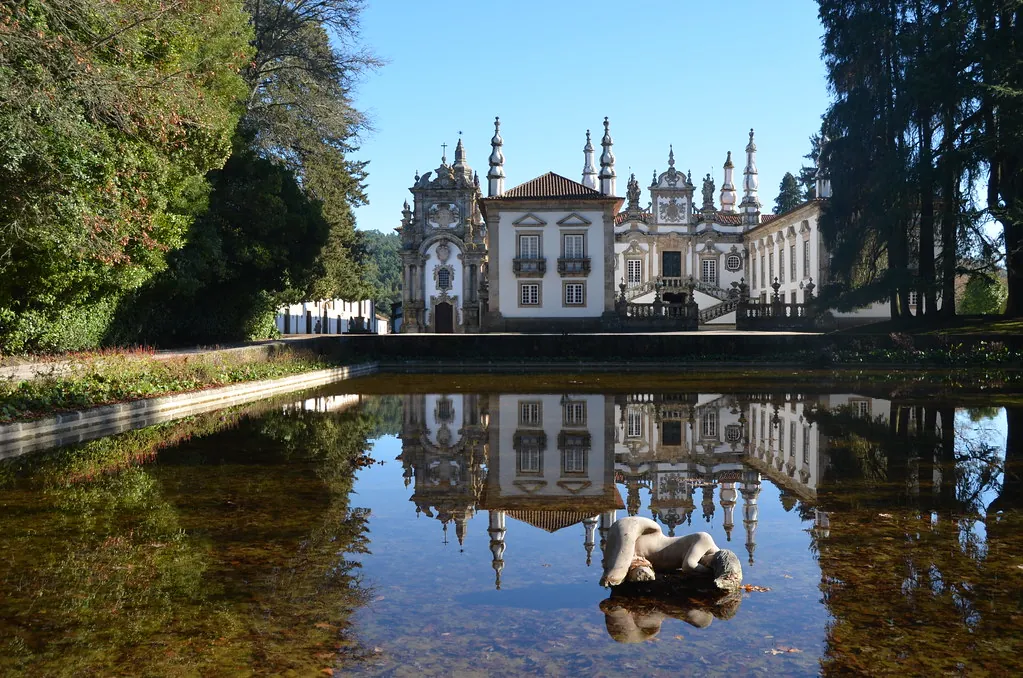
The granite steps exhale the day’s stored heat, and the late sun throws a filigree of baroque shadows across the courtyard. Thirty-five metres above, a cedar planted in 1635 leans imperceptibly east, a living compass pointing toward the terraced vineyards that climb to the edge of the Alvão Natural Park. Water whispers across box-edged tanks; swallows wheel high overhead. Mateus keeps time not by the clock but by waxed timber, glazed tile and stone worked three centuries ago.
A manor that became a label
The parish and the palace have shared a bloodstream since 1620, when António Álvares Coelho entailed the estate and endowed the chapel whose gilded altarpieces still shelter the family’s tombs. The great baroque house itself arrived a century later, commissioned between 1730-40 by João Maria de Sousa Botelho Mourão e Vasconcelos, court noble and deputy to the liberal parliament of 1821. Attribution wavers, yet most fingers point to Nicolau Nasoni, the Italian whose Clerigos Tower rears over Porto’s skyline. Declared a National Monument in 1910, the house became an unwitting pop-culture stamp in the 1960s when the rosé brand “Mateus” adopted its flask-shaped bottle, exporting the silhouette to London trattorias and Manhattan diners alike.
Long before baroque drama, Rome left fingerprints here. The little-known Mateus necropolis – a fenced patch of pasture above the vineyards – has yielded brick-lined graves, smelting slag and a votive altar inscribed to Jupiter, a rarity north of the Douro now displayed in Lisbon’s National Archaeological Museum. The find fixes this 4.14 km² parish – one of the municipality’s tiniest – to the imperial map.
Stone paths and water logic
Alvão’s granite ridges rise directly from the palace gates; way-marked trails follow the Olo river to a sequence of quartzite waterfalls and the mirror-calm pools of Bornes. Closer to the village, the Corgo river drives restored water-mills such as the Moinho do Meio, brought back to working order by the town hall in 2018 and still turned on feast days to grind neighbours’ maize. Between vines and olives, the circular Mills Walk and the Mateus wine route thread past drying racks for chestnuts and vegetable plots fenced with blue hydrangeas. The Portuguese interior leg of the Camino – the Via Lusitana – crosses the parish, ushering pilgrims through the tiny chapel of São Frutuoso where they pause to stamp credentials before the final push to Vila Real.
Smokehouse and cellar
Transmontana cooking is refreshingly free of foam or fanfare. Expect Carne Maronesa DOP seared over bay-scented embers, then finished with chestnuts; Terrincho sheep’s-cheese aged either in clay pots or wrapped in walnut leaves; and the iron-rich blast of arroz de sarrabulho, rice simmered in pork-blood and smoked sausage. Smokehouses dangling alheira, chouriço and salpicão perfume pantries with paprika and oak; in wood-fired ovens kid goat crackles to a deep bronze. Desserts stay loyal to convent tradition: pillowy pão-de-ló from Vila Real, toucinho-do-céu (literally “bacon from heaven”) made with egg yolks and almond, and brittle almond biscuits ideal for dipping into a glass of tawny.
Inside the palace, guided tastings pair the estate’s own Douro reds with DOP charcuterie, while the library – 18,000 leather-bound volumes including a 1572 first edition of Camões’ Lusiads – smells of beeswax polish and centuries-old paper.
Saints, fires and harvest
From June to September devotion and party fuse in open-air romarias. São João on 24 June sets street bonfires alight and turns the churchyard into an impromptu dancefloor; São Pedro, five days later, brings sung mass followed by pop-up stalls grilling squid and peppery chouriço. The municipality’s own Festas da Cidade honour St Anthony (13 June) with folk-dance parades and brass bands beneath fairy-lit plane trees. Early September doubles down with simultaneous fairs for Santa Maria, Santa Bárbara and São Frutuoso, timed to the grape harvest and livened by craft tents and free-flow Mateus rosé in the old carriage courtyard. Easter keeps its austerity: the Steps procession, staged since 1923, sees hooded farricocos from Vila Real declaim outside the palace chapel while candlelight flickers against the stone.
Dusk gilds the pediment; the cedar’s shadow stretches across the water tank. From the parish church of St Francis comes the 1797 bronze bell, its note rolling over red-tiled roofs, out across the vines, calling the faithful – or simply telling the swallows that another warm day in Mateus is folding gently into night.