Full article about Souselo: Where River Hush Precedes the Village
Chestnut-shaded terraces, 14th-century bridge and baroque saints guard Cinfães’ quiet parish.
Hide article Read full article
The river arrives before the village
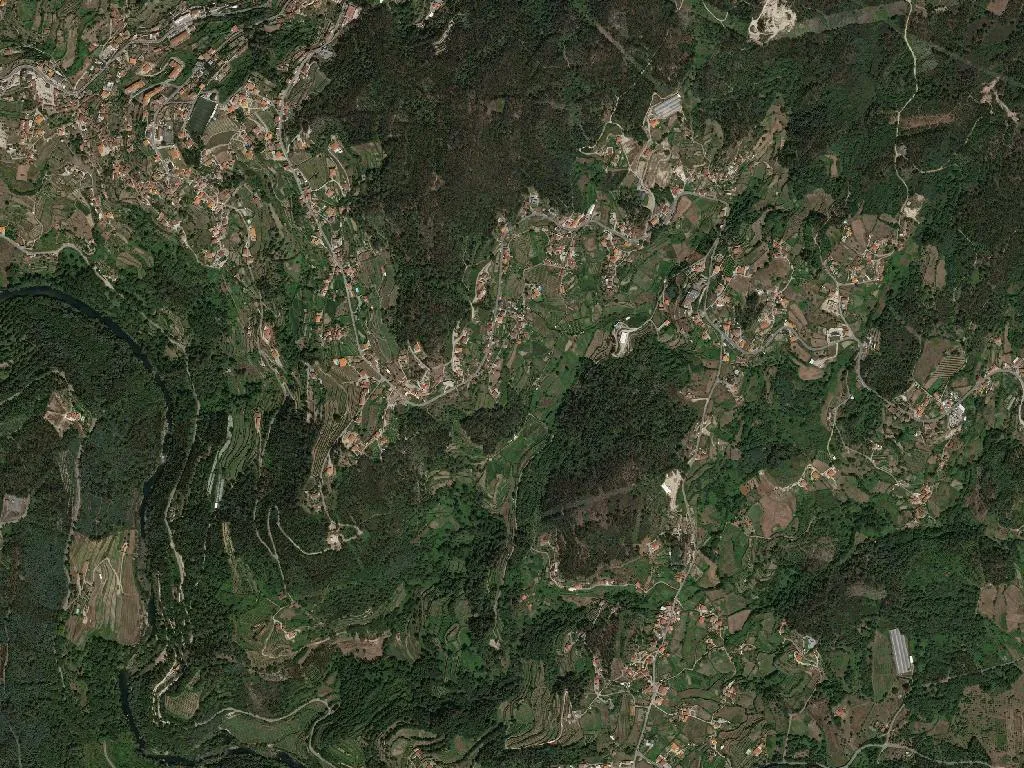
You hear Souselo before you see it: water skimming schist, a low constant hush that rises through chestnut and oak. The river that gives the parish its name slips down from the Serra de Cinfães and meets the Douro 7 km later, squeezed between terraces still planted with maize and beans. At a modest 262 m above sea level, time is measured by two calendars: the tractor’s and the liturgical. Three annual romarias in a community of barely 2,800 souls are not folklore; they are how the year is stitched together.
Stone, lime and borrowed saints
The parish church, rebuilt in 1757 after the Lisbon earthquake, is dedicated to St John the Baptist. Its gilded baroque altarpiece, carved in 1762 by José de Santo António Ferreira, conceals a 16th-century statue that spent the Napoleonic wars hidden in a hayloft at Quinta do Pinheiro. Walk uphill to the hamlet of Cidadelhe and the tiny chapel of St Peter keeps 1642 tiles that narrate the apostle’s life; the blue has softened to dove-grey, yet “S. PETRVS” can still be read in the cartouches. Down-lane, the 1713 Chapel of the Lord of the Sick has a side-door worn smooth by three ritual knocks—pilgrims once left smallpox sufferers here overnight, trusting the saint to decide their fate.
Beside the river, the three-arched bridge is a palimpsest: the central span is 14th-century, the flanking ones added after the 1867 flood that swept away bridges at Foz and Oliveira do Douro. On the east bank the Penedo water-mill still cradles its grinding stones; production ceased in 1982 when miller António Cerqueira died, aged 87, without an apprentice. A kilometre upstream, the Ribeira mill has been turned into a cedar-scented holiday house, yet its 1946 wooden water-wheel—built by the present owner’s father—turns for guests on request.
Three processions, one parish
24 June, 6 a.m. A gang of men called the Maios haul straw giants from the chapel of St Sebastian where they have spent the night under guard. By nine the main procession sets out, the image of St John ceremoniously dunked in river water—an 1835 stratagem by Canon João Ferreira to halt a locust plague that actually worked. Afternoon brings the São João cake contest: Isabel Maria Gomes has won fourteen of the last twenty years with a recipe scented with bitter-orange peel and a suspicion of old aguardente.
Five days later the São Peter pilgrimage blesses braids of garlic at his chapel; farmers knot the bulbs with rush twine, recite a single Pater Noster and hang them above door lintels for the year. The first Sunday of September belongs to the Lord of the Sick. Pilgrims trek in from eighteen parishes—some 18 km on foot from Resende—pausing at the “health fountain” to knock back three mouthfuls reputed to cure sluggish livers. Women still drape the saints with bobbin-lace shawls; every family pattern is unique, handed from mother to daughter since mid-19th-century dowries were measured in thread.
A plate with a passport
The steak you eat in Souselo is Arouquesa DOP, from oxen that graze the oak forests of Quinta da Moita and Quinta do Outeiro for eighteen months, then spend a final thirty days on hay and barley. Miranda’s butcher on Rua Dr José Falcão displays the yellow oval stamp like a passport: “Arouquesa – Carne de Boi”. Lamb stew is strictly Gralheira mountain stock, slaughtered at four months and simmered for three hours in clay with backyard bay and Arinto white wine made by Sr Albano at Quinta da Veiga.
Honey comes from Pousade, where Carlos Alberto Silva tends 120 hives of heather that took first prize at the 2019 São Mateus fair. Souselo’s thin, brittle cavacas biscuits still follow the 1954 recipe clipped from the Jornal de Notícias: twelve egg yolks to the kilo of flour, goat butter and a nip of medronho aguardente for velvet depth.
Between forest and furrow
The PR3 “Souselo River Route” is an 8.3-km figure-of-eight that needs no more than two and a half hours. Start on the medieval bridge, climb the cobbled lane to Cidadelhe past granite water-division markers dated 1847, drop to the Penedo mill and follow the irrigation levada once fed by lock and paddle. At kilometre four the Pousade oak has a 12-m girth; locals insist Afonso Henriques lunched here in 1139 en route to São Mamede, though the only carved certainty is “AH 1832”.
The São Sebastião stream, a Souselo tributary, rises at 420 m in the Cidadelhe ridge. Eagle ferns, wood lilies and the winter-star orchid—found in only three other Portuguese sites—thrive in the splash zone. With 309 inhabitants per km² you might expect clutter, yet 68 % of the 9.2 km² is native forest, 21 % scrub and barely 11 % tilled. When the church bell strikes noon the note rolls down-valley for eleven seconds; the clapper was replaced in 1943 after French soldiers looted the original in 1811. Stand on the bridge and you can still feel the vibration in the stone—proof that, in Souselo, even the landscape keeps the time.