Full article about Ferreiros de Avões
Ferreiros de Avões, 3 km from Lamego, hides schist terraces, a 16th-century cruzeiro and Jaime’s dawn sheepdogs.
Hide article Read full article
Footsteps on granite
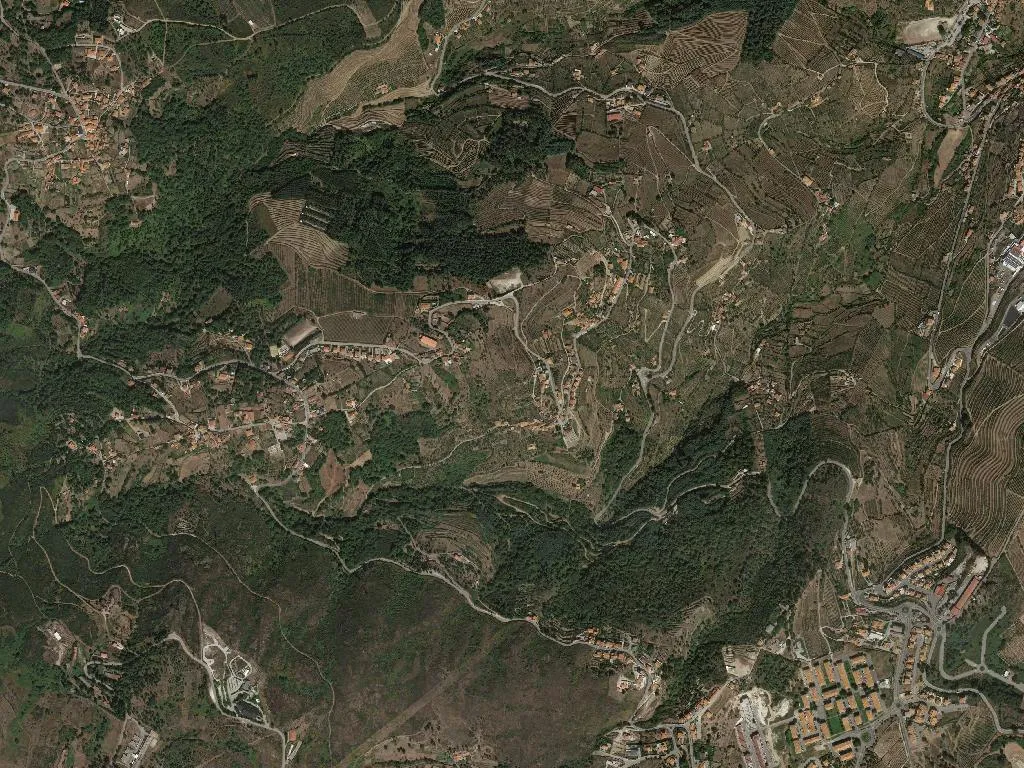
Boots clack against uneven cobbles; the sound ricochets between whitewashed stone walls until the bell of Igreja de Santa Maria parcels the morning into hours. Ferreiros de Avões perches 591 m up in a wrinkle of hills exactly 3.2 km south-east of Lamego. Terraces stitched from dry-stone schist still clutch vines and gnarled fruit trees, and the air smells of newly-turned earth. When the wind swings upriver from the Douro it carries a dampness that settles on skin like cool silk. The only counter-melody is the Avões stream whispering over polished pebbles and the occasional bark from Jaime’s sheepdogs—Jaime being the last full-time shepherd who still climbs the schist paths at dawn.
Forge & faith
The name is a receipt for medieval labour: King Afonso Henriques’ 1170 charter lists “Ferreiros d’Avões”—the iron-forgers who fired bog-ore in riverside kilns. The settlement was autonomous from 1514 until 1836, when Lisbon bureaucrats folded it into Lamego. Inside the mother church an exquisite 16th-century limestone cruzeiro dominates the high altar. The stone was quarried near Ançã, south of Coimbra, then hauled 120 km by ox cart and paid for with 12,000 réis from the chapel of St John the Baptist. In a region dominated by granite, that pale limestone—still delicately pleated around the Virgin’s mantle—amounts to a geological guest star.
Crossing paths
The inland variant of the Portuguese Caminho de Santiago cuts through the parish, leaving the IP3 for a steep detour via Avões village before dropping to the Douro at Santa Cruz. Pilgrims pause at D. Amélia’s front-room café where €2 buys a “pot” coffee—boiled grounds tipped from a dented aluminium jug—and a fist-sized chorizo roll. The terraces are part of the Alto Douro UNESCO site, yet here the walls are narrower, built by hand and long since abandoned after 1992 EU subsidy reforms. Olive groves have colonised the gaps, their roots prize-opened by winter frosts that can touch –8 °C.
Festa & fire-cured pork
The calendar is still movable by saints. On 2 February church doors swing wide for Senhora das Candeias: candles are blessed, then carried home to ward off thunderstorms. Mid-August brings the procession of Nossa Senhora do Pilar up to the hilltop chapel; eight men shoulder the float in step to a single drum. Santo António on 13 June means a bodo—village feast—beside the communal wash-fountain where women scrubbed linen until the 1990s. No DOP label exists, yet Zélia’s smokehouse turns out morcela de arroz (blood-and-rice pudding) and wine-marinated chouriça that grandchildren smuggle back to Lisbon in cabin luggage. Arroz de cabidela is rust-red with the blood of a landrace cockerel; pudding is the horseshoe-shaped sponge baked by 82-year-old Sr António in his wood-fired oven—the last operational bakery in the parish.
Living topography
Of 426 residents, 50 occupy the two mixed-age classrooms that keep the primary school open; 104 draw pensions. Three family homes have quietly become guesthouses—Casa do Alpendre, Quinta do Avô and Cantinho da Ribeira—where guests fall asleep to water drumming over weirs. Geologists map Devonian outcrops along the stream; slate slabs carry fossil trilobites that local children call “stones with bugs”. At dusk, when granite walls glow like embers, Sr Albano waters his nabal tree exactly as his father did, and Dona Ana splits kindling for the range, the axe-fall echoing downhill like a second, slower bell.