Full article about Lalim: terraces, bell-cast echoes & Douro must
17th-century chapel, chestnut balconies and 30 % vineyard grades above Lamego
Hide article Read full article
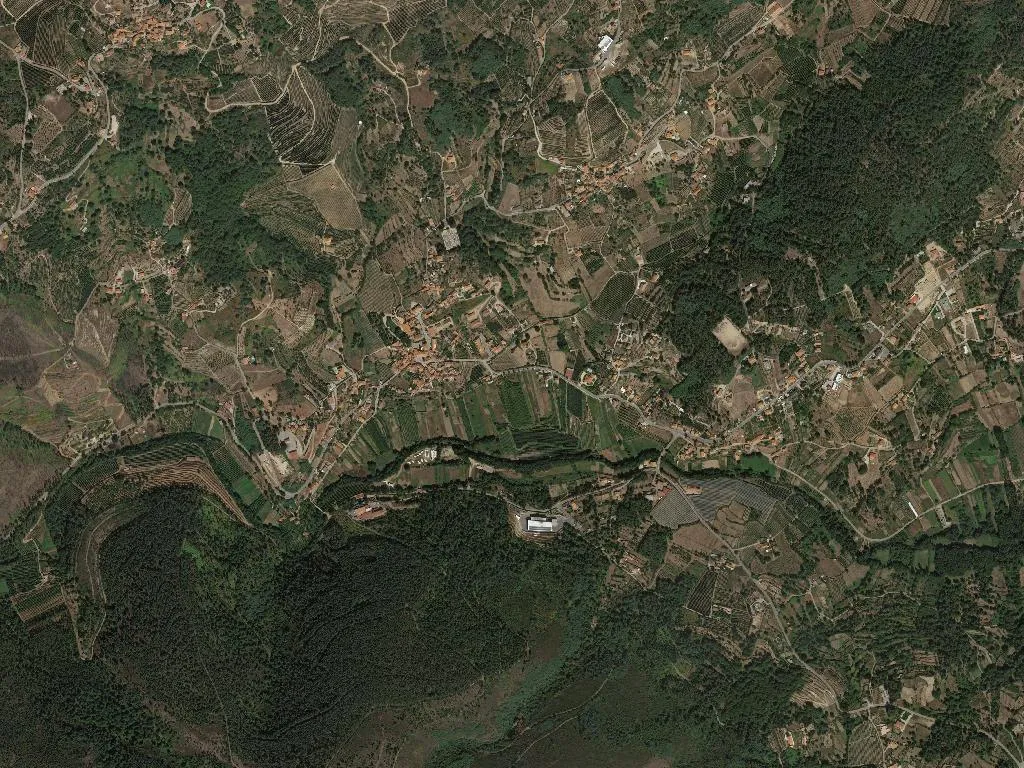
The schist walls hold the morning heat as the valley exhales upwards, carrying the scent of turned soil and crushed vine leaf. At 526 m, Lalim’s terraces—so narrow you could span them with outstretched arms—run ruler-straight until the Douro’s granite bones force a bend. Between rows of Touriga Nacional, the only movement is a blackbird flicking last year’s prunings into the air and, somewhere below, a tractor in low gear grinding through first gear on a 30 % grade.
Autumn is the village’s high season of colour. Overnight the canopy shifts from malachite to vermilion, and the low sun sets the whole slope smouldering—straw yellow at the crest, ox-blood at the river’s edge. The UNESCO-listed Alto Douro Vinhateiro isn’t a label here; it is the engineering principle that dictates every wall, every gate, every Friday in October when the cooperative winery opens its presses to the scent of fermenting must.
Stone & Bell
Only one building carries official protection—the 17th-century chapel of Nossa Senhora dos Remédios, its granite block corners rebated like linen napkins—but the entire hamlet is a manual on Atlantic-Mediterranean survival. Roof eaves project half a metre to throw winter rain clear of 80 cm-thick walls; balconies are built from chestnut darkened to Bournville brown by centuries of August sun. Inside, the year is still measured by the Festa dos Remédios in early September: a procession, yes, but more importantly the collective peeling of 30 kg of salted cod in the parish hall while the church bell—cast in 1755—swings a beat behind the village band.
Two Ways to Santiago
The Via Lusitana and the Torres route braid across the parish like old colleagues who can’t quite agree. Both climb past a 1 000-year-old olive whose hollow trunk fits three pilgrims and a dog, then pause at the spring of Fonte da Vila, water so cold it makes fillings ache. Lalim offers no albergue, only two granite cottages registered under the Douro Vinhateiro rural tourism scheme: solar panels disguised within original rooflines, espresso machines beside wood-fired ovens. Walkers leave at dawn, boots striking frost from the cobbles, and the village returns to its 91 inhabitants per km²—enough silence to hear your own pulse in your ears.
Dusk is announced by cypress shadows stretching across the threshing floor and a single plume of wood-smoke rising vertical in still air. The granite cools so fast you can feel the day’s heat being pulled out through your palm. Somewhere below, the river keeps the score in a language of schist and water; above, the terraces hold their line, unbroken since the Jesuits mapped them in 1623. Lalim does not ask to be understood—only to be crossed slowly, in shoes that can grip loose schist, with enough time to let the smell of fermenting grapes settle behind the eyes.