Full article about Penude: granite hush above Lamego’s mist
Penude, Lamego—terraced village on the inland Camino, scented by oak smoke, cowbells and the Romaria dos Remédios.
Hide article Read full article
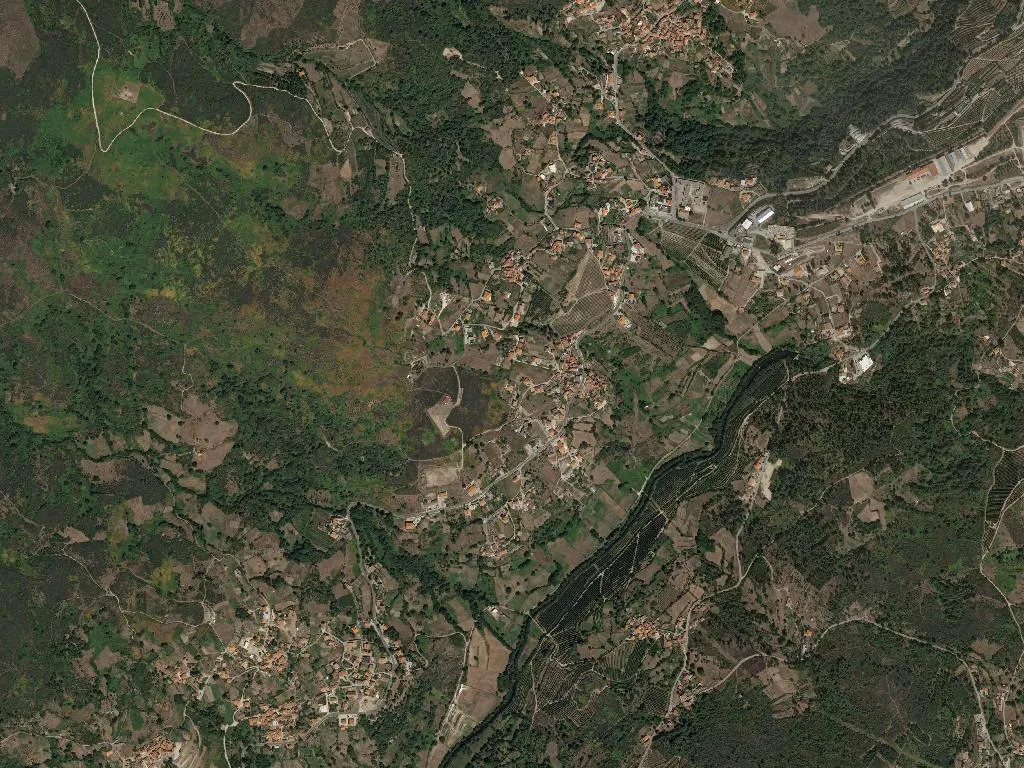
The silence arrives first. Not the hollow hush of cities after dark, but the weighted stillness of the Montemuro range—wind hissing through gorse, a cowbell clinking somewhere far below. At 747 m, Penude’s morning light unpicks the mist thread by thread, revealing granite-and-schist houses staggered down the slope like loose change. Air comes cold and damp, laced with wet earth and the sweet tannin of wood smoke leaking from stubby chimneys.
On the Spine of the Hill
“Penude” derives from the Latin penna—a feather, or sharp ridge—and the topography keeps the promise. Granite crests rear to almost 800 m, separating the narrow veigas (water meadows) where rye and white lupin still grow without irrigation. The parish was carved from neighbouring Almacave before 1528, the year it appears in King Manuel’s charter. Dry-stone terraces shoulder each dwelling into the hill; slates absorb what little winter warmth the sun concedes. On the stonework, moss colonises every crumble of mortar, and the occasional drift of blue smoke signals an outlaw charcoal kiln in the oak scrub—an occupation now hedged by EU rules but not quite extinguished.
A Parish in Pilgrimage
Local time is reckoned from the second Sunday in September, when the Romaria de Nossa Senhora dos Remédios climbs from the village to the 1947 hilltop chapel. Until the mid-20th century the procession continued all the way to the Planalto de Penude, where a tiny shrine once received barefoot promessistas. Today banners flicker, petals bruise the packed earth, and the litany rises in antiphony with the wind. Ex-votos—tin hearts, crutches no longer needed—hang in the parish church like modest trophies. Pilgrims still arrive from São João da Madeira and Vila Nova de Gaia, descendants of emigrants settling old family debts to the Virgin.
Footprints Across the Moor
Penude sits on the lesser-known inland branch of the Portuguese Camino, the variant that leaves the Douro at Lamego and strikes south toward Castro Daire. Way-markers lead pilgrims up the EM534-1, past the Venda Nova spring where water threads between fern-covered boulders. Behind them the Douro valley unrolls like a relief map; ahead, the plateau swells to a horizon of gorse and broom. Bronze at dusk, yellow at noon, the upland palette is decided by altitude and Atlantic weather fronts. Shepherds’ paths—still called caminhos de arrieiro—rat-run the scrub, the most famous dropping to the River Bestança, once a muleteers’ highway for charcoal bound for the Minho.
Slow Breaths
There is no checklist here. Walk the contour track between Venda Nova and Casas de Folhadela and you’ll pass stone granaries the size of garden sheds, their rye stores padlocked against rodents. Sit in the veiga da Cerdeira and let granite walls radiate the day’s stored heat back at you. The senses adjust: cracked grey bedrock, lichen the colour of oxidised copper, gates warped to the curve of their own weight. When the temperature plummets at dusk, chimney smoke rises ruler-straight into a sky rinsed clean of cloud. The 16th-century church bell counts time not in hours but in agricultural beats—when the cattle go up to the high pastures in May, when they come down in October, when the rye is threshed and the charcoal stacks finally cool.