Full article about Arcozelos: where the Douro’s heat meets thyme-scented upland
Bronze bells echo over granite terraces above the Távora gorge in Moimenta da Beira’s hidden village
Hide article Read full article
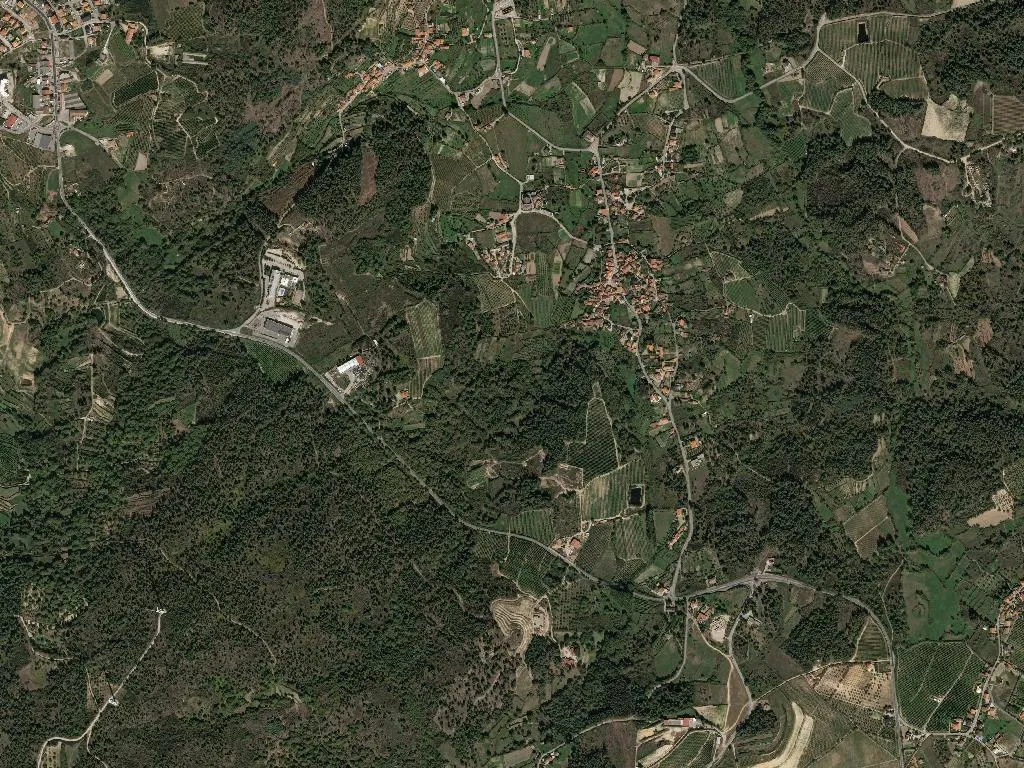
The church bell strikes twelve and its bronze note rolls downhill, unhindered, until it meets the Távora valley. Six hundred and eight people live here, scattered across 950 hectares of tilted granite and schist terraces that ride the 606 m contour line. At this altitude the Douro’s furnace heat is tempered by uphill breezes smelling of wild thyme and leaf-mould.
The geometry behind the name
Local scholars still argue whether the “arc” in Arcozelos refers to a Roman bridge—long collapsed—or simply to the natural sweep of the land. Either way, the topography explains everything: winter streams carve abrupt gullies, medieval pack-tracks had to ford them, and stone for an arch was never more than a pick-axe away. The first secure mention appears in a 13th-century parish charter, when the church network pushed west from the Douro and vines followed the clergy.
São João: the parish’s entire social calendar
On the last Saturday of June the village quadruples. Returning emigrants from Paris, Geneva and Newark book flights months ahead; the women’s association spends three days shaping folar de São João, a saffron-scented loaf that tastes of aniseed and homecoming. After mass the priest carries the silvered statue of John the Baptist around the square, the brass band strikes up a waltz, and lunch is served at communal tables: smoked alheira, roast kid, potatoes slicked with dripping, and a table wine drawn from the cooperatives of the Távora-Varosa. By dusk the younger crowd has migrated to the football pitch where a sound system plays Pimba until the generators gasp.
What to see
The 18th-century parish church opens only for Sunday liturgy at 11.30, but the parish council (telephone ahead: +351 254 582 123) will unlock it for visitors. Inside, a single barrel nave leads to a gilded rococo retable whose acanthus leaves still hold traces of original crimson. Two kilometres east, the Alto de São João viewpoint gives a 270-degree scan of the Távora gorge; take the EM 549 but avoid it after rain—bitumen thins to shale and the verges crumble like biscuit.
Where to eat
Arcozelos contains one café, installed in the former sacristy. Breakfast finishes at 11 a.m.; lunch is whatever owner Graça has simmering—perhaps cozido broth or a wedge of queijo da serra wrapped in waxed paper. Thursdays, she closes. For a full meal drive ten minutes to Moimenta da Beira. At O Távora (reserve essential) Ana Paula Rodrigues serves postas mirandesa—two-finger-thick slices of maroon beef seared on holm-oak charcoal—and a rabbit hunter’s stew scented with colorau and white wine.
Arriving and leaving
From Moimenta da Beira follow the EN 221 towards Paradinha, then swing onto the EM 549. The lane narrows to a single granite-lined corridor; when two Clios meet, one must reverse. No buses come here; the last taxi driver refuses the fare after dark.
Density and silence
Sixty-four inhabitants per square kilometre leave room for black redstarts to nest in dry-stone walls and for night skies to remain genuinely dark. Footpaths still link walled smallholdings where rye and potatoes occupy the high ground and south-facing terraces hold unirrigated vines—roupeiro, touriga franca, malvasia fina—whose grapes sell to the sparkling-wine cooperatives down-valley. Children number 78; the primary school needs only two teachers. Yet 155 residents are over sixty-five, guardians of a memory bank that includes how to read granite’s colour shift before rain and which spring yields the softest water for bread. Walk at twilight and you will hear neither traffic nor irrigation pumps—only the after-echo of that midday bell reminding the hills that time here is still negotiated by bronze, not by fibre-optic cable.