Full article about Leomil: Bronze bells, pine air & 1932 mountain Port
Granite chapels, 1832 espigueiros and icy Douro nights shape this Beira Alta village
Hide article Read full article
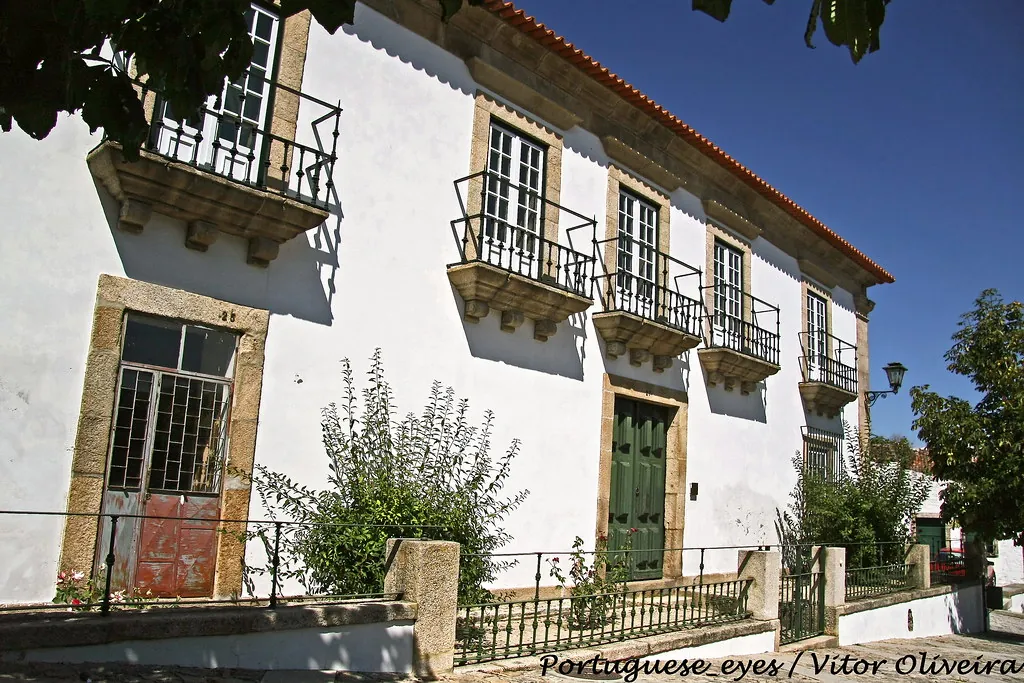
At noon, the bronze bell of São João Baptista strikes twelve, the note ricocheting off granite slabs in the churchyard and down Rua da Igreja. Leomil, 726 m above the Távora valley, inhales the thin, resin-scented air of Beira Alta; a draught of altitude and pine that clears the head like chilled white wine. By mid-morning the oblique sun has already picked out every cornice on the eighteenth-century Casa dos Tiagos, its coat-of-arms still sharp above the arched doorway, while wood-smoke from the padaria Carvalho—baking since 1953—threads between television aerials and drying linen.
Carved memory
The parish first appears in Viseu’s “Black Book” of 1191. The name fuses a pre-Roman “Lemos” with the Latin miliarium that once marked the Roman road north to Galicia. The present church was rebuilt in 1712 (the date is chiselled into the sacristy wall) and shelters a 1743 gilded altarpiece attributed to José Fernandes de Lima, one of the region’s most sought-after talha carvers. Outside, the diminutive 1676 chapel of São Sebastião still displays azulejos reproducing the Marquês de Pombal’s public-health edicts after the last plague. Walk ten minutes to the hamlet of Póvoa and you find granite espigueiros engraved “1832”, tiny granaries that survived both the Liberal Wars and the phylloxera blight that followed.
Mountain vineyards
Leomil has lain inside the Douro Demarcated Region since 1756, but its vineyards behave more like alpine plots. At 550 m, Quinta do Reboredo’s 1932 plantings deliver a bright, high-acid Port—6.5 g/l total acidity in ADVID’s 2022 lab report—because the night-time temperature can drop 14 °C between dusk and dawn. The narrow schist terraces, hand-built 1935-40 under Salazar’s National Viticultural Plan, are held up by dry-stone walls whose craftsmen have now retired; their sons became electricians in Paris. The local co-op, founded in 1962, bottled an everyday red labelled “Távora” until 1994, when the last full-time picker turned 65 and the gates were locked for good.
The Beira table
Sunday lunch starts at 13:00 sharp in Maria do Céu’s one-room tasquinha, “O Cantinho”, where kid goat is seasoned the night before, lowered into a wood-fired oven and served with crackling the colour of burnt sugar. At the simply named “O Távora” the Abreu family still simmer chanfana—goat braised in local red wine—for three hours in a black iron pot, a recipe codified when their grandfather returned from Mozambique in 1950. In Póvoa a smokehouse cures chouriça de carne for ninety days; the drying calendar is copied from grandmother Albertina’s 1928 notebook. Finish with doces de ovos from Confeitaria Silva, yellow as egg yolk from the village’s own Amarela hens.
Trails and riverheads
The 7.3 km PR2 “Trilhos do Távora” links Leomil to Aricera, crossing the 1897 Ponte de Póvoa where the stream shrinks from 150 l/s in March to a mere 5 l/s by August. From the Alto da Senhora da Graça lookout, 812 m high, the view stretches 23 km east to the glacial scarps of the Serra da Estrela. Between 15 and 30 April the furze blooms acid-yellow; the parish council organises the annual “Marcha da Flor do Carquejo” to coincide with the flowering, a six-hour hike that ends with grilled sardines and a glass of branco.
Midsummer fire
Leomil’s São João is held on the Sunday nearest 24 June and draws roughly 3,000 people—tripling the population. The 1.2 km procession route was fixed in 1892 and still pauses at the medieval cross whose stones are blackened by 132 years of candle-wax. At 22:00 the parish president lights a pyre of 150 cartloads of vine prunings; sparks drift upwards until the hill opposite looks like a second night sky. Folk group “Os Camponeses do Távora”, founded the same year Portugal won the Eurovision Song Contest, perform “A Rusga de Leomil”, a circle-dance collected by ethnomusicologist Michel Giacometti in 1967. Every visitor is handed 100 ml of communal wine, bottled especially for the night. When the police-mandated curfew falls at 01:00, silence returns—broken only, as it has been since 1872, by the church clock striking every fifteen minutes until dawn.