Full article about Sarzedo: Warm Granite, Cold Fog, One Church Bell
A 154-soul Beira ridge village where dusk still glows from sun-baked stone and June revives 1965.
Hide article Read full article
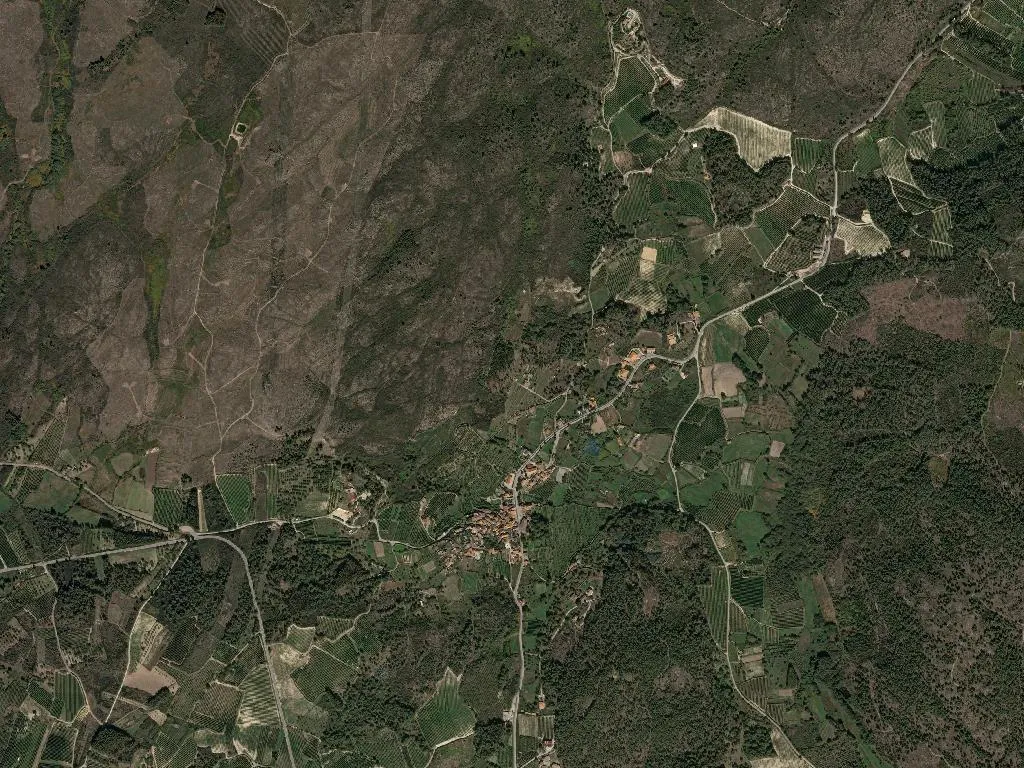
The granite is still warm when the sun slips behind the ridge. At 765 m, the village walls of Sarzedo store the heat of the long June afternoon; press a palm to the west-facing stone at dusk and you’ll feel the day’s surplus radiate back like a slow exhalation. One-hundred-and-fifty-four souls occupy barely five square kilometres of hillside, and the silence is not empty but thick—broken only by a dog barking somewhere in the chestnut shade or the scrape of a chair across the churchyard.
Geography that shapes the day
Dawn arrives cool, even in midsummer, and a gauze of valley fog unspools upwards until noon burns it off. Between houses, hand-dug terraces no wider than a dining table hold rye, potatoes and the odd row of vines; the Douro’s demarcated region officially ends just short of here, yet Sarzedo’s small-plot agriculture keeps its own ledger. Dirt tracks, more foot-worn than tyre-flattened, link the hamlet’s scattered clusters like loose stitches on a hem.
Stone with a file number
The 12th-century Igreja de Sarzedo has carried Portugal’s “Public Interest” seal since 1977. Come for the Romanesque side portal—archivolts braided like stone rope, a lamb carving centred in the tympanum—and stay for the demographic exhibit in the nave: thirteen children under fourteen, fifty-six residents over sixty-five. Arithmetic becomes architecture: every slow footstep on the schist pavement is a census.
São João after dark
On the night of 23 June the village swells. Emigrants fly in from Paris, grandchildren up from Lisbon, and the square fills with the smell of grilled sardines and eucalyptus smoke. A single bonfire is fed until the flames taper into embers; someone produces a guitar, someone else a carton of Super Bock. For four hours Sarzedo recovers the population density it last held in 1965. By two o’clock only the coals remain, and the silence that returns feels almost upholstered.
How to arrive
Fifteen kilometres of writhing N-road separate Sarzedo from the municipal seat at Moimenta da Beira. There is no bus; ring ahead for the local taxi or practice your thumb-portuguese. Mobile signal drops twice—download the map before you leave.