Full article about Trezói: Where the Bell Drifts Through Silence
Granite hamlet above the Dão, scented with wood-smoke and fermenting must.
Hide article Read full article
The Bell’s Echo
The church bell tolls the hours with a slow, resonant echo that drifts through the valley without urgency. In Trezói, the sound travels between the granite and slate houses, reaches the sloping meadows where a few cows still graze, then dissolves into the wooded ridge that fences the parish to the north. At 266 metres above sea-level the air carries the smell of damp earth and wood-smoke; even at midday someone keeps a fire ticking over.
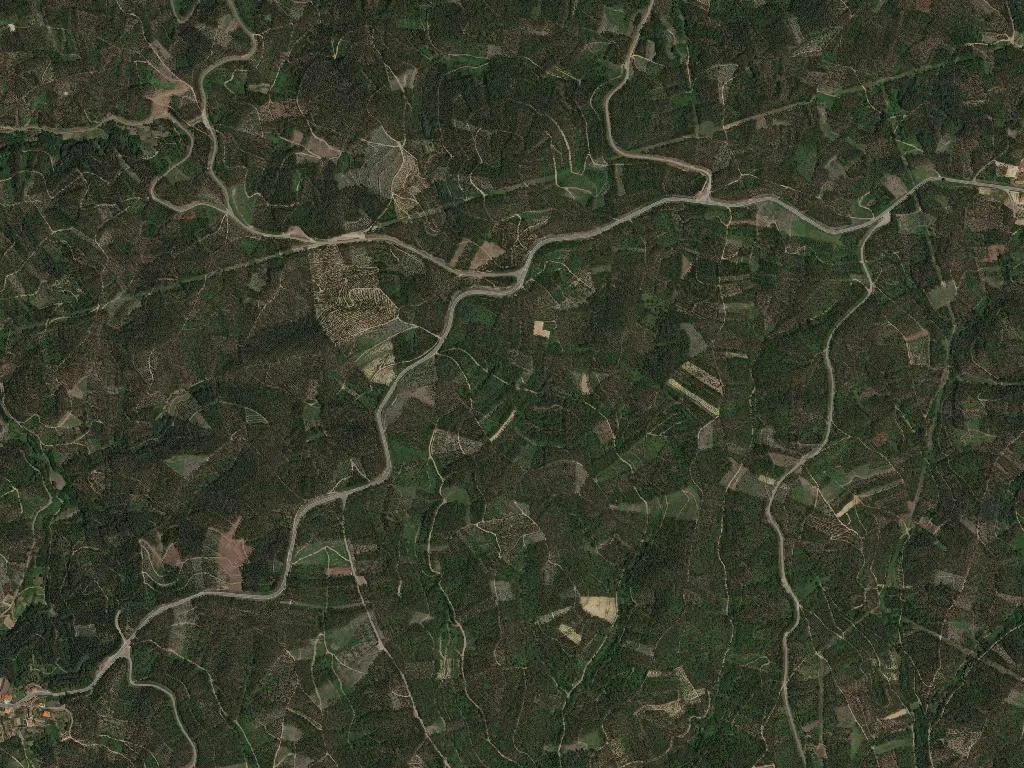
Trezói belongs to Mortágua, in Viseu’s upland interior, and spreads across 1,750 undulating hectares where small woods alternate with maize terraces and swathes of broom. Population density is barely twenty souls per square kilometre. The 2021 census recorded 343 inhabitants, only 24 of them under fifteen while 159 had already turned sixty-five. In the single, narrow street the silence loosens after four o’clock, when pensioners gather outside the only café to arbitrate on the afternoon.
Vine, Stone and Memory
The parish sits at the outer edge of the Dão wine zone. Vineyards are scattered rather than dominant, clinging to south-facing slopes where Touriga Nacional, Alfrocheiro and Encruzado root into coarse granite. The resulting wines are taut and stony, nothing like the plush reds of the lower Dão. There are no show-cellars; instead, half-open barn doors exhale the sweet, metallic breath of fermenting must, and a weather-gnarled farmer will pull aside a tarp to show you his father’s 500-litre oak barrel, still in service.
Houses cluster in tight nuclei: granite quoins, slate roofs, the occasional wall washed white with lime. Behind each dwelling a backyard plot yields potatoes, kale and the last of the winter cabbages; elderly pear trees lean under the weight of small, syrupy fruit. Nothing is ornamental, yet the repetition of local stone and identical eave-heights gives the settlements the visual coherence of a dry-stone wall rebuilt every generation.
Walking Nowhere in Particular
Farm tracks link Trezói to the neighbouring hamlets of Coval and Póvoa de Cima. The gradients are forgiving, the surfaces a patchwork of compressed earth and worn cobbles where cattle hoof-prints overlap with trainer tread. You might share the path with a farmer on a Honda mule, otherwise the soundtrack is reduced to twigs cracking underfoot and bees working the heather. Signage is absent; navigation is by osmosis—keep the pine plantation on your left, follow the stone wall until you meet the stream. Cross the granite slab where children once caught freshwater mussels, climb through the oak spinney whose floor is varnished with acorns, and you emerge onto a ridge that lets you see the bell tower you left an hour earlier.
What Lunch Remembers
There is no restaurant, so you eat what the kitchen offers: pork loin smoked for three days over oak and bay, a slice of goat cheese that leaves a white tidemark on the plate as it melts, cornbread whose crust shatters to reveal a saffron-yellow crumb. Recipes are family title deeds. The eel stew that grandmother Albertina lifted from the Mondego delta survives only in anecdote—no one can replicate the exact ratio of tomato, bay and smoked paprika she eyeballed every October.
When the light slants and the air tightens, Trezói discloses its quiet persistence: wood-smoke rising perfectly vertical, a dog whose bark greets every passer-by by name, the reluctant creak of a front door shut against the night.