Full article about Senhorim: oak smoke, granite hush, Dão wine
In Nelas’ granite folds, Senhorim wakes to chouriço smoke, slow winters and vine rows that keep 300-
Hide article Read full article
Smoke coils from the village smoke-houses, grey ribbons against a scrubbed winter sky. Senhorim wakes before seven, the air laced with oak-wood fire and the paprika sting of curing chouriço. Between granite parapets, December’s sun skims the whitewash, stretching shadows down uneven cobbles that have been polished by 300 years of boots and Sunday-best shoes.
Geography of stillness
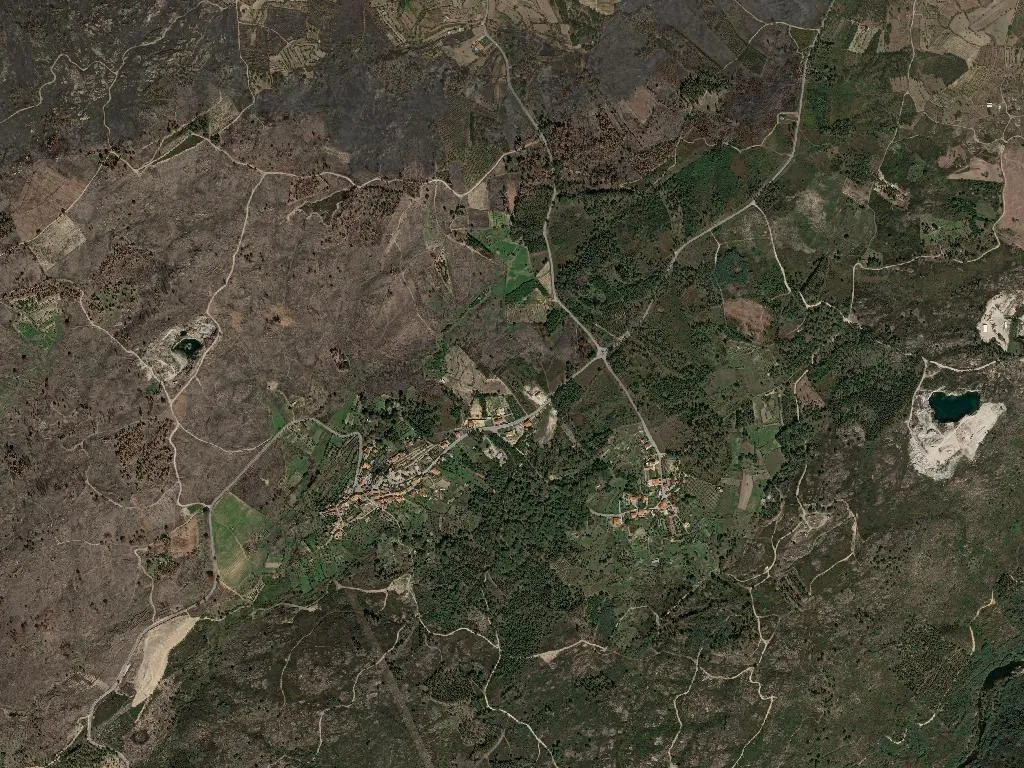
The parish unrolls across 3,000 undulating hectares on the Dão’s southern rim—an intermediate shelf, 430 m up, that catches the plateau’s chill without the full violence of Estrela’s summit winds. Vineyards alternate with olive terraces and pocket-handkerchief pine plots; dry-stone walls sketch property lines first mapped after the 1755 land reforms. Population density is 31 souls per km². Of the 1,019 inhabitants counted in 2021, 366 are over retirement age; only 81 are under 14. The arithmetic explains the hush: you hear chestnut leaves hit the ground.
Cheese, lamb and Friday deliveries
Dona Zulmira’s grocery receives cheese still warm from Mangualde every Friday, ferried in the back of a shared taxi. The wheels sweat through crinkled cellophane; break the seal and you smell meadowsweet and thistle rennet. Spring lamb appears between April and June, when shepherds drive flocks down from the high pastures—beyond that, the menu reverts to what the larder holds. On feast days it’s transmontana bean-and-pork stew; mid-winter calls for turnip soup thickened with chorizo ends. At Café Central, António pours Dão red into 200 ml glass tumblers because, as he points out, “nobody stops at one.” There is no printed menu—ask the counter what’s cooking.
Vine rows and horizons
Dão’s vineyards are laid out in gentle terraces, less vertiginous than the Douro but just as ruthlessly geometric. Touriga Nacional, Tinta Roriz and Alfrocheiro give medium-bodied reds with fine tannins and a racing acidity. Here the vine is not postcard scenery; it is January pruning and September hand-picking, wicker baskets slung over shoulders and purple must fermenting in family cellars until November. Knock at the Adega de Senhorim before 11 a.m. and Sr Armando will lever open the 1940s basket press and draw off a glass for you—after that he heads home for lunch and the door stays shut.
Rhythms of the everyday
The village organises itself around three fixed points: the baroque parish church, the café, and the bench in front of the Civil Parish noticeboard. Conversation is unhurried; pauses are part of the syntax. Daily life acquires texture: the exact pewter shade of sky before rain, the two-note bell that marks the hour, the January wind that nibbles bare fingers. Parking is directly outside; doors open without buzzers. The butcher locks up at 1 p.m. and reopens Monday morning. Zé’s tasca lifts its shutter around 10 a.m. and closes when the last glass is rinsed—rarely after 9 p.m.
Dusk arrives early. When low sun breaks beneath cloud and gilds the worn terracotta, Senhorim reveals its quiet covenant: no spectacle, no stage set—just smoke still rising, tracing the promise of a slow-cured sausage in the cold air, everything proceeding at the pace it always has.