Full article about Vilar Seco: where woodsmoke and exile flavour the Dão air
Dry-stone terraces, Manuelin arch, August stew—village re-boots when Paris returns
Hide article Read full article
The scent that still sells the village
Woodsmoke drifts through the streets of Vilar Seco at dawn, carrying a ghost of burnt grape must. It is the only reminder that, until the 1970s, copper stills inside Solar da Bestança turned Dão wine into aguardente, the high-proof firewater once stamped “Vilar Seco” on every bottle. The distillery closed, the slogan faded, but the vines still climb the schist terraces at 404 m. Over half of the stone houses shutter their doors on 1 September; 60 % of the parish now lives in Paris, and the year beats to the rhythm of return tickets and August mortgages.
A parish the king un-anchored
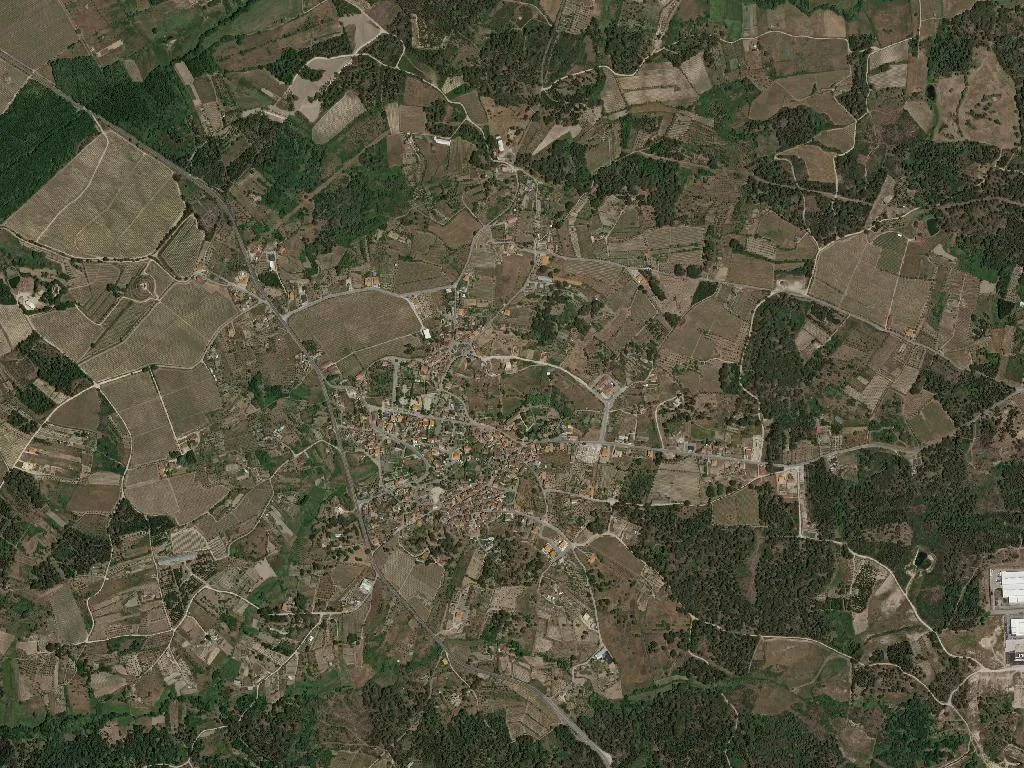
On 24 August 1557 Dom João III signed Vilar Seco’s independence from Santar, elevating the dry plateau—“sicca” in Latin—to a parish in its own right. No river reaches this crystalline saddle; only winter cloudbursts fill the seasonal streams of Póvoa and Bestança, feeding tiny irrigation dams between 200-year-old olive groves and Dão DOC vineyards. Dry-stone schist walls box the slopes, interrupted by cork oaks the colour of bottled tannin.
The Manueline mother church dominates the central square: local granite, perfect round arch, gilded carving of Saint Bartholomew catching candlelight. From its steps a 1724 baroque cross kicks off the Compasso, the Easter boundary-walk that splashes holy water on every lintel. Three kilometres away, the hamlet of Casal hides a chapel to Saint Sebastian whose 18th-century azulejos still recall plague-time prayers.
August, when the village re-boots
The weekend closest to 24 August belongs to São Bartolomeu. Rockets announce the procession, Mass is sung in the open air, and a white canvas tent fills with the scent of the saint’s own stew: pig’s liver, chouriço, potato and kale reduced to a viscous, iron-rich broth. Emigrants fly in, keys are turned, guitars appear. July’s “Night of Songs” already rehearsed the desgarradas—call-and-response ballads that last until the sky pales over the Caramulo ridge. On the first Tuesday of every month the grocery coach turns the square into a pop-up market; a single convex mirror halts what little traffic there is while grandmothers prod cabbages.
Eating like you owe the house a favour
Local cooking never got the memo about lightness. Kid goat roasts in a wood-fired oven; lamb stew is thickened with strings of melted Serra da Estrela DOP; goat chanfana spends half a day burbling in a clay pot. During the harvest, wheat-and-liver “dry soup” is served in rock-hewn cellars where Touriga Nacional and Tinta Roriz rest in talha, the clay amphorae Romans introduced. Blood sausage with rice, wine-smoked chouriço and liver farinheira hang above the hearth; pumpkin jam sweetened with heather honey and ovos-moles-style “tijelos” wait in the larder for visitors who claim they have no room left.
The trail where the fountains run dry
Sign-posted as PR3, the “Rota das Fontes” strings together church, chapel and two 18th-century washing tanks—Fonte da Vila and Fonte do Casal—where water appears only when the Atlantic remembers to storm. Blackbirds quarrel in espaliered vines, granite granaries throw long shadows, and the municipal hunting reserve keeps wild-boar slots crisp in the dust. Darkness brings the plateau’s real luxury: a Milky Way unsullied by street-light glow.
From the baroque cross lookout the horizon is serrated by the Caramulo massif; silence is broken only by a distant tractor or the clink of a spoon against clay as cheese meets pumpkin jam. Taste that, add the view, and you understand why 60 % of those born here still book the same August fortnight, even if the other eleven months tick by with 668 souls and a village that waits, politely, for next summer’s reunion.