Full article about Esmolfe: Where Granite Breathes & Time Slows
Penalva do Castelo's hilltop hamlet keeps 13th-century echoes & €1.20 Dão wine
Hide article Read full article
The road tilts, the plateau begins
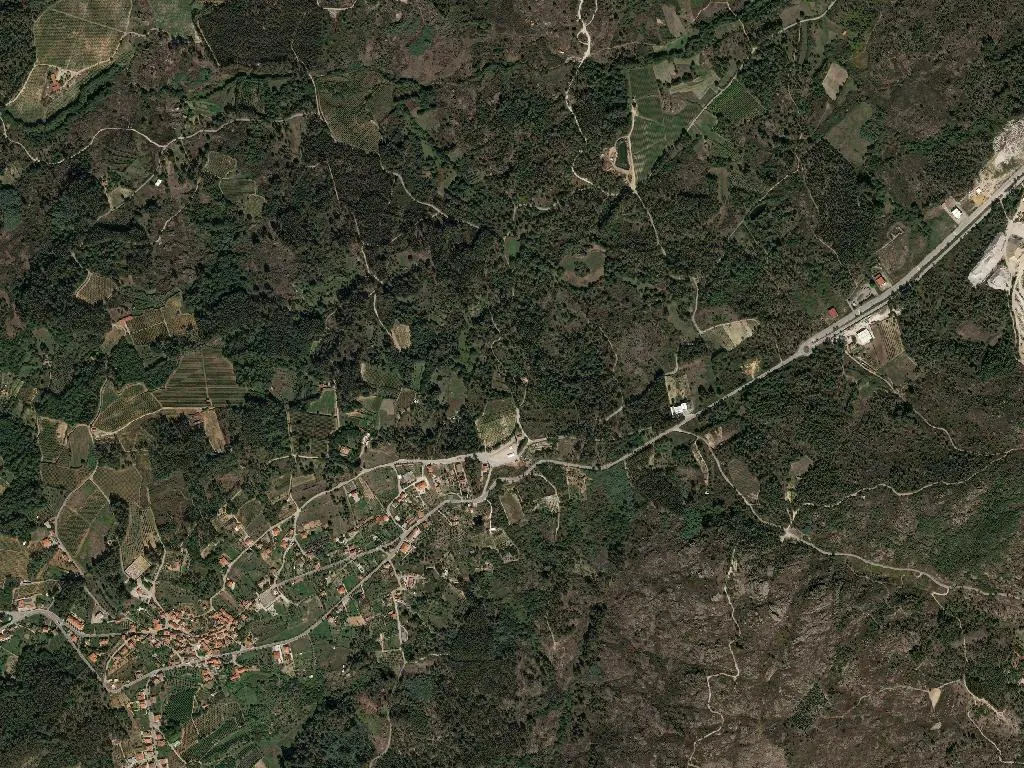
A single-lane road climbs through wheat stubble and unmortared walls until the dashboard altimeter flickers to 537 m. Suddenly the wind arrives, uninterrupted, across 1,087 hectares of Beira Alta granite and grass. Esmolfe appears—not a village that announces itself, but one that loosens its grip on the slope: low whitewashed houses, a bandstand-sized square, a catalpa tree holding court. Sound behaves differently up here; a gate scraping shut travels half a parish, and the yap of a farm dog arrives late, as if relayed from another century.
Population 382, human density measured in nods rather than numbers. Thirty-six children, 133 elders; the arithmetic explains why mornings start at tractor throttle and afternoons lengthen into doorframe conversations. Time is kept by sowing dates, not Apple watches; the parish council still rings a handbell for meetings.
Stone that out-waits empires
The 13th-century parish church squats at the gravitational centre, its Romanesque tower footings narrower than the 16th-century body they carry. During the Liberal Wars the high altar was dismantled brick by brick and buried in a potato plot; the surviving Manueline panels, repainted and reinstalled, still smell faintly of soil when summer heat lifts the grain. Granite blocks the size of railway sleepers absorb noon warmth and exhale it after dusk, keeping the nave temperate for the eight householders who constitute Sunday mass.
Houses are stitched together shoulder-to-shoulder, their lime wash the colour of weak tea where rain has bled iron from the stone. No one hurries to repaint; flaking is accepted as a slow-motion diary.
Taste of 537 metres
Esmolfe lies inside the Dão demarcation sketched in 1908 by José Maria da Fonseca. Vineyards sit at 500-600 m on fracture-patterned granite that drains like a colander; the local co-op’s Touriga Nacional—labelled simply “Esmolfe”—costs €1.20 a glass in the only café, poured from an unlabelled bottle kept under the counter.
Pasture matters more than vines. Borrego Serra da Estrela DOP lambs graze the surrounding broom and heather, their meat dense, almost maroon, slow-roasted at weekends in the wood oven of O Cacito, a restaurant that opens Friday-Sunday and considers bookings an eccentricity. Cheese arrives direct from José Augusto’s kitchen at Casa do Cimo: Serra da Estrela DOP curd hand-stirred with cardoon thistle, then pressed into wicker trays that leave a weave imprint on the rind. Requeijão, eaten warm with a spoon of pumpkin jam, tastes faintly of thyme from the upland meadows.
And then there is the apple. Bravo de Esmolfe PDO—small, asymmetrical, russet-snagged—was first recorded in 1750 and is still picked by ladder in mid-October. Its flesh bruises into pear-like sweetness, high in polyphenols that Portuguese labs link to cholesterol-lowering and antioxidant punch. Locals bake it whole inside a clay chicken, the steam scented with cinnamon and the region’s own Port wine.
A horizon that answers back
There are no signed viewpoints; instead, clear-cuts reveal sudden cinema screens. Above Lugar das Vinhas the 2017 pine harvest opened a west-facing scar from which, on scrubbed-air days, the summit tor of Serra da Estrela glints 70 km away. A dirt lane begins at the 1897 cholera cross—erected after 47 villagers died in six weeks—and climbs to Alto do Marco, once the municipal boundary stone between Penalva and Mangualde. Walking is gentle; the plateau refuses drama. The reward is acoustic: larks, wind shear over granite, the inward sound of your own lungs.
Evening light arrives sideways, turning door-sills petal-pink. Wood smoke from Sr Alfredo’s fireplace—last year’s cork oak still hissing with resin—rises ruler-straight in still air. Esmolfe offers no spectacle, only a cane chair beneath the catalpa, a €1.20 glass of co-op red, and silence so complete you can hear your pulse negotiating with the altitude.