Full article about Trancozelos: granite silence above the Dão valley
Where abbey ruins, runny Serra cheese and Dão-cooked lamb outshine any festival
Hide article Read full article
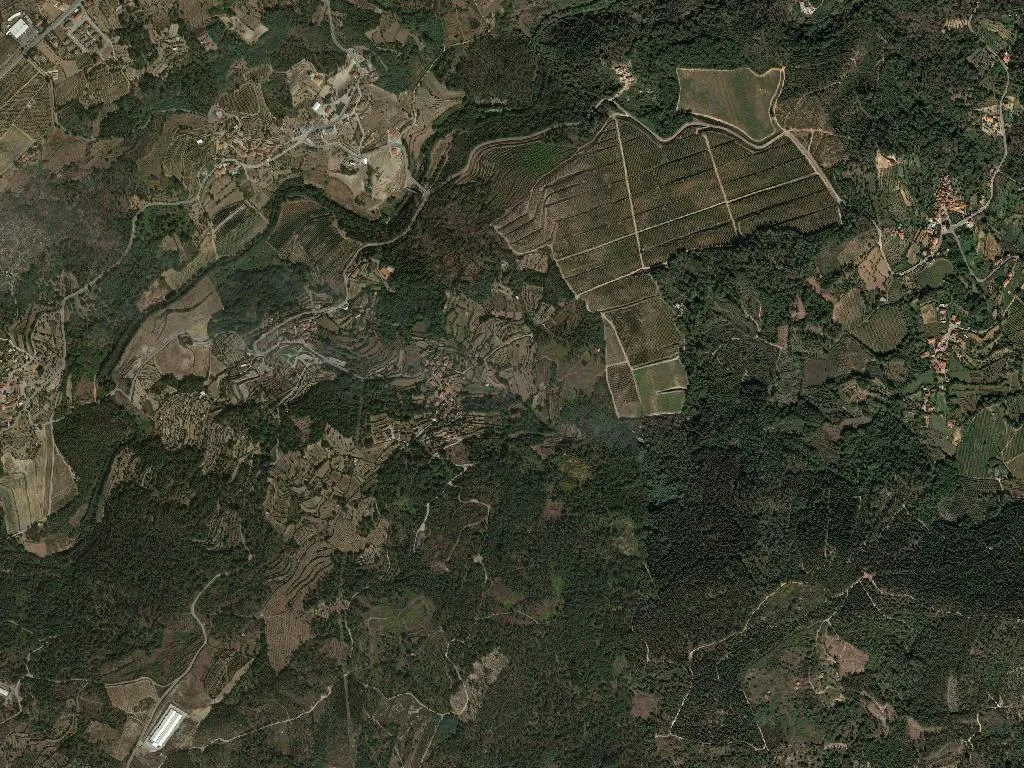
Granite blocks shoulder the lane into Trancozelos, their fissures stitched with lichen the colour of oxidised copper. At 472 m the ridge barely qualifies as a hill, yet the view still unfurls across the Dão valley in disciplined terraces of vines and olive. Only the wind and the single bell of São João Evangelista disturb the air; 247 people are scattered across 512 hectares, their stone houses huddled along the CM566 like a defensive line that never quite closed.
The abbey that Teresa endorsed
Halfway down the slope, Quinta do Mosteiro keeps the skeletal remains of Portugal’s first Knights of the Holy Sepulchre house. Afonso Henriques donated the site in 1139; his mother Teresa had already rubber-stamped it fourteen years earlier, a rare maternal intervention in a chronicle usually dominated by men-at-arms. Granite ribs of the apse still stand, proud against the sky, and the arch springers look capable of carrying another eight centuries. The toponym itself – from the Galician “tranco” – speaks of obstruction, a place where the valley walls once forced travellers to check their stride.
The parish church, rebuilt after the 1755 earthquake, keeps Mass to a punctual 11:30 on Sundays. Trancozelos has never bothered with a summer fair or a procession; the calendar is dictated by what happens in field and fold: the grape harvest rolling into October, the slow southward drift of sheep from the high plateau in May, the cheese-making that begins when the first frosts arrive.
Cheese, lamb and Dão in the glass
Proximity to the Serra da Estrela supplies the table. Wheels of DOP Serra da Estrela arrive at the village shop already runny at the edges; Severina bakes rye every Friday in the communal oven, its crust blistered just enough to give the soft cheese something to push against. Requeijão, the whey-cheese cousin, is folded into scrambled eggs or simply spooned. At O Cimo do Marão, mountain lamb is braised in Dão red until the fibres collapse into the sauce – a chanfana in miniature, scented with oak-smoked chouriço that Armindo cures in his own fumeiro. Touriga Nacional and encruzado share the glass: the reds brisk with sour-cherry acidity, the whites (try Quinta da Pellada’s) best poured cellar-cool, around 12 °C, so the granite minerality stays sharp.
Tracks through the mosaic
A 4.3 km loop drops from the church to the Trancozelos stream, a minor tributary that slips through gorse and stone oak before joining the Dão. No signposts blare “Rota” here; you follow the schist slabs that once carried ox-carts. Cherry and almond orchards interrupt the vineyards, their dry-stone walls thrown up in the 1920s by emigrants back from Brazil with money and time. Partridge whirr, hares zig-zag, the occasional boar rustles out of sight. The only place to sleep is Casa do Brigadeiro, the old forestry guard’s cottage restored with exposed beams and a fireplace that swallows whole logs. Book ahead: there are two rooms, and silence is included.
When the afternoon sun warms the monastery stones, the granite exhales a dry, resinous breath – pine sap, ripe vine leaf, dust that once belonged to a 12th-century wall. Trancozelos does not reward speed; it repays the walker who stops long enough to hear the joint between past and present click softly into place.