Full article about Cárquere’s Ridge: Saints, Coins & Honeyed Stone
Romanesque tower, Roman coins, May ladainhas: Cárquere watches over Douro slate & Montemuro quartz.
Hide article Read full article
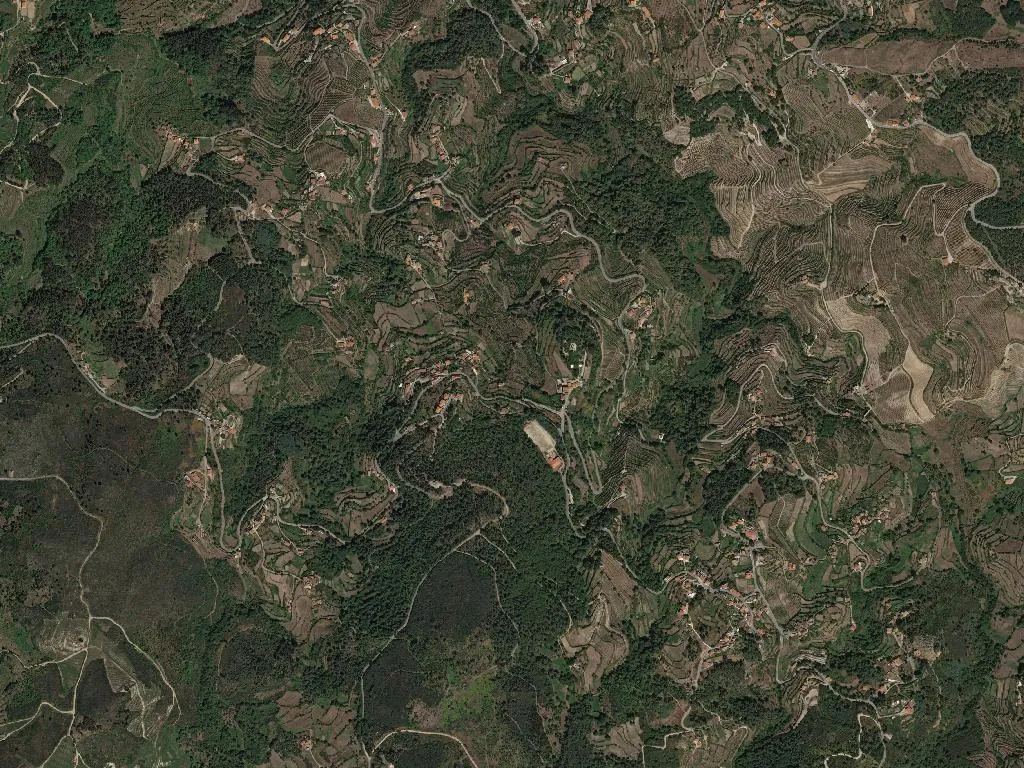
The granite of the Romanesque tower turns liquid honey at dusk, when the sun slips beneath the oaks and ignites the west front of Santa Maria de Cárquere. From its 510-metre ridge, halfway between the Douro’s slate-blue trench and the quartzite crests of the Serra do Montemuro, the parish surveys a mosaic of smallholdings worked by 746 souls. Beneath the cabbage plots and the terraced vines lie more than a hundred Roman coins; above them, on the fourth Sunday of May, fifteen neighbouring parishes still climb the old mule track chanting ladainhas, converging on the church where, legend insists, a young Afonso Henriques was cured of a childhood limp.
Eight centuries quarried into stone
The monastery is a palimpsest you can read without a guide. Start with the twelfth-century bell tower: birds—doves, partridges, a single cormorant—carved on the capitals that frame the Romanesque sound-slit. Step inside and the nave jumps two centuries to a late-Gothic rib vault; walk east and you meet the early-sixteenth-century Manueline portal, its perfect arch braided with seaweed-thin vegetation. Against the north wall four granite sarcophagi carry the Resende coat of arms—the same family that founded the house in 1140—and dozens of second-century Roman tombstones are countersunk into the masonry like fossilised postcards. On the whitewashed plaster, faded ochre saints—Anthony, Lucy, winged cherubs—compete for attention with two polychrome Virgins: the local Madonna of Cárquere and a delicate Virgem do Leite, her breast offered to the infant Jesus. Jesuits ran the place from 1541 until the Marquis of Pombal expelled them in 1759; the University of Coimbra took over and still owns the keys. Their legacy is an acoustic hush that makes the quarter-hour bell feel as if it descends from the sky rather than the 1150 belfry.
Processions, cramóis and answered rain
May’s romaria begins at dawn with a side-chapel Mass for Santa Luzia, patroness of eyesight. By nine the roads are thick with walkers: women in pressed scarves, men shouldering banners painted with their parish saint. The Bishop of Lamego waits on the forecourt to administer confirmation; the air is sharpened by wood-smoke and the brass of village bands. Before tractors arrived the same procession included cramóis—ritual wails for rain—and a rabeca-driven Chula Rabela, a call-and-response dance where couples taunt each other across a widening circle. On Good Friday these paths become the Via Sacra: fourteen granite crucifixes strung across schist walls and newly-pruned vines to a ruined Franciscan chapel. Corpus Christi detours through the oak grove, incense drifting into the canopy. Every August the monastery yard hosts an International Folklore Festival; Galician bagpipes answer Serbian flutes while swallows stitch the sky above the tower.
Arouquesa veal, mountain sausages and high-altitude reds
Kitchens here are fuelled by Carne Arouquesa DOP, veal that arrives via the same drove-roads used since the Middle Ages. Expect kid goat blistered in a wood-fired oven, transmontana bean stew laced with smoked lard, and bowls of caldo verde thickened with corn bread. Schist-smoked chouriço, alheira and salpicão hang in every larder; the corn loaf is still sliced with a pocketknife at table. Cárquere sits inside the Vinho Verde demarcation, yet south-facing plots ripen Touriga Nacional and Tinta Roriz enough for small producers—Terrus Winery among them—to make a tense, high-altitude cousin of Douro red. Finish with honey from the Barroso and Gerês uplands, its heather and gorse scents caught between slices of sponge cake, or with a fist-sized bolo de carqueja, fried dough dusted with sugar and washed down with cinnamon-scented mulled wine.
Oak forests, moorish streams and healing rocks
The parish tilts north, dropping from 600 m to 400 m in a patchwork of vineyard, olive grove and rye pasture. Deciduous oak gives way to cork and maritime pine; common broom turns the commons into a yellow mattress each April. Two streams—the Taquinho and the rego do Boi—slice the ridge, powering horizontal water-wheels and irrigation levadas. Locals still argue whether the channels are Moorish or Afonsine. Above them rises the Penedo do Medorro, a granite outcrop that served first as a pre-Celtic castro and later as a Roman oppidum; rain collects in natural basins and children are brought at dusk to bathe warts away. A lattice of footpaths links hamlets called Serradinho, Corvo and Tulhas, their dry-stone walls framing sudden vistas of the Douro gorge and the Montemuro buttresses where short-toed eagles ride the thermals.
When the moon clears the ridge the tower glows like fired iron, the only sounds wind in the oaks and a distant dog announcing the hour before the bells do. In that thick silence you understand why fifteen parishes still walk uphill every May, singing plain-chant across a landscape where Roman coins, medieval saints and the first king of Portugal share the same slab of granite.