Full article about Sun-polished granite & Dão’s murmur in Santa Comba Dão
Four-century cobbles, baroque bells and river-cooled vines shape this Viseu parish
Hide article Read full article
Polished granite and the river’s murmur
The cobbles throw back the noonday sun like shards of light, each slab of granite burnished by four centuries of leather soles. Above the tapering roofs, the baroque bell tower counts the hour—one, two, three—its bronze note sliding over tiled eaves towards the Dão. In the main square, an 1887 cast-iron fountain releases a steady trickle that braids itself into the river’s deeper hum below the bridge.
Stone that remembers
Medieval fingerprints survive in the grid of Rua da Cadeia and Rua Direita, where late-afternoon light lays shadow rulers against whitewashed walls. The parish church, rebuilt after the 1755 earthquake, lifts its twin belfries like exclamation marks over the skyline; opposite, the Renaissance facade of the 1583 Misericórdia keeps its own quieter counsel. Between them, the Casa dos Arcos—once a staging post for the Counts of Castelo Melhor, overnight stop for the future Carlos I in 1901—has become the public library, its stone staircase still scooped by the passage of processions. In the centre of the square, a Manueline pillory marks the charter granted by Bishop Dom Gonçalo Pais in 1321, knitting together the riverine hamlets of Vimieiro and Rojão into a single civic body.
Where the river levels the land
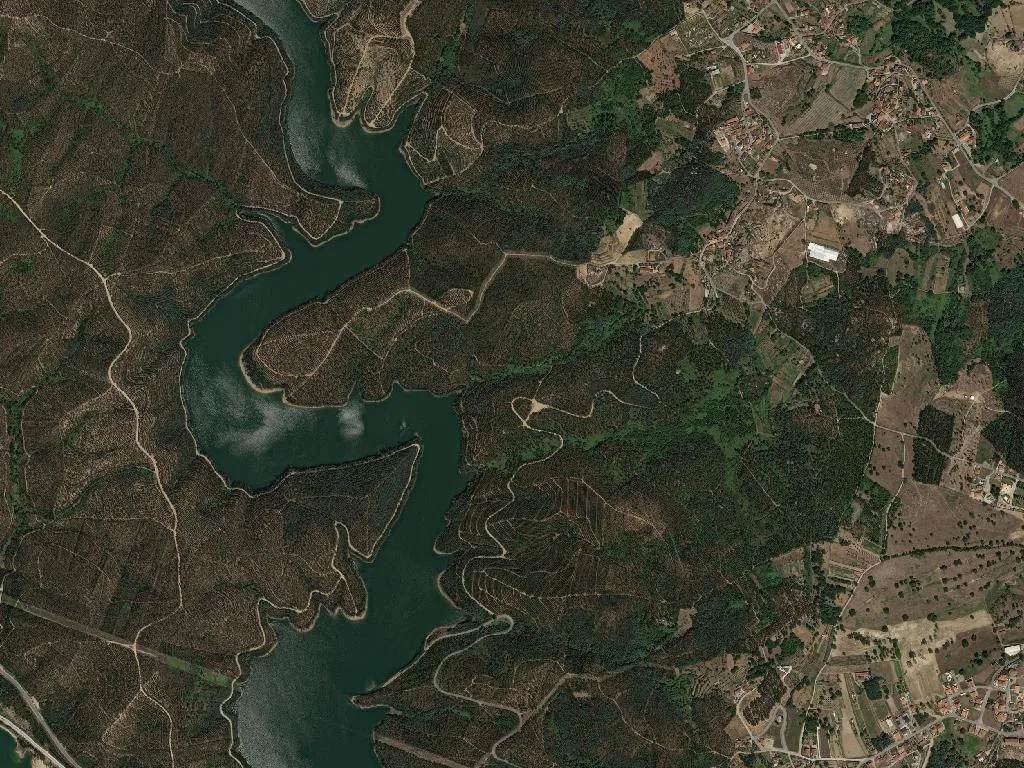
The Dão slips southward, slackened by the 1956 weir into a chain of glassy pools. Walkers cross the 1893 stone bridge, then drop onto boardwalks added in 2018 that skirt allotments and riverside allotments. From the Outeirinho viewpoint, the valley tilts open: rows of Touriga Nacional at Quinta da Pellada and Quinta dos Roques descend in ruler-straight terraces to the water’s silver thread. At the Senhora da Ribeira river-beach, imported sand softens the margin where the current slows enough for a measured swim. Eastwards, the 47-kilometre Dão Ecopista follows the abandoned Vouga railway, poplars and willows flickering strobe shadows across the tarmac.
Flavours drawn from water and vine
Order the caldeirada at A Taberna and you taste the river itself—achigã (zander) and boga simmered with potatoes and coriander, the broth thickened against cornbread from Padaria Central. Come March, lamprey ascend from the Atlantic; the resulting rice, darkened with the fish’s own blood, appears on every local table for six short weeks. Conventual sweetness survives in the broinhas de Santa Columba, domed biscuits whose recipe escaped the 1834 dissolution of the Concepcionist nunnery. Every glass, meanwhile, belongs to the Dão DOC: tannic reds from granitic slopes at Quinta da Pellada, high-altitude whites from Quinta dos Roques, each swirl releasing schist and pine in liquid form.
Footpaths that fold time
Since 2015 the Torres variant of the Portuguese Caminho de Santiago has bisected the parish, way-markers guiding pilgrims along the riverbank and between vineyard walls. The 3.5-kilometre stretch from the town centre to Couto do Mosteiro takes under an hour, boots raising ochre dust unchanged since medieval packhorses. At the Granjal spa, built in 1882, sulphurous water emerges at 32 °C beneath faded azulejos; guests still stroll the formal gardens, towel-wrapped, believing the same mineral cure that drew Lisbon society here on the old narrow-gauge railway.
Dusk settles; baroque towers ripple on the water. Someone fills a clay jug at the fountain while the bell tolls once more. Granite, river, vine—the three strands remain, plaited into the geography and into anyone who lingers long enough to listen.