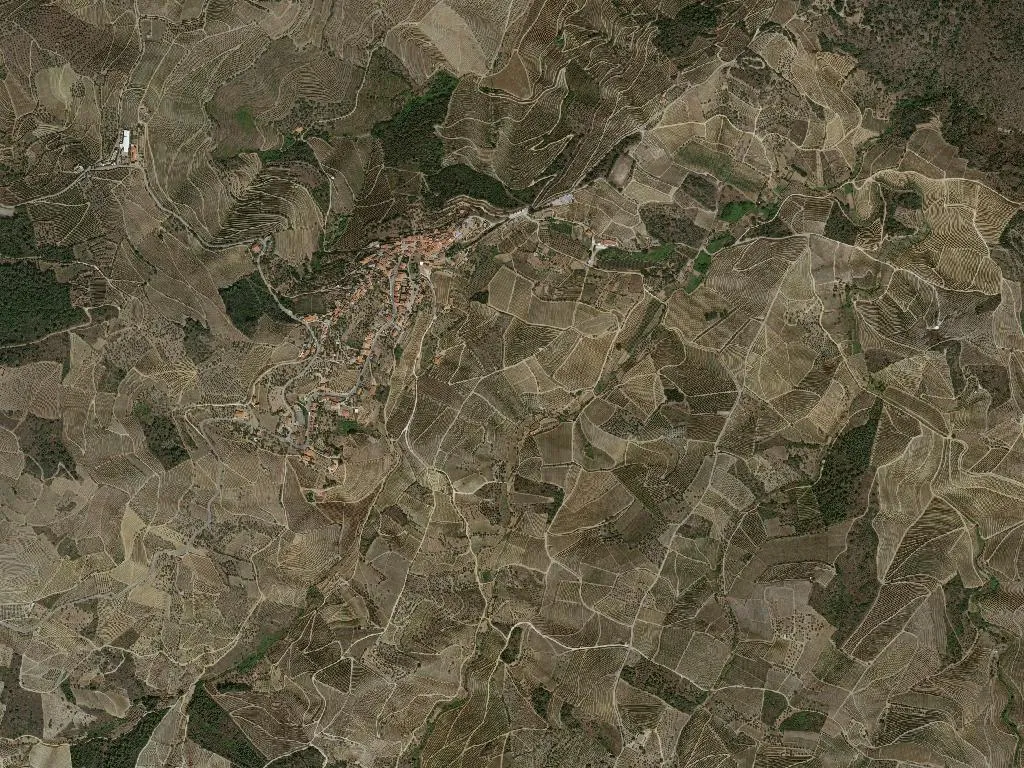
Full article about Nagozelo do Douro: sunlit schist above pewter Douro
Baroque tiles, chestnut soup & barefoot São João embers in a 340-soul hamlet
Hide article Read full article
Sunlight on Schist
The late-day sun hits the south wall of the 18th-century parish church and bounces back a dry, almost flinty heat. In the forecourt a granite crusader cross, dated 1722, throws a ruler-straight shadow across the uneven cobbles. Beyond the retaining wall the land drops 300 metres to the Douro in a succession of stone-ribbed terraces; the vines grip the slope as though they have grown directly from the slate. Nagozelo do Douro counts 340 souls, one national monument, four kilometres of footpath and a horizon line sliced in two by the river’s pewter glint.
Stone, Tile and Ember
The settlement is documented from the 1500s, but its present face was fixed in the 1700s. Inside the mother church, a gilded baroque altarpiece still smells faintly of beeswax, while cobalt panels narrate the life of St John the Baptist in the tight, narrative style of 1750s Lisbon tile-makers. Outside, the communal wash-house runs continuously: a thin brass spout feeds a rectangular tank where sheets are scrubbed every Saturday, the water metallic and ice-cold even in August.
On the eve of São João (23 June) bonfires are lit along the single main street. Teenagers once leapt the coals “to grow brave”; today their barefoot grandchildren repeat the rite under the surveillance of folding-chair grandparents. After the procession, caldo verde is ladled from clay bowls and lemon-zested São João cake is handed round. The elders still sing the Cântico ao São João—a plain-chant lineage that has never seen sheet music.
Kid, Goat Stew and Ewe’s-Milk Cheese
Cooking here is wood-fired and slow. Kid goat is doused in white wine and garlic, then roasted until the skin fractures like caramel. Chanfana—older goat braised in red wine—spends an afternoon in a terracotta pot set over oak embers, thickening with bay and smoked paprika. In October dried chestnuts are simmered into a sweet, mahogany soup served with coarse maize bread. Nagozelo sits inside the Terrincho DOP zone: wheels made from Churra da Terra Quente ewes’ milk spend 30 days in slate cellars, emerging firm, peppery, with a faint schist finish that clings to the molars.
Terraces to the River
The Caminho dos Socalcos begins beside the churchyard and switch-backs four kilometres down to the 200-metre contour where the Douro slides past, broad and the colour of strong tea. There are no guard-rails or Interpretation Boards—only dry-stone walls, olive trunks twisted into corkscrews and the dense, bee-heavy silence of the slope. Halfway down, the Carril lookout gifts a full-amphitheatre view: opposite terraces, white quintas, the river’s blade of light. During September’s vindima a handful of estates welcome volunteers: snip the bunch into a wicker basket, ferry it on your back, then tread the grapes in a granite lagar exactly as your great-great-grandparents did.
Dusk settles slowly. Up in the churchyard the crusader’s shadow stretches until it kisses the threshold of the house opposite. Far below, invisible but audible, the Douro turns over its shale bed—a low, continuous note that climbs the hillside and mixes with the wind in the olive leaves.