Full article about Trevões & Espinhosa: slate, vines & 1514 pillory
Granite pillory to schist terraces, these Douro villages live wine every day
Hide article Read full article
The granite of the pillory still carries the 1514 inscription, its letters defying the wind that slips off the plateau and scours Trevões square each winter dawn. Touch the stone and it feels glacial—an ancient, mineral cold that contrasts with the dry summer heat that splits the schist terraces lining the Douro slopes. On the first Sunday of every month a craft fair sets up here: five tables at most. Dona Albertina brings corn-bread still warm from the communal oven; Sr Joaquim pours olive oil pressed from his 80 centuries-old trees. Mid-week, the only sound is a cock crowing behind the eighteenth-century manor house whose coat of arms has watched bishops pass—one, Dom Frei António de S. José, slept next door in the “chapter house” during his 1783 pastoral visit.
Crossroads that learnt to make wine
The name is Latin—trivium, the meeting of three roads—and the place never forgot its vocation as a junction. Trevões was a town in its own right until 1836, chartered by Manuel I in 1514; Espinhosa, “place of hawthorns”, appears in Lamego cathedral records from 1226. An administrative merger in 2013 banded the two villages into a single parish, yet the 3.2 km between them feel like a buffer zone: each keeps its own Manueline cross, its church-centred compass, its distinct daily rhythm.
Vine, olive and cereal have always dictated the economy. After 1756 the Companhia Geral da Agricultura das Vinhas do Alto Douro stamped the landscape with ruler-straight walls. Local boy Joaquim Augusto Ribeiro—born 1865 at no. 42 Rua do Conselheiro—installed the region’s first hydraulic press at Quinta do Pesqueiro in 1898. A century later, António Carvalho, raised in the Casa dos Lóios, shipped his Quinta das Covas reds to London in 1987. Tradition here is not behind glass; it is still fermenting.
Gilded altars, stone dogs and communal presses
Trevões’ parish church, listed since 1977, began rising in 1535. Inside, a 1605 Mannerist altarpiece attributed to Gaspar Coelho unpacks the Virgin’s life across sixteen panels; 1743 Lisbon tiles frame the Annunciation in full rococo curl. Espinhosa’s church, rebuilt after the 1755 earthquake, devotes an 1787 azulejo strip to the beheading of St John the Baptist, honoured every 24 June with an 11 o’clock mass, a cobbled-street procession, a bonfire and sardines grilled on a two-metre iron plate kept year-round by the Hunters’ Club.
Dom Luís de Távora ordered up the chapel of São Sebastião in 1579. Scattered between the hamlets are seven granite olive-presses; Espinhosa’s communal tank takes 800 kg of olives and opens only the third weekend of November. Look for the “dog’s head” carved into a gatepost in 1892—José Maria “the Stone-Mason” knocked it out so vineyard dogs could be tethered during harvest. “Grandad tied Riscas right there,” says 87-year-old Dona Amélia, pointing from her window.
Terraces, almond blossom and the silence of griffon vultures
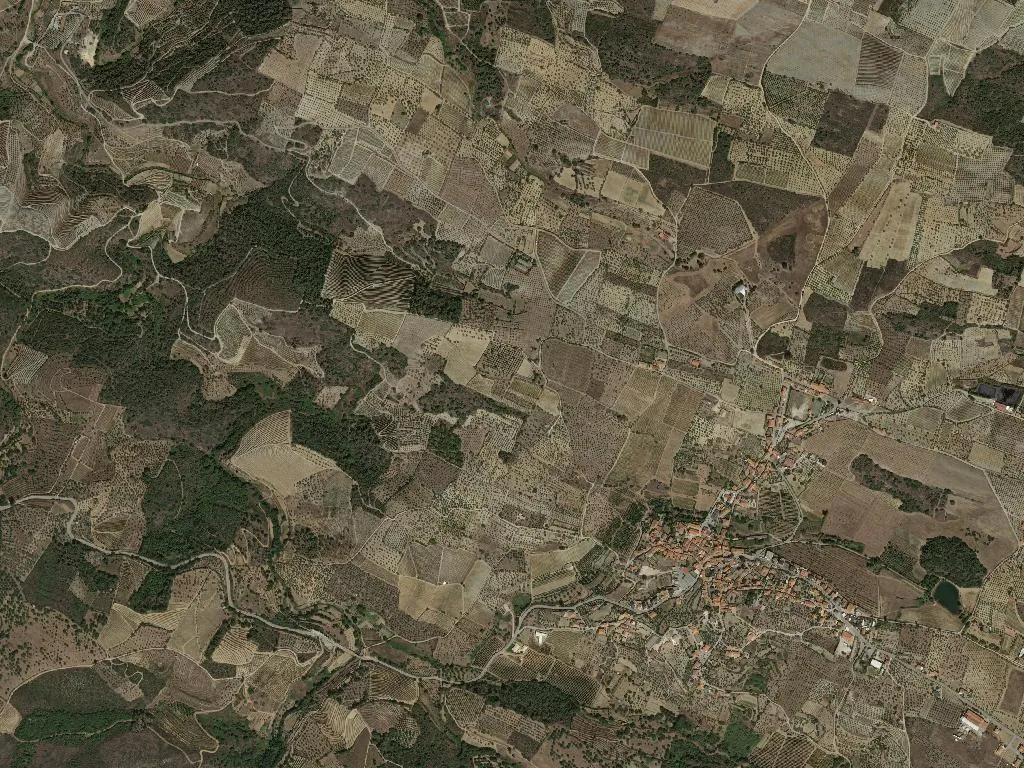
The parish sits dead-centre in the Alto Douro Wine Region, a UNESCO World Heritage site since 2001. Altitudes swing from 150 m at the river to 700 m on the Senhora da Graça ridge. The PR3 “Terrace Trail” is a 7.8 km loop linking both villages; 400 m follow the paved Roman road XVIII that once ran between Lamego and Guarda—ruts two millennia old climb towards Portela do Judeu. Fourteen granite waymarks log every contour change. Come February, the Almond-Blossom Route lists 823 trees between the municipal road and the Trevões stream. From the 615 m lookout you can pick out Marco de Canaveses 46 km away—on the rare day when the Douro haze loosens its grip.
What grows on the slope ends on the plate
Wednesdays and Fridays, Restaurant O Solar serves kid goat chanfana in a black-clay pot from Nisa, four-hour simmered in Quinta do Pesqueiro red. The accompanying Terrincho DOP cheese is trucked in from Trás-os-Montes, but the honey is hyper-local: Sr Armindo’s 45 hives sit just above Espinhosa. Trevões sponge cake, its recipe locked in Casa da Cerca since 1923, demands a dozen eggs per tin. Drink what the earth gives you: Quinta das Covas Reserva 2019 (93 pts Robert Parker) or the 20-year-old tawny that Sr Joaquim draws straight from 550-litre pipes in his garage.
What lingers after you leave
546 people—221 over sixty-five, forty-eight under fifteen—tend 3,012 hectares: 847 ha of vine, 203 ha of olive. On 6 January masked “mascaros” troop from the Casa do Conselheiro at 9 a.m.; 11 November is the date for new-wine tasting at the growers’ association. Population density: eighteen souls per square kilometre. On an autumn afternoon, the only note you’ll register is water murmuring beneath the single arch of the medieval bridge—built 1350-75, 14 m long, 8 m high—a sound the villagers no longer need to hear to know it is there.