Full article about Granite Dawn in Carvalhais e Candal
Roman castros, smoke-cured veal and oak-shadowed hamlets above the Vouga
Hide article Read full article
Granite that remembers
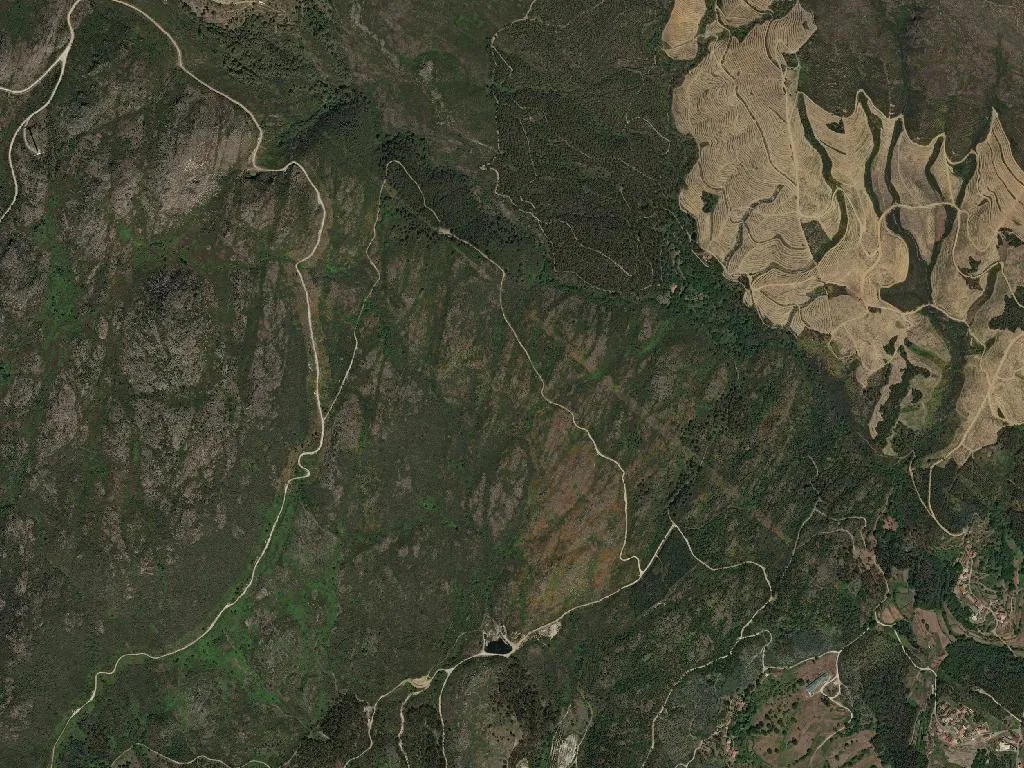
The granite warms beneath the morning sun as the bell in Carvalhais strikes seven. On the flanks of Serra da Arada the wind carries the smell of damp earth and wood-smoke; somewhere a wood-fired oven is being coaxed back to life for the daily broa. Schist walls pen Garrano ponies into water-meadows, and the stream slides between centuries-old oaks that gave the village its name. At 700 m above the Vouga basin, the merged parish of Carvalhais e Candal stretches across 43 km² of ridge and valley—28 hamlets, 1,413 inhabitants, layer upon layer of time. A castro crowns Cárcoda hill; charters pre-date Portugal’s 1139 birth; a Roman necropolis sleeps under the bracken of Germinade.
Stone archives
Climb to the castro: twenty-seven house-platforms bite into the ridge. Double walls, fosses, metallic glints of Roman coins and a gold bracelet map six centuries of habitation (6th c. BC–3rd c. AD). Locals still whisper of the “Goat’s Mine” guarded by a caprine dragon, but the documented past is vivid enough. In 1104 the church of Carvalhais was gifted to the Benedictines of São Pedro do Sul; Santiago became patron and the community still answers to his name. The present building—13th-century skeleton, 18th-century skin—keeps its gilt baroque retable and a bell whose bronze voice times every agricultural day.
Candal, two kilometres east, earns its moniker: “stony, sloping place”. Cobbled lanes climb between shoulder-rubbing houses of schist and lime-wash. The parish church is pure Beira granite austerity, yet beside it the manor of Mourel flaunts a 1740s portal and coats-of-arms eroded to ghostly cameos. In 1952 a Roman tombstone surfaced here—now in Lisbon’s Museu de Belém—proof that imperial roads once threaded these uplands.
Tasting the slope
The menu is geography. Arouquesa DOP veal, fire-grilled, arrives from cattle that graze the Arada wetlands. Gralheira IGP kid is slow-roasted with bay and rosemary until the skin crackles like parchment. October fairs line up salpicão, paio and wine-stained chouriço; fingers come away garnet. Dark maize broa soaks up the juices of chanfana—goat stewed in an iron pot until it submits. Dessert is a study in texture: queijadas of fresh curd, gritty cornmeal cake, suspiros that dissolve on contact. Dão wines—tight granite-grown reds, whistle-clean whites—are poured from unlabelled carafes; after dinner the transparent fire of medronho arrives in thimble glasses.
Water, rock, oak
Serra da Arada fills the horizon. At 1,000 m, Oiteiro dos Carvalhos is São Pedro do Sul’s rooftop; from it the rivers Sul and Teixeira uncoil through green corridors. The way-marked PR1 “Rota da Cárcoda” threads stone-walled gradients where orchids root in schist. Below Candal, the Cascata da Cabrela dives into a fern-circled pool—the nearest thing to a beach for 80 km. Terraces of rye and maize contour the slopes, held in place by moss-covered banks; their geometry predates the Reconquest and refuses to yield to bramble.
Firelight and festival
July brings the Romaria de São Tiago: open-air mass, brass and drum corps, processional banners flickering against granite. On 15 August Candal honours Nossa Senhora da Assunção with makeshift taverns in front gardens and vira dances that set dust flying. The local folk group still wears the Lafões costume—indigo skirts, embroidered shawls, wide straw hats—unchanged since 19th-century field photographs. December’s “Enchanted Forest” turns a stand of pines into a living Nativity, lit by olive-oil torches while grilled sardines drift wood-smoke through the branches. The bells count down the small hours; voices climb the slope and dissolve among the stars.
When the air cools, Carvalhais’ bell sends a last bronze ripple across the valley. Gold light catches in the church’s mullioned windows; chimney smoke rises ruler-straight. In the meadows the Garrano ponies lift their heads at footfall on stone. The ridge turns violet, then slate, and the night smells of wet oak, ember and earth that refuses to forget.