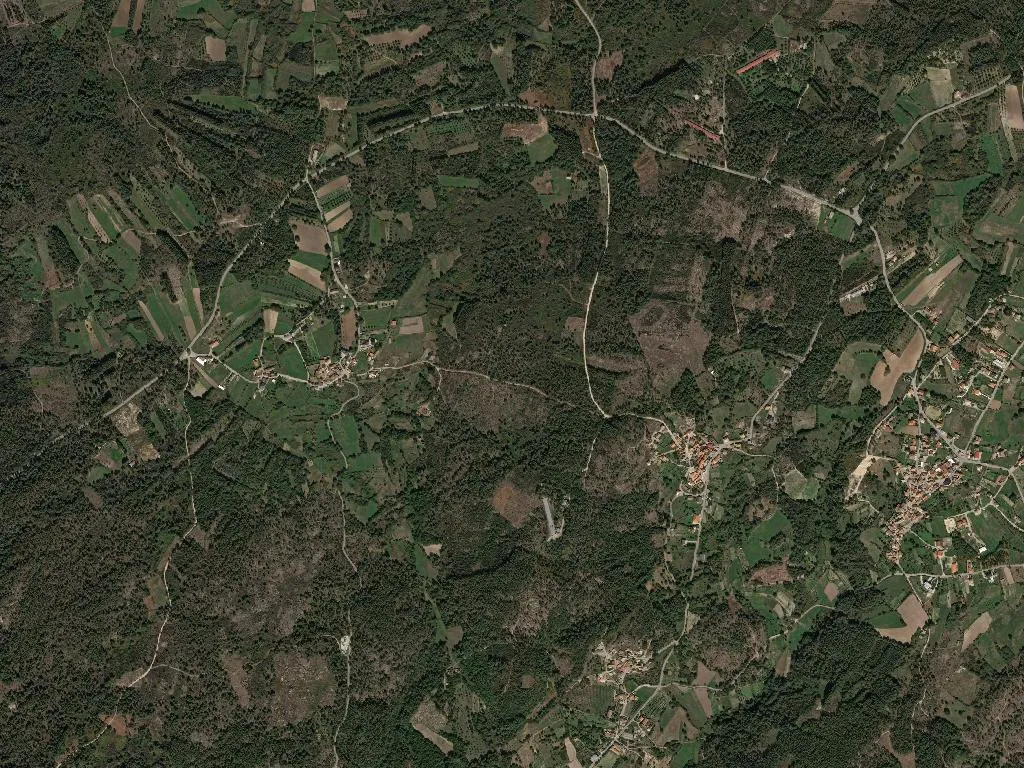
Full article about Ferreira de Aves
Granite tower stumps, chanfana smoke and mirror-pools of the Ferreira stream lure hikers into Sátão’
Hide article Read full article
Granite, smoke and chanfana
The crackle of burning oak still reverberates between the schist walls of Castelo, a scatter of houses at 827 m where the stump of Ferreira de Aves Tower keeps watch over the Vouga valley. Grey granite blocks – once a medieval keep, later a pillory for a municipality that disappeared in 1834 – pile up like sedimentary time. Up from the stream rises the smell of wet earth and ripe chestnut; the parish bell tolls twice and the sound rolls down the slope like dry seed pods.
Iron, tower and lost charter
The name records iron forges that worked the hillside ore. The tower, now only waist-high, once surveyed the corridor between the Vouga and Paiva rivers when this parish sat at the centre of its own micro-republic, complete with outside judges and a notary listed in 1530. The pillory still stands in the square – a granite column that outlived the Liberal reforms, when six tiny councils here were erased from the map and Sátão swallowed their functions.
Inside the Baroque parish church, gilded carving from the 1600s catches stray shafts of mountain light. Stone crosses mark crossroads; wayside fountains spill from carved spouts; granaries on stilts keep maize clear of rats. Roman-segment arches survive in two bridges over the Ferreira stream.
Chestnut woods, granite cliffs and river beaches
The land folds between 400 m and 900 m, a green quilt of centuries-old chestnut groves, oak and pine that enclose the Vouga and Paiva. The Ferreira stream has planed granite into natural diving slabs and mirror-clear pools. The PR4 footpath – nicknamed the Chestnut Walk – links Castelo to the main village through orchards where, in October, nuts snap underfoot like porcelain.
Wild boar root the terraces at dusk; foxes slip along the walls; red-legged partridge clatter up from heather. Griffon vultures ride thermals on the migration flyway that ties Estrela to the Douro gorges.
Goat stew, rye bread and Dão in a tumbler
Cooking here is high-country sustenance without flourish: chanfana – goat slow-simmered in red wine and clay – served with rye broa; salt-cod and chickpea stew smoked a deep rose; chouriço, alheira and morcela de arroz hanging in the kitchen chimney. Turnip or kale soup is thickened with cornmeal; dessert might be bolo podre laced with walnut and aguardente, or gila jam that glints like citrine.
Vines of the Dão demarcated region stripe the surrounding hills; their granite-tinged whites and violet-scented reds accompany sheep and goat cheeses cured in mountain lofts.
Midsummer fire and living memory
On the night of 23 June, Castelo builds a bonfire visible the length of the Vouga. In January, the village still receives the masked singers of Reis – a winter carolling tradition that pre-dates printed hymnals. Memory is recent as well: the 2017 wildfire that jumped three municipalities in 24 hours left charcoal scars now quietly lignifying under moss and heather.
When the air is still, smoke from the smokehouse rises as straight as a pencil line against the pewter sky. The smell of curing sausage braids with damp moss on stone, and footsteps echo on the uneven cobbles – the same sound, unhurried and destination-free, that has marked these lanes for half a millennium.