Full article about Granite, Grape & Silence in Sátão’s Forgotten Ridge
Three stone villages exhale dusk above Dão vines, their lanes too narrow for echoes
Hide article Read full article
The Granite Release
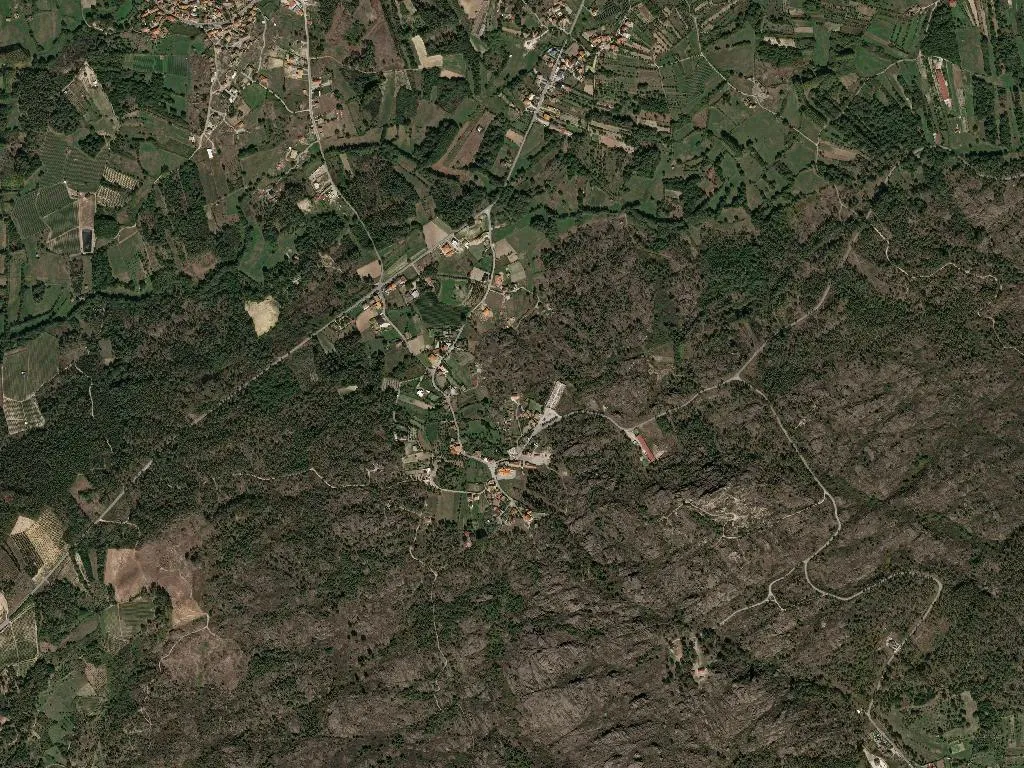
At 640 m the sun drops behind the ridge and the stone cottages of Romãs, Decermilo and Vila Longa exhale the day’s heat like slow breath. The lanes—too narrow for anything wider than a Citroën Berlingo—twist uphill and down, carrying the sound of exactly nothing. One thousand and sixty-two people are scattered across forty-seven square kilometres of valleys and quartz-strewn crests; the silence has the density of a place where every footstep is accounted for.
Three villages, one topography
Administrative Portugal fused the trio in 2013, split them again in 2025, but contour lines ignore parish boundaries. The same slate-coloured granite, quarried locally since the twelfth century, still shoulders doorways. The same south-facing slopes still pleat into terraces of Dão vines. Place-names pre-date both mergers and divorce: Romãs appears in King Afonso III’s 1258 land survey, its pomegranate orchards long since replaced by Loureiro and Touriga Nacional; Decermilo—first “Decimilio”—records a tenth-century decimal land division; Vila Longa, granted a royal charter in 1295, stretches along the old corredor that once linked Viseu to the coast. Excavations near the River Côja have turned up Visigothic belt buckles and Roman coins minted under Constantine, loose change wedged in the soil rather than displayed in a museum.
Vine and matrix
The Dão Demarcated Region begins here. Smallholders still hoe by hand, tying canes to chestnut stakes, the rows stitched together by low dry-stone walls that double as adder habitat. Come September the air smells of crushed grapes and woodsmoke from curing chimneys; the cooperative winery at Santa Comba Dão, fifteen kilometres away, receives the harvest in 30 kg crates rather than stainless-steel tankers. Quinta do Cerrado and Casa de Mouraz bottle under their own labels—wines you will rarely see north of the Mondego, yet which quietly supply several Michelin tables in Lisbon.
Demography tilts elderly: 439 residents are over sixty-five, only ninety-five under fifteen. Still, mobile-phone coverage is reliable, fibre arrived in 2021, and the morning bus to Viseu carries schoolchildren and retirees in equal number.
What remains
Only one building carries national protection status—the sixteenth-century Capela de São Sebastião in Vila Longa, its Manueline portal framed by granite rope moulding—but heritage here is measured in use, not listings. At crossroads you find niches no larger than a medicine cabinet, candles flickering before hand-painted azulejo panels of Nossa Senhora da Saúde. In Romãs threshing floors still host August rye-flailing; in Decermilo the communal well is capped with a schist lid carved to accept a padlock the size of an orange.
Accommodation is scarce on purpose. Casa da Tapada occupies a former olive-mill in Vila Longa; Casal da Serra is an agricultural outbuilding reborn with larch trusses and solar tubes; Quinta da Comenda offers two rooms overlooking a chestnut grove once owned by the Knights Hospitaller. Breakfast arrives from Padaria Silvério in Sátão—bread made with locally milled rye—and quince jam produced by the women’s cooperative at Candemil. There is no reception desk, no checkout queue, no high season. The A25 is twenty minutes away; the experience starts when you switch the engine off.
Dusk brings long shadows and the single toll of Vila Longa’s church bell. Sound lingers between stone walls, colliding with a distant dog, the squeak of a gate, the soft pop of a cork being drawn in a kitchen where dinner is stewed goat and Dão red poured at cellar temperature. Outside, the granite continues to cool, degree by degree, until the valley exhales again.