Full article about São Miguel de Vila Boa: Woodsmoke & Archangel Relics
Stone oven fires, chestnut groves and a Turin-borne relic shape life in Sátão’s hill hamlet.
Hide article Read full article
Smoke from the communal oven
Three times a year the stone vault of the village oven glows. On the eve of the feast of St Michael, at Christmas, and again at Easter, someone arrives with dry oak, strikes a match, and the scent of woodsmoke drifts through the single street of São Miguel de Vila Boa. Once the bricks are white-hot the dough follows – a heavy, corn-speckled loaf known locally as pão de esmoio – and for a few hours the hamlet, population 1,226, smells like a working place rather than a pause between harvests. The rest of the calendar is left to the chestnut trees and the shallow river that slips south toward the Dão.
The archangel and a fragment of Turin
The parish church sits exactly at the centre of the settlement’s irregular grid, an 18th-century rectangle of whitewashed granite with a single nave and a noon-dazzling façade. In the churchyard a stone cross records 1787 in lettering now soft as wax. Inside, an iron reliquary the size of a child’s fist contains what is said to be a bone of St Michael himself, couriered home in 1873 by António Carvalho, a carpenter who had followed the railway boom to Turin. No certificate accompanies the relic; none is requested. On the Sunday closest to 29 September the statue of the archangel is carried shoulder-high through lanes barely two metres wide, followed by a brass trio and tables loaded with sardines, turnip broth and candied yellow pumpkin. The wine is vinho de mesa, drawn from the south-facing terraces of João Dias’ quinta on the Encosta do Sol, a plot his family has harvested since 1964 – too small, too irregular, ever to bother with the Dão DOC paperwork.
Schist walls and silent granaries
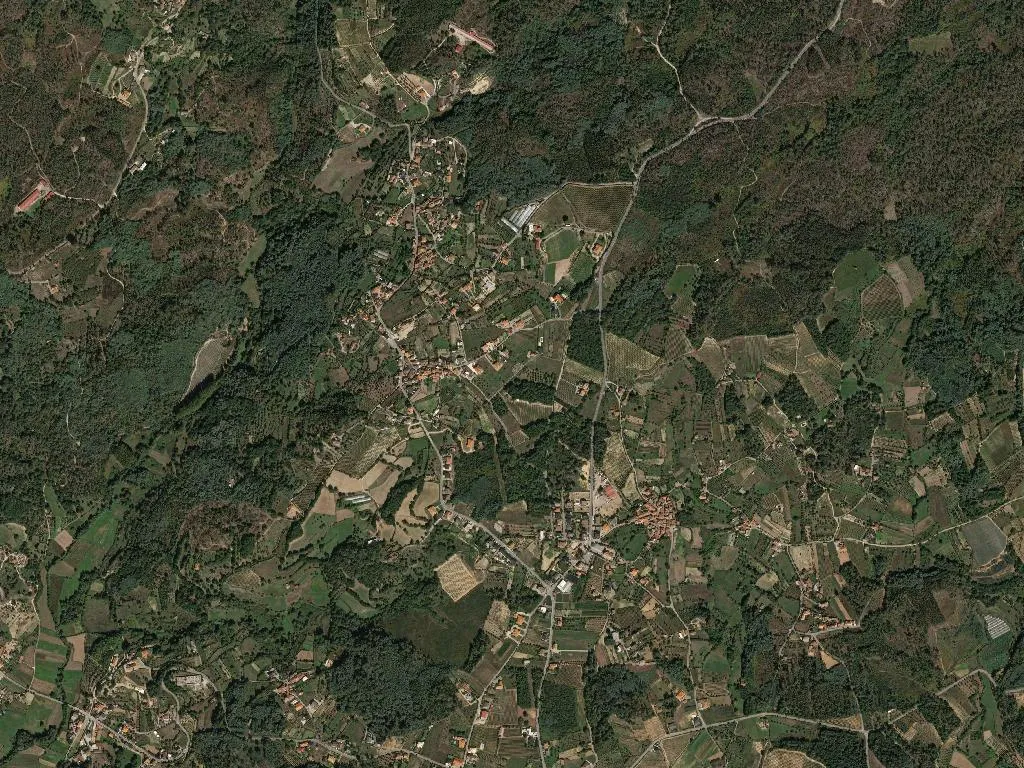
Dry-stone walls divide the hillsides into pocket-handkerchief parcels of olive and chestnut: 340 hectares of the former, according to the last agricultural census. Along the lanes abandoned espigueiros – the narrow granite granaries once lifted on stilts to keep out rats – stand empty since maize gave way to olives. Behind the church the 1835 village lock-up, built after the dissolution of the monasteries, still has its iron ring bolted into the wall for chaining petty offenders. A kilometre further west the olive press at Quintela has been roofless since 1978; moss cushions the great circular stones. The entire complex was listed in 1982, but there are no boards, no QR codes, no gift shop – protection exercised, Portuguese style, through benign neglect.
Lamb stew, chanfana and a three-day loaf
The cooking is dictated by what the hillside provides. Winter begins with turnip soup thick with smoked belly pork; spring brings kid roasted on a vine-wood fire; autumn is the season for chanfana, kid simmered overnight in red wine, garlic and colorau sweet paprika, the recipe guarded by Dona Albertina, 92, who still cooks in her mother’s iron pot. For feast days the yellow pumpkin is reduced to a translucent jam; the round village loaf, the bola de cozedura, is carried still warm from the communal oven. The dough is mixed at dusk, left to rise under linen while the stars harden, then slid into the oven at first light. It keeps for three days, the crust growing a candid bloom that tastes faintly of chestnut smoke.
Tracks through olives and along the stream
No way-marked trails interrupt the landscape, yet a lattice of farm tracks links the smallholdings. One, the Carril path – 3.2 km of rutted earth once used to lead donkeys laden with oil to the press at Póvoa – threads between 200-year-old olives whose trunks have twisted into charcoal helixes. The Vila Boa stream, fringed with rock-rose and gorse, slips down to join the larger Póvoa tributary. Climb to 580 m, the parish high point, and the Dão valley opens in a slow-motion panorama of vineyards and pine. No orientation table, no summit cairn – only the smooth boulder known as the Castelo stone, where shepherds once unwrapped cloth parcels of rye bread and sheep’s-milk cheese.
Three firings, twelve months
When the last loaf is out, the oven door is sealed with a slate slab and silence reasserts itself. The embers still exhale, but no one disturbs them; the fragrance of corn bread lingers in the schist alleys, braided with woodsmoke and damp earth. São Miguel de Vila Boa measures its year not in calendar pages but in three firings: Michaelmas, Christmas, Easter. Everything else is the interval.