Full article about Vila da Ponte: granite hush above the Rio Bestança
Stone terraces, three pilgrimages, 468 souls and a café that locks on whim
Hide article Read full article
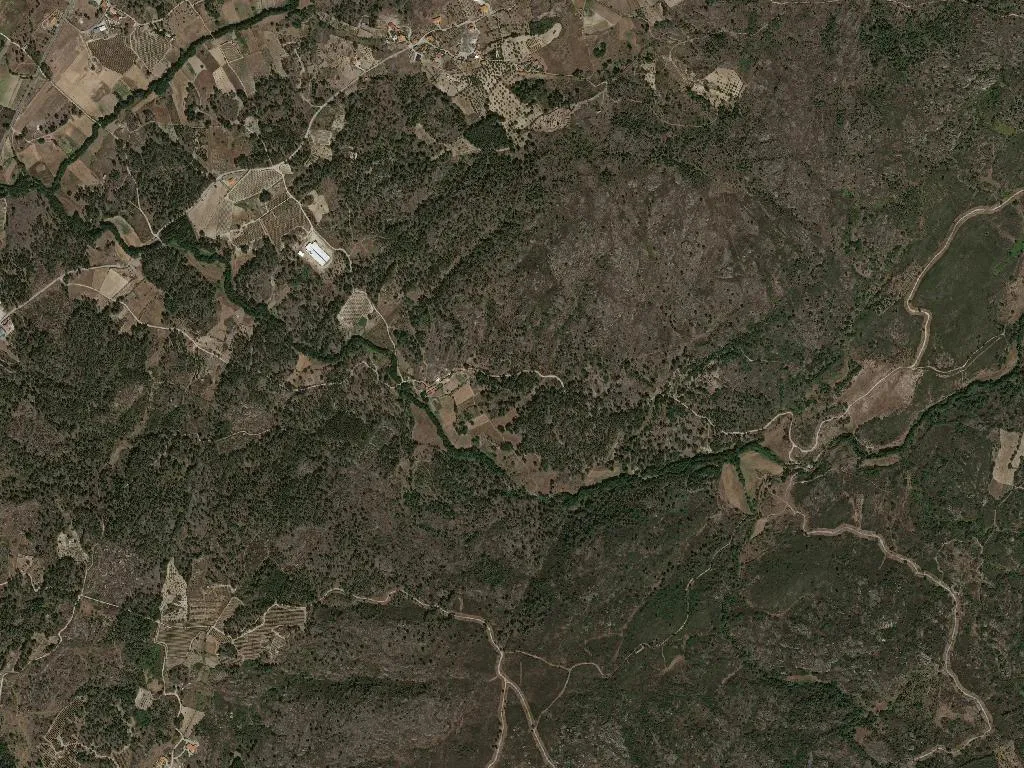
The granite cobbles clatter underfoot like an Olivetti left too long in the rain. At 585 m, Vila da Ponte wakes reluctantly, folded into a ridge of the Serra do Montemuro where pale stone pushes through schist walls the way a broken tooth shows through skin. A single dog – Aurora’s Bobi, notorious for chasing anything on two legs – barks once, then thinks better of it. Beyond the last house the land tips into terraces stitched together by footpaths that link scattered hamlets, a stone chapel, a spring piped into a 1930s basin. Twelve square kilometres, 468 residents, one café that unlocks at seven and locks again when the owner feels like it.
Festivals that map the year
Three pilgrimages – Nossa Senhora das Necessidades (May), Nossa Senhora da Lapa (August) and Nossa Senhora ao Pé da Cruz (September) – sketch the parish’s spiritual geography. Processions leave from the churchyard of Santiago, swing past the granite cross that leans like a drunk sentinel, then climb to each shrine in turn. They double as census days: anyone who ever left for Lyon or Lausanne reappears with a foreign-plate Renault and a duty-free bag. Women unfold embroidered shawls last seen at their mother’s wedding; men dust off the statues that spend the rest of the year in the sacristy drawer. The Lapa chapel sits exactly on a hair-pin of the M654 – drivers flash their lights, pilgrims raise a hand, nobody slows down.
Stone, slate and the arithmetic of leaving
Everything here is built as if gravity were negotiable. Walls are a metre thick, doorways trimmed with hand-dressed blocks, roofs weighted with slabs of dark slate that turn the colour of wet charcoal in winter. Windows stay small to keep the heat of the log-pile inside; eucalyptus from the council plantation now costs more per kilo than the local red. In back gardens fig trees muscle over schist banks, their fruit once simmered into jam that grandmothers stood over for hours – today labelled “too much trouble” by daughters who work checkout in Viseu.
The maths is brutal: 36 inhabitants per km², 35 of them under thirty, 116 over seventy. Fields that fed generations revert to broom and bramble; paths narrow to single-file as the hedges advance; shutters close without admitting why. Yet some stay. On Wednesday mornings 82-year-old António loads his turnips into a van that still smells of 1984 and drives to the market in Sernancelhe. The priest keeps the feast-day rota; the council paints fresh yellow arrows on the hiking trails; the parish council WhatsApp group buzzes with lost-cat alerts.
Fragmented vineyards, informal hospitality
Vila da Ponte sits at the south-eastern edge of the Douro DOC, though the landscape is less postcard-terrace, more patchwork quilt. Vineyards interrupt olive groves, maize patches and allotments of runner beans. Plots are measured in “steps” rather than hectares – the fragmented inheritance of four siblings who now live in Porto, Paris and Zürich and return only for the harvest. That weekend is strictly domestic: daughter flies in from Gatwick with Lidl sun-cream, son-in-law’s back gives out on day two, grandchildren hunt for a 4G signal among the chestnut trees. The wine never reaches a label; it travels in five-litre jugs to neighbours, accompanies chouriço sliced at the counter of Sr Joaquim’s grocery and the wheel of Serra da Estrela cheese that Antero brings down from the Covilhã market.
There are three legal beds in the entire parish – all in village houses whose owners list them, half-heartedly, on Airbnb. No swimming pool, no yoga deck, no breakfast buffet. Guests wake to Alfredo’s cockerel, eat yesterday’s sponge at the kitchen table, then set off with nothing more than a description: “Turn left at the eucalyptus, keep the wind turbine on your right.” You can climb to the Senhora do Monte lookout for a 40-kilometre sweep of the Douro gorge, or follow the Tedo river downstream to water-mills that have stood empty since the 1974 revolution, their millstones still tagged with chalk prices.
The only clock that matters
At noon the iron bell of Santiago – cast in Lamego in 1937 and cracked since 1962 – sends a flat note across the valley. It ricochets off the schist, fades somewhere beyond the Crasto ridge. No one checks a watch; hunger, thirst and the angle of the sun divide the day. By the time the bell has stopped vibrating the café has filled with men in berets arguing about the price of diesel, the bakery has sold its last rye loaf, and the village dog has reclaimed the middle of the road. Night will come down the pass at nine; the lights of the lone tractor return from the terraces; someone closes the church door, someone else lights the first fire. Vila da Ponte keeps its own time – a stubborn, granite heartbeat you have to slow your own pulse to hear.