Full article about Barcos & Santa Leocádia: silence etched in schist vines
Explore Barcos & Santa Leocádia in Tabuaço: Unesco wine terraces, gilded church coffers and a village named for stone arches.
Hide article Read full article
Barcos: where the terraces remember
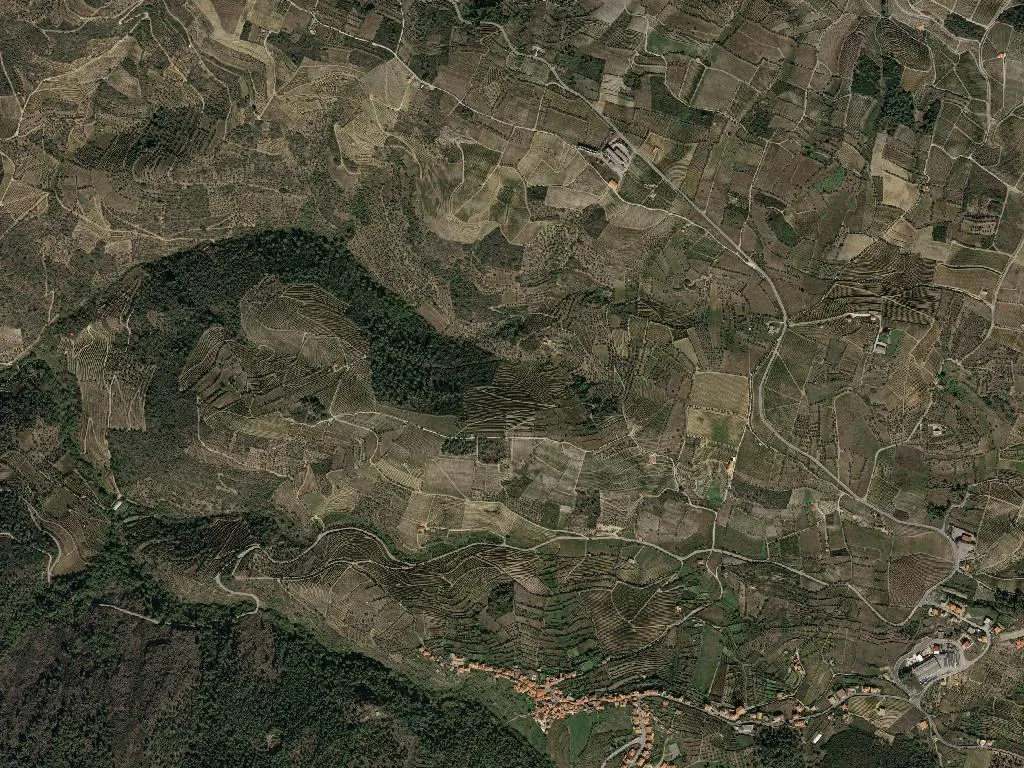
The first thing you hear is nothing. No tractor, no voices, not even a church bell—only the wind combing through the terraces of the River Tedo, 485 metres below, and the faint creak of old vines gripping their schist walls. The lane to Barcos threads between hedges of lichen-dark stone until the village tilts into view: 625 souls, a single café, and a gravity-defying staircase of vineyards that Unesco calls the Alto Douro Wine Region.
Stone arches and buried names
The place-name is a memento mori. Medieval charters record “Barcos” as a shortening of arcos, the arched tombs that once lined the Roman road south-east to Nagozela. Death christened the village, yet life accumulated here for a millennium. By the twelfth century Barcos was a parish of some consequence, a waypoint for mule trains hauling olive oil and cloth between the Douro and the Spanish plateau. Its younger neighbour, Santa Leocádia, founded only in 1567, was grafted onto Barcos administratively in 2013; together they sprawl across 15 km² of wrinkled schist inscribed in the World Heritage core zone.
Barcos earned the official label Aldeia Vinhateira—Wine Village—not as municipal PR but because every wall, footpath and cottage is mortared into the slope to keep the earth from sliding downhill. This is landscape as labour: generations stacking slate, diverting run-off, coaxing vines to grip 45-degree pitches.
Twenty-eight coffers between floor and sky
Push open the weighty door of Igreja Matriz and the nave inhales you into a honey-coloured gloom. The baroque high altar—rated a National Monument—explodes with gilded foliage so deep it seems to exhale. Yet the ceiling is the spellbinder: twenty-eight painted coffers, each framed in cedar, narrate the life of Christ and the Virgin in postcard-sized panels. Centuries of candle smoke have tuned the palette to ox-blood reds, lapis blues and the exhausted flesh tones of Flemish primers. Wax and cedar linger in the cold air like incense.
Outside, the Stations of the Cross climb through the village, brushing past the fragmentary pillory—an ankle-high stump that once marked Barcos’s brief claim to municipal rights—and the granite arms of the Cunha and Magalhães Coutinho manor houses, their coats of arms softened by rain into blurred cameos.
A river you feel rather than see
The Tedo forms the western boundary, but it keeps itself to itself; you sense it as a cool updraft in the heat of early June or a distant hush when the wind veers west. Between the quintas—wine estates such as Monte Travesso—narrow footpaths switchback through olive groves and chestnut orchards. Look for the DOP chestnuts from Soutos da Lapa: dense, yellow-fleshed nuts that carpet the ground each October in spiny green burrs.
The local reds and ports are built from schist and diurnal shock: 35 °C afternoons followed by 12 °C nights bully the grapes into thick skins and ferocious sugar. Olive oil pressed from trees that once shaded medieval muleteens carries a peppery catch at the back of the throat; pour it over broa, the crusty maize loaf that Rosa Lopes still bakes in a wood-fired oven behind Café Central. On Saturday evenings Zé Pinto unhooks his three-month-cured smokehouse chouriço from the rafters; slices are served with a thumb’s-width of local red that tastes of graphite and sun-baked slate.
Sanctuary above, strangers below
The road corkscrews another 250 metres to the Santuário de Nossa Senhora do Sabroso, a whitewashed lookout that commands the Tedo valley. Each 15 August the village decants itself here for the romaria of Santa Maria do Sabroso and Santa Bárbara: processions, polyphonic hymns and the scent of rosemary bonfires coaxing home émigrés from France and Switzerland. In daylight the climb justifies a bowl of caldo verde served from a caldron in the forecourt; carry water—shade is rationed until the mid-slope ilex grove.
Beside the chapel lies the early-medieval necropolis of Sabroso: graves hacked into bedrock, now open to the sky and filled only with last week’s rain. No names, no dates—just silhouettes the length of a man facing the same terraces the living still hoe.
The moment a coffer lights up
Towards evening, when the sun rakes the terraces into gold and graphite, the valley stalls: wind drops, swallows cease, the Tedo becomes a photograph. Inside the church a single ray slips through the side-slit window and ignites one painted coffer—perhaps the Flight into Egypt, perhaps the Annunciation—so that 300-year-old pigment flares as if the artist had just laid down his brush. Then the beam moves on, chill returns to the stone, and anyone still inside hears only their own pulse measuring the silence of Barcos.