Full article about Valença do Douro: Dawn pruning on 200-metre schist ledges
Valença do Douro, Tabuaço, is a UNESCO-listed hamlet where misty Douro terraces, chestnut-fired cafés and centuries-old port vines outnumber residents.
Hide article Read full article
Dawn on the schist terraces
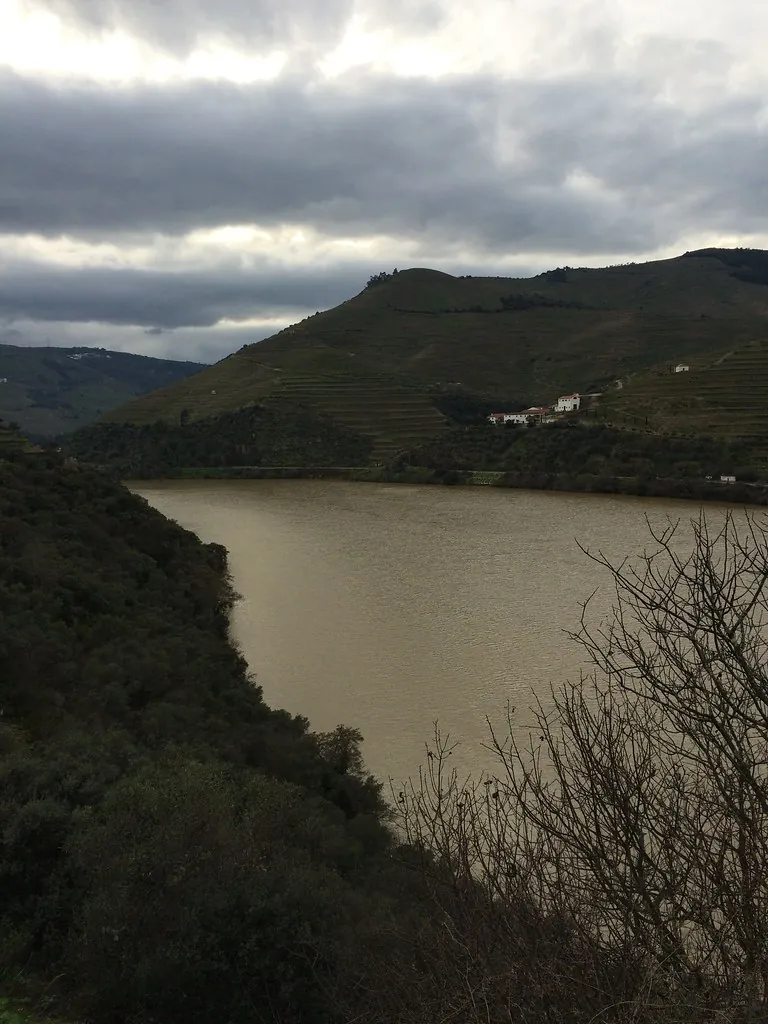
The click of secateurs travels downhill before sunrise. One by one, gnarled canes of Touriga Nacional are trimmed back, the cuttings left to smoulder in narrow fire-breaks. Below the retaining walls, 200 m of air and the river’s cool breath separate the workers from the Douro itself, unseen but measurable in every lungful of mist. Valença do Douro wakes like this: no traffic, only the shuffle of boots on slate and the low murmur of men who know that wine and chestnuts keep their own calendar.
Vine, slate and memory
The parish was erected in 1514, when the valley already supplied England with “Red Portugal”. The toponym couples valenza – old Galician-Portuguese for “worth” or “river meadow” – with the hydronym that pays the bills. After the 1756 Demarcation – Europe’s second-oldest wine appellation – schist terraces crept higher each decade, etching a topographic ledger of ownership, grape price and inheritance. Nine square kilometres now support 244 souls (2021) and 309 m of altitude, all inscribed on UNESCO’s World Heritage list since 2001.
Chestnuts, corn bread and table wine
In the Douro, Port is headline news, yet the daily wines poured in Valença’s two cafés are the steady column inches: field-blends of Tinta Roriz, Touriga Franca and others, raised in chestnut barrels made down-river at Peso da Régua. At lunch they accompany feijoada transmontana thick enough to stand a spoon in, and corn bread smoked over heather. Between rows of vines, scattered soutos of grafted chestnut give shade in August and DOP fruit in October. Roasted on a terrace brazier, the nuts taste faintly of eucalyptus sap and the river’s damp stone.
Saints who repopulate the valley
The parish calendar hinges on three saints. On 15 August, Santa Maria do Sabroso draws returnees from Porto and Paris; they park rental cars beside tractors and swap London rents for the price of a plot here. December brings Santa Bárbara, patron of miners and artillerymen, whose feast supplies the village’s only fireworks display. São João on 24 June turns the churchyard into an open-air ballroom: grilled sardines, basil plants in terracotta pots, and a single accordionist playing until the river swallows the last chord. In 2021 only 13 children were counted; the accordionist is 78.
Footpaths between river and sky
From the cemetery, a slate path contours east through abandoned olive presses to the belvedere at Alto de São Bento, where the terraces resemble a topographic model. In April the vines are lime-green dots; by September the leaves have turned ox-blood. Quinta de São José still trods grapes in an 1856 granite lagar; visitors arriving by kayak from Pinhão can climb the 400 steps to taste the result, then freewheel back to the river on a single-gear bike.
Europe’s wine region of 2023
The EU’s “Wine Region of the Year” accolade arrived without fanfare – no new marina, no cable car. Instead, eight small guesthouses gained booking-engine traction. At Casa do Xisto, mornings begin with coffee on bedrock: the foundations are pinned directly to the terrace wall, so every footstep reverberates through 200 years of stone. Outside, a levada built in 1932 still conducts winter rainwater to a stone tank where village women once washed the parish sheets.
By late afternoon the sun slips behind Marão’s ridge and the terraces turn anthracite. A final chestnut cracks open on the brazier; wood smoke drifts downhill towards the river you still cannot see. Somewhere below, a chapel bell counts only the hours that matter.