Full article about Salzedas: chestnut-leaf hush above Varosa’s vines
Cistercian terraces, abbey-stone alleys and 651 echo-soft souls in Tarouca’s sky-high hamlet
Hide article Read full article
Salzedas: where stone exhales chestnut and silence
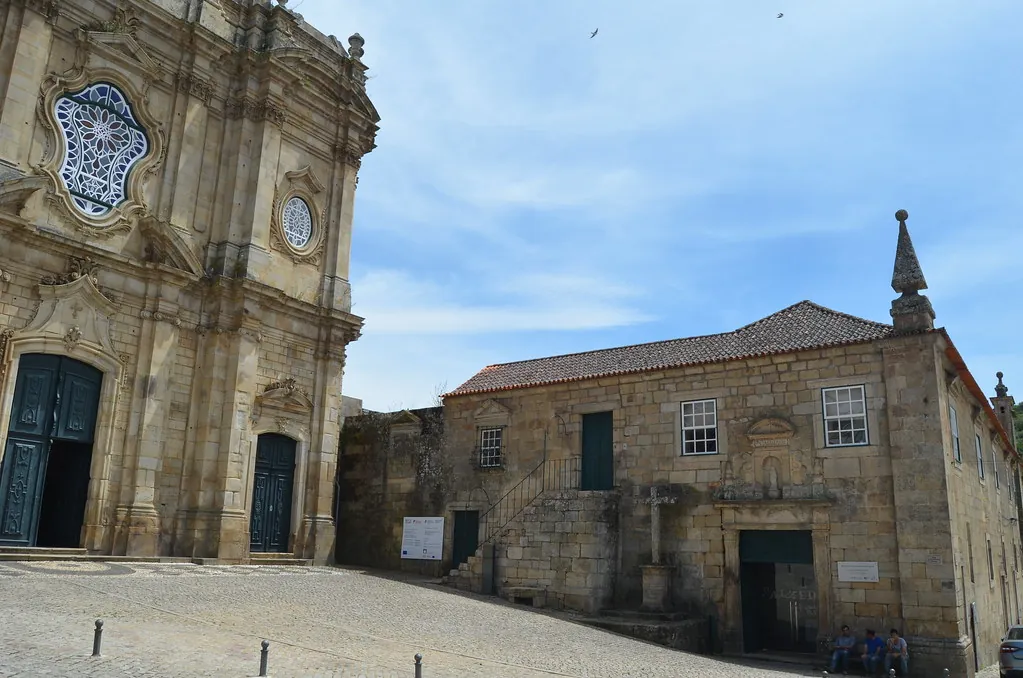
The first thing you notice is the hush – not emptiness, but a deliberate, granular quiet that settles on your skin like the finest Douro dust. Step out of the car on Rua Direita and the engine’s last vibration seems to vanish upwards into the granite. For a moment nothing stirs; then a chestnut leaf turns over with the soft click of a coin, and somewhere below the village a runnel of water clears its throat. At 543 m above sea-level, Salzedas has only 651 souls, yet its acoustic feels even sparser, as though the valley’s walls had been tuned to a lower octave than the rest of the world.
The Cistercian blueprint
The name is a contraction of the Latin saliceta, “willow grove”, but Salzedas’ real baptism came in 1168 when monks of the Cistercian Order began laying the first stones of what would become Portugal’s largest abbey north of the Douro. Their charter was practical: drain the marshes, terrace the slopes, plant vines, pray. The grid they drew – church on the ridge, cloister to the south, barns and presses aligned to the river – still dictates how houses line up along the alleys. Parish records show the same family names for 400 years; even the chestnut trees were grafted from monastic stock.
Inside the parish church – itself the abbey’s former nave – the aesthetic is all Cistercian restraint: limestone piers, a single carved capital, light entering at oblique angles as if filtered through parchment. Stand at the west end at four o’clock on a winter afternoon and the sun lays a ruler-straight bar across the floor, an illuminated manuscript in negative space.
Terraces that remember labour
Follow the mule path east of the church and the village dissolves into dry-stone staircases that descend 250 m to the Varosa. Each terrace is barely two metres wide; some are held together only by gravity and moss. On south-facing slopes the vines are low and head-trained, the traditional carta de condução still used for Port production. Higher up, where the sun barely skims, old chestnut groves form a green nave. Between 20 and 25 October their burrs split with a sound like tearing linen, releasing the DOP-certified Castanha dos Soutos da Lapa – large, firm-fleshed nuts that are roasted over cane fires and folded into a monastic dessert of egg-yolk threads called fios de ovos.
The water channels you cross are too modest to appear on Michelin maps, yet they have irrigated these plots since the 13th century. Listen and you’ll locate them by ear: a thin, metallic trickle beneath bramble and dog-violet, the audio equivalent of finding a coin in long grass.
Beef, chestnut and the theology of lunch
Mid-morning in the single café, farmers in waxed cotton coats are already drinking red from straight-sided glasses. Order postas de carne de Arouquesa and you receive a slab of native-breed beef, dry-aged on the bone, grilled over holm-oak coals until the fat edges turn the colour of antique mahogany. The meat tastes of upland grasses and heather; its fibres relax slowly, obliging you to chew with the same unhurried cadence as the bells that still mark the canonical hours. With it come potatoes smashed in their skins, and a soup of galician cabbage thick enough to support a spoon upright. Nothing arrives garnished; the dish is its own footnote.
June, São Pedro and the smell of melted wax
On 29 June the village breaks its own rule of silence. At 10 a.m. the silvered statue of São Pedro emerges from the church, borne by eight men in black waistcoats who match their tread to a drum and a single cracked bell. The procession inches down lanes no wider than a cart, stopping at every house so that incense can enter open doorways. Women lean from wrought-iron balconies, letting down baskets of bread and coriander. By dusk the square smells of beeswax and charred sardines; someone tunes a braguesa guitar to an open chord and the notes ricochet between granite walls like swallows in a dovecote. For 24 hours the village operates at full volume, then folds itself shut again before dawn.
The arithmetic of staying
Since joining the Aldeias Vinhateiras network in 2021 Salzedas has four licensed guest spaces – two granite cottages, a first-floor loft in the old primary school, and a manor wing whose library still smells of acacia glue. None has a reception desk; keys are left under a loquat tree or handed over by the baker. What you get is a bed, a window that frames the south-facing amphitheatre of vines, and a silence so complete you can hear the thermostat in the fridge click off. There is no itinerary beyond what you invent: walk the 7 km loop to the Varosa gorge bridge, drive 20 minutes to Quinta da Folgosa for a vertical tasting of tinto, or simply sit on a warm wall at 6 p.m. and wait for the sun to bruise the sky above the Serra de Leomil.
The after-image
Leave at checkout time and the village will not wave. The car winds uphill; below, the abbey’s ruined cloister shrinks to a rectangle of grass. What lingers is not a postcard but a temperature: the residual heat stored in a hand-cut block, the faint caramel note of chestnut burrs curing in shade, the memory of a place that asked nothing of you except that you match its cadence. Halfway to Lamego you lower the window, convinced you can still hear a leaf turn over – a sound smaller than a heartbeat, yet large enough to map an entire valley.